
In January 2000, chunks of ice weighing up to 6 pounds fell out of clear blue skies over Spain for 10 days. One smashed through a car windshield, and scientists still can’t fully explain where they came from
Large chunks of ice, including pieces weighing more than 3 kg (6.6 pounds), fell over Spain in January 2000 during weather reported as clear. One broke a car windshield in Tocina. The falls launched research into megacryometeors, large ice bodies whose formation outside ordinary thunderstorm conditions remains incompletely explained.
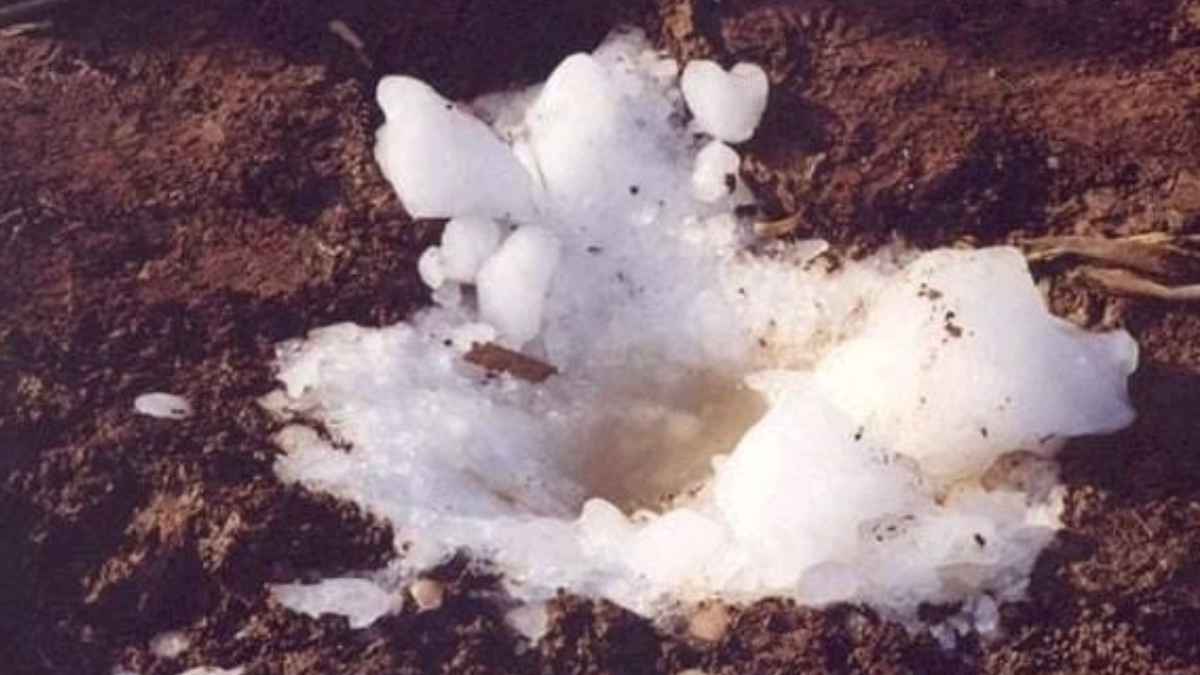
Credit: J.M. Frias/Seprona
The Spanish National Research Council, known as CSIC, coordinated an investigation led by geologist Jesús Martínez-Frías. Samples were collected and preserved for laboratory analysis. The name “megacryometeor” was proposed later, in 2002, for large ice bodies associated with unusual atmospheric conditions.
An early research paper described falls between January 8 and 17, 2000. A subsequent study discussed a broader episode across the Iberian Peninsula extending to January 27. The often-repeated ten-day account therefore describes the early reporting window.
The Tocina fall left a damaged car and an ice sample
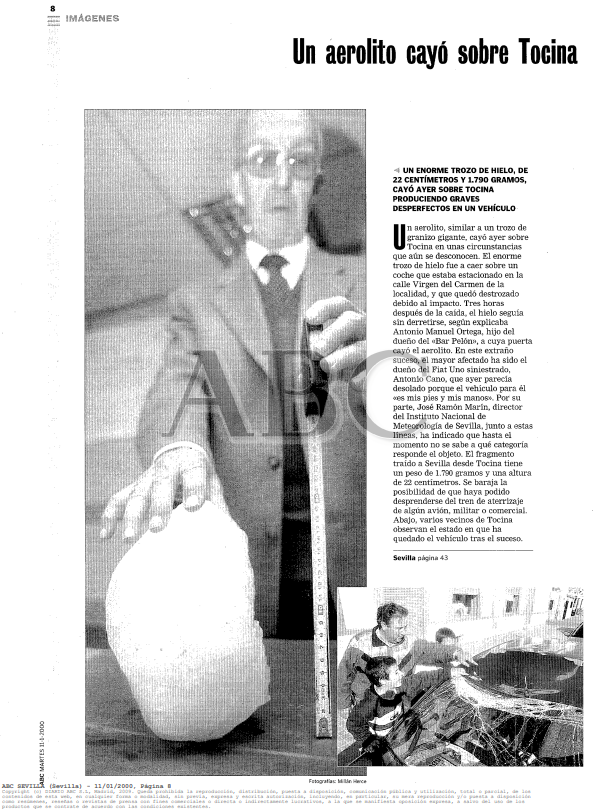
The Tocina strike occurred on January 10, 2000. The following day, ABC Sevilla pictured the damaged Fiat Uno and identified its owner as Antonio Cano. The later CSIC account explicitly described a broken windshield.
Cano called the car “my feet and my hands,” according to ABC’s report, translated from Spanish. A recovered fragment taken to Seville weighed 1.79 kg (3.9 pounds); that was the collected piece, rather than a confirmed measurement of the entire object before impact.
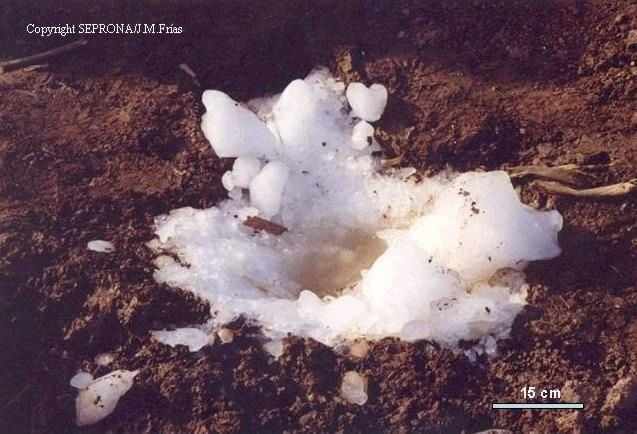
The research samples had more complicated structures than a uniform block of frozen water. The 2001 paper described solid ice, cavities, oriented air bubbles, and layers of varying thickness. Those features gave researchers something to investigate beyond the accounts of objects falling from the sky.
Isotope tests identified atmospheric water
In 2005, Martínez-Frías and colleagues reported oxygen and hydrogen isotope measurements from 11 specimens. Isotopes are forms of an element with different numbers of neutrons. Their relative abundances change as water evaporates, condenses, and freezes, leaving clues to its history.
The samples followed the relationship typical of terrestrial precipitation, called the meteoric water line. Here, “meteoric” means water associated with precipitation. It does not mean that the ice was a meteorite. The team interpreted the results as evidence for atmospheric water.
A further study, published in 2010 by Fernando Rull, Antonio Delgado and Martínez-Frías, examined four Spanish specimens with micro-Raman spectroscopy. The technique compares patterns in light scattered by a material to investigate its molecular structure.
The researchers compared spectra from the ice cores with water freezing under laboratory conditions. They inferred formation temperatures between −20 and −10 °C (−4 and 14 °F), with results correlating with earlier isotope measurements. This was a laboratory-based estimate of formation conditions; nobody had measured the blocks growing in flight.
Ordinary hail needs a thunderstorm’s supply of water and lift
Hail normally grows inside a thunderstorm. Rising air carries ice through regions containing supercooled liquid droplets, which can remain liquid below freezing. Droplets collide with the ice and freeze onto it. The hail falls when it becomes too heavy for the updraft to support, or when that rising flow weakens.
Layers of clear and cloudy ice can form under different freezing conditions. Their presence alone does not prove that a specimen repeatedly traveled up and down through a storm. NOAA’s National Severe Storms Laboratory notes that hail can grow while moving across or near an updraft.
The Spanish researchers described unusual atmospheric conditions during the 2000 falls, including unusually low tropopause heights, moist layers, and great changes in wind with height. The tropopause is the boundary between the lower atmosphere and the stratosphere.
These observations suggested possible ingredients for an unusual ice-growth process. They did not show an individual block forming, or establish that climate change caused the falls.
A proposed atmospheric mechanism left essential questions open
In their 2008 paper, the research team proposed ice-supersaturated air, meaning air containing more water vapor than would be in equilibrium with ice, combined with strong turbulence. Such air can exist without an obvious cloud.
The atmospheric explanation had drawn objections. CSIC’s 2002 summary cited hail researcher Charles Knight, who argued that solid ice could not form without thick, visible clouds.
The 2008 paper acknowledged that “no model is able to satisfactorily explain what factors cause the ice nucleation and growth.” The unresolved problem included how a growing ice mass could be maintained in the atmosphere.
That statement described the limits of the research in 2008. Heathrow’s current guidance also treats unexplained clear-sky ice falls as an ongoing subject of investigation. The label identifies a proposed phenomenon; it does not supply a verified formation history for every reported block.
Clear ice can also come from an aircraft
Aircraft provide a known alternative explanation for some falls. Water can freeze on an aircraft’s exterior and detach. Leaking lavatory fluid can produce discolored “blue ice,” but an aircraft can also shed ice formed from other water sources.
A 2018 letter in Mausam, by Bimal K. Srivastava, specifically noted that ice from aircraft galley water may be white rather than blue. The absence of blue disinfectant therefore cannot settle the question. It follows that identifying atmospheric water cannot, on its own, exclude later storage or freezing on an aircraft.
This distinction appeared in a 2017 roof strike in Chino, California, where the aircraft explanation remained under investigation. A 2019 ice fall in Tully, New York, was likewise reported with its origin unresolved.
The 2007 roof strike showed the value of preserving evidence
On March 13, 2007, a roughly 10 kg (22-pound) block struck an industrial roof in Mejorada del Campo, about 20 km (12 miles) east of Madrid. Workers were inside, but nobody was injured. Some ice remained on the dented roof; fragments also fell into the building.
The Guardia Civil’s forensic service worked with academic laboratories. Investigators transported ice in portable freezers and compared its chemistry with local rainwater and tap water.
Heathrow’s investigation guidance similarly emphasizes preserving ice and recording the time of impact so that flight activity can be examined. Those details help distinguish an observed ice fall from an assumed explanation. A photograph can establish damage; linking it to a source requires evidence that survives after the ice melts.
References:
1 Megacriometeoros – CSIC communication reproduced by Revista del Aficionado a la Meteorología – August 13, 2002; republished November 18, 2010.
2 Martínez-Frías, J., et al. Compositional heterogeneity of hailstones: Atmospheric conditions and possible environmental implications – Ambio, author-shared full text, 30(7) – November 2001. DOI: 10.1579/0044-7447-30.7.452.
3 Martínez-Frías, J., et al. Oxygen and Hydrogen Isotopic Signatures of Large Atmospheric Ice Conglomerations – Journal of Atmospheric Chemistry, 52, 185–202 – October 2005. DOI: 10.1007/s10874-005-2007-7.
4 Alamilla Orellana, F., et al. Monitoring the fall of large atmospheric ice conglomerations: a multianalytical approach to the study of the Mejorada del Campo megacryometeor – Journal of Environmental Monitoring, 10, 570–574 – first published February 25, 2008. DOI: 10.1039/b718785h.
5 Srivastava, B. K. Incidents of fall of ice from sky – Mausam, 69(3), 477–478 – July 2018. DOI: 10.54302/mausam.v69i3.347.
6 Un aerolito cayó sobre Tocina – ABC Sevilla, page 8, archived scan – January 11, 2000.
7 Rull, F., Delgado, A., and Martínez-Frías, J. Micro-Raman spectroscopic study of extremely large atmospheric ice conglomerations (megacryometeors) – Philosophical Transactions of the Royal Society A, abstract, 368, 3145–3152 – July 13, 2010. DOI: 10.1098/rsta.2010.0103.
8 Severe Weather 101: Hail Basics – NOAA National Severe Storms Laboratory – undated.
9 Ice falls from aircraft – Heathrow – undated; checked November 9, 2026.

Rishav Kothari is Editor-in-Chief of The Watchers, where he runs the newsroom and covers earthquakes, volcanoes, severe weather and space weather.
Published in the last 24 hours
- The fastest wind gust ever measured on Earth, 253 mph, hit an oil island off Australia during Cyclone Olivia in 1996, and nobody noticed for more than a decade, until experts reading old data quietly took the record from New Hampshire's Mount Washington Epicenter
- The people who pay closest attention to the weather are the ones storms have already cost the most, a study of 946 students found, with one damaging storm making little difference to how much attention a student paid, but two or more making a clear one Epicenter
- A dam above Los Angeles collapsed just before midnight on March 12, 1928, and the flood killed more than 400 people, hours after the engineer who built it had spent two hours looking at a new leak and decided there was no danger Epicenter
- In 1903, 17 coal miners in Frank, Alberta, dug their own way out of a mountain after a rockslide sealed the mine, and came up 13 hours later to find part of their town buried Epicenter
