
Argon-40 may reveal where Uranus and Neptune formed better than what lies inside
Models of argon in Uranus and Neptune show that an isotope proposed as a tracer of their rocky interiors may instead preserve a stronger record of where their building blocks acquired their composition. The calculations indicate that primordial argon incorporated during planet formation can overwhelm argon-40 produced by radioactive decay inside the planets, changing what a future atmospheric measurement would reveal.

Uranus and its ring system observed by the James Webb Space Telescope's NIRCam on September 4, 2023. Webb resolved the planet's seasonal north polar cap, dim rings and numerous moons. Credit: NASA, ESA, CSA, STScI
Argon-40 (40Ar) attracted attention as a possible window into the hidden interiors of Uranus and Neptune because some of the isotope is produced when radioactive potassium-40 (40K) decays in rocky material. If enough of that radiogenic argon reaches the atmosphere, its abundance could carry information about how much rocky material the planets contain.
The unresolved problem is that 40Ar has another source. Uranus and Neptune could have inherited primordial argon from the protosolar nebula, the disk of gas and solids from which the Solar System formed. Mousis et al. (2026) calculated that this inherited component can become so large that it masks the isotope produced inside the planets, turning the same atmospheric measurement from an interior tracer into a record of planetary formation conditions.
The research does not report a new measurement of argon at Uranus or Neptune. No atmospheric probe has yet sampled either planet. The team instead combined calculations of radiogenic 40Ar production with a time-dependent thermochemical model that followed how argon condensed, became trapped in water-ice structures called clathrates and moved through the evolving protosolar nebula.
Clathration matters because argon does not have to freeze as pure argon ice to become incorporated into planetary building blocks. A clathrate is a crystalline structure in which water molecules form cages around gas molecules. Under the protosolar-nebula conditions modeled in the paper, argon clathrates form at about 35 K, while pure argon condenses at about 22 K. Trapping in clathrates therefore allows argon to remain in solid material at higher temperatures and closer to the young Sun than pure argon ice alone would permit.
| Argon source | Physical origin | What it could reveal |
|---|---|---|
| Primordial 40Ar | Inherited from gas and solids in the protosolar nebula | Where and under what thermal conditions planetary building blocks acquired their composition |
| Radiogenic 40Ar | Produced by decay of 40K in rocky material | The rocky component, if the primordial inventory is small enough and interior argon reaches the atmosphere |
The model therefore separates atmospheric 40Ar into two reservoirs. Primordial 40Ar was inherited from the nebula. Radiogenic 40Ar was generated later by 40K decay in rocky material and can contribute to the observable atmosphere only if material from the deep interior is transported upward into the hydrogen-helium envelope.
That interior-to-atmosphere transport is itself uncertain. The study adopts a nominal degassing efficiency of 0.3 as a reference case rather than a prediction for either planet. The authors note that compositional layering inside Uranus or Neptune could restrict mixing and substantially reduce the amount of radiogenic argon reaching the observable atmosphere.

To estimate the primordial contribution, the researchers connected their disk calculations with atmospheric carbon abundances inferred from methane. The study cites methane concentrations of approximately 2.4–3% in Uranus and 4–6% in Neptune, corresponding in the adopted model to carbon enrichments of about 38–47 times the protosolar value for Uranus and 63–94 times protosolar for Neptune.
Argon spans a much wider modeled range. Depending on where and when the planets’ building blocks acquired their composition relative to the moving argon clathration front and ice line, primordial 40Ar could range from approximately 1–610 times the protosolar abundance in Uranus and 1–1 220 times protosolar in Neptune.
| Model result | Uranus | Neptune |
|---|---|---|
| Atmospheric methane used in the study | Approximately 2.4–3% | Approximately 4–6% |
| Carbon enrichment | Approximately 38–47× protosolar | Approximately 63–94× protosolar |
| Modeled primordial 40Ar enrichment | Approximately 1–610× protosolar | Approximately 1–1 220× protosolar |
The wide range reflects the changing thermal structure of the young Solar System. In the study’s irradiated-disk calculation, the argon ice line lies roughly 25–30 AU from the Sun, equivalent to about 3.74–4.49 billion km (2.32–2.79 billion miles). In a comparison model without disk irradiation, the same boundary can move inward to approximately 8–12 AU, or about 1.20–1.80 billion km (744 million–1.12 billion miles).
The relevant formation constraint is therefore not simply the present orbital distance of Uranus or Neptune. What matters is where their accreted solids were located relative to the evolving argon condensation and clathration boundaries when those solids acquired their composition. Migration of the growing planets or radial movement of material through the disk can further complicate that relationship.
During the first 3 million years of the modeled disk, the Ar/C ratio in solids develops a strong enrichment peak near 23–24 AU, approximately 3.44–3.59 billion km (2.14–2.23 billion miles) from the Sun. The peak reaches about 13 times the protosolar Ar/C ratio. The model attributes it to argon vapor diffusing outward across the argon ice line, recondensing and accumulating in solids.
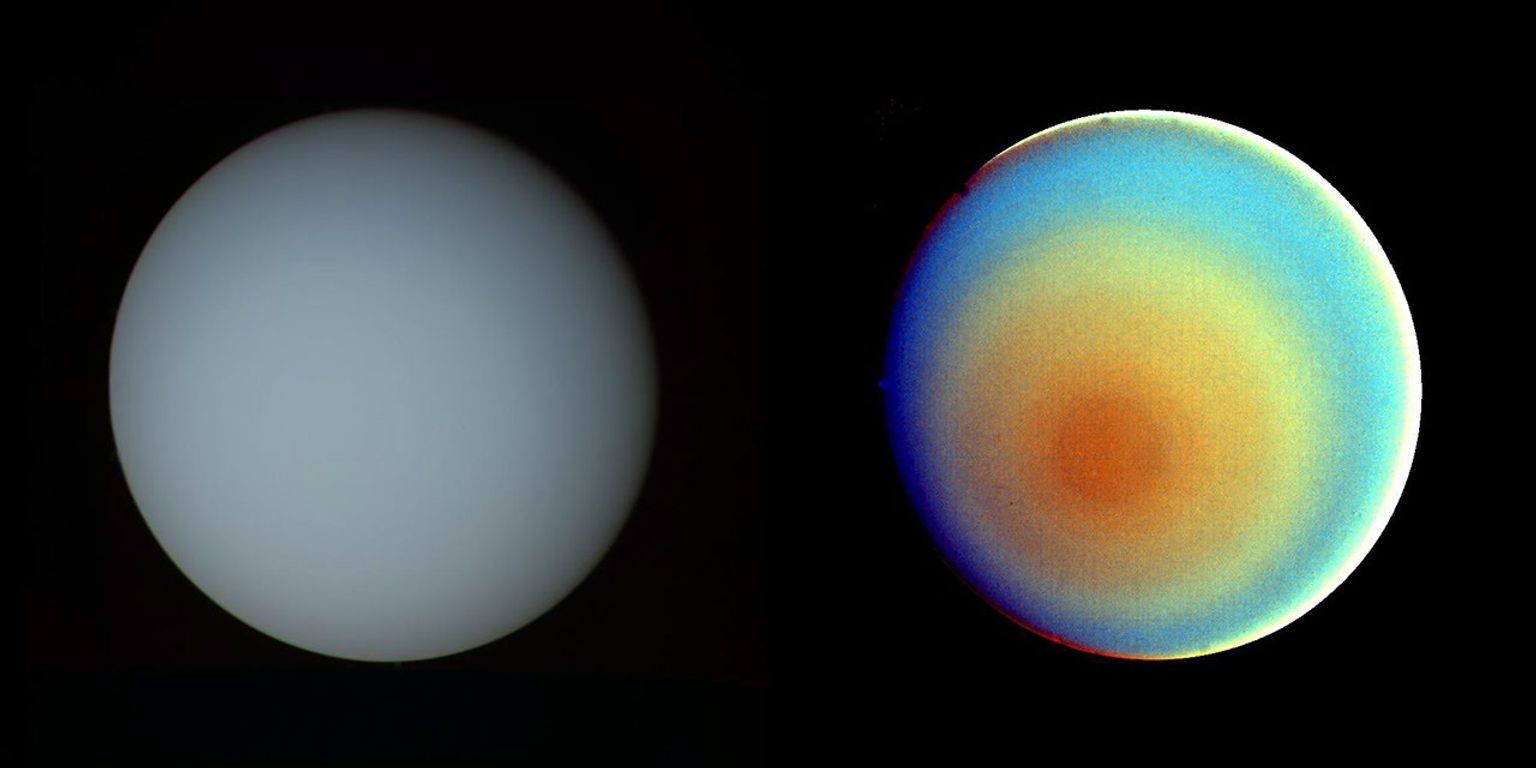
The radiogenic calculation provides the other side of the comparison. Interior models summarized in the paper give Uranus and Neptune heavy-element mass fractions of approximately 0.85–0.95, with 0.9 adopted for the calculation. Treating that entire heavy-element inventory as rock gives a rock-to-envelope mass ratio near 9.
The authors explicitly describe that assumption as an end-member case. Uranus and Neptune are not being claimed to consist of 90% rock. Treating all heavy elements as rocky material deliberately maximizes the amount of 40K available to generate radiogenic argon, producing an upper limit on the atmospheric 40Ar that could come from the rocky component.
For rock-to-envelope ratios representative of Uranus and Neptune under that assumption, radiogenic production yields atmospheric 40Ar mole fractions of approximately 1.9–13 × 10-9. The spread depends partly on the potassium abundance assigned to the rocky component. Reducing potassium by a factor of 10 produces a corresponding reduction in radiogenic argon.
The study compares those values with a nominal in-situ mass-spectrometer detection threshold of 3 × 10⁻⁹. Cases with little primordial enrichment and a weak radiogenic contribution can fall below that threshold. Greater primordial enrichment can keep the total atmospheric abundance detectable even when very little of the signal originated through radioactive decay inside the planet.
When argon stops being a simple interior tracer
The source ambiguity becomes strongest as the primordial inventory increases. In the modeled Uranus and Neptune cases, radiogenic 40Ar can contribute substantially when primordial enrichment remains modest. At large primordial enrichments, however, the inherited component dominates the atmospheric inventory and the sensitivity to rocky material rapidly declines.
Keep reading
| Possible future result | Scientific interpretation |
|---|---|
| Primordial argon close to protosolar abundance | Radiogenic 40Ar has a better chance of constraining the rocky component, provided transport from the deep interior is understood. |
| Strong primordial argon enrichment | The measured 40Ar is dominated by material inherited during planet formation and becomes more informative about the protosolar nebula. |
| Weak 40Ar signal | Could reflect little radiogenic argon, inefficient interior transport, low primordial argon or a combination of these effects. |
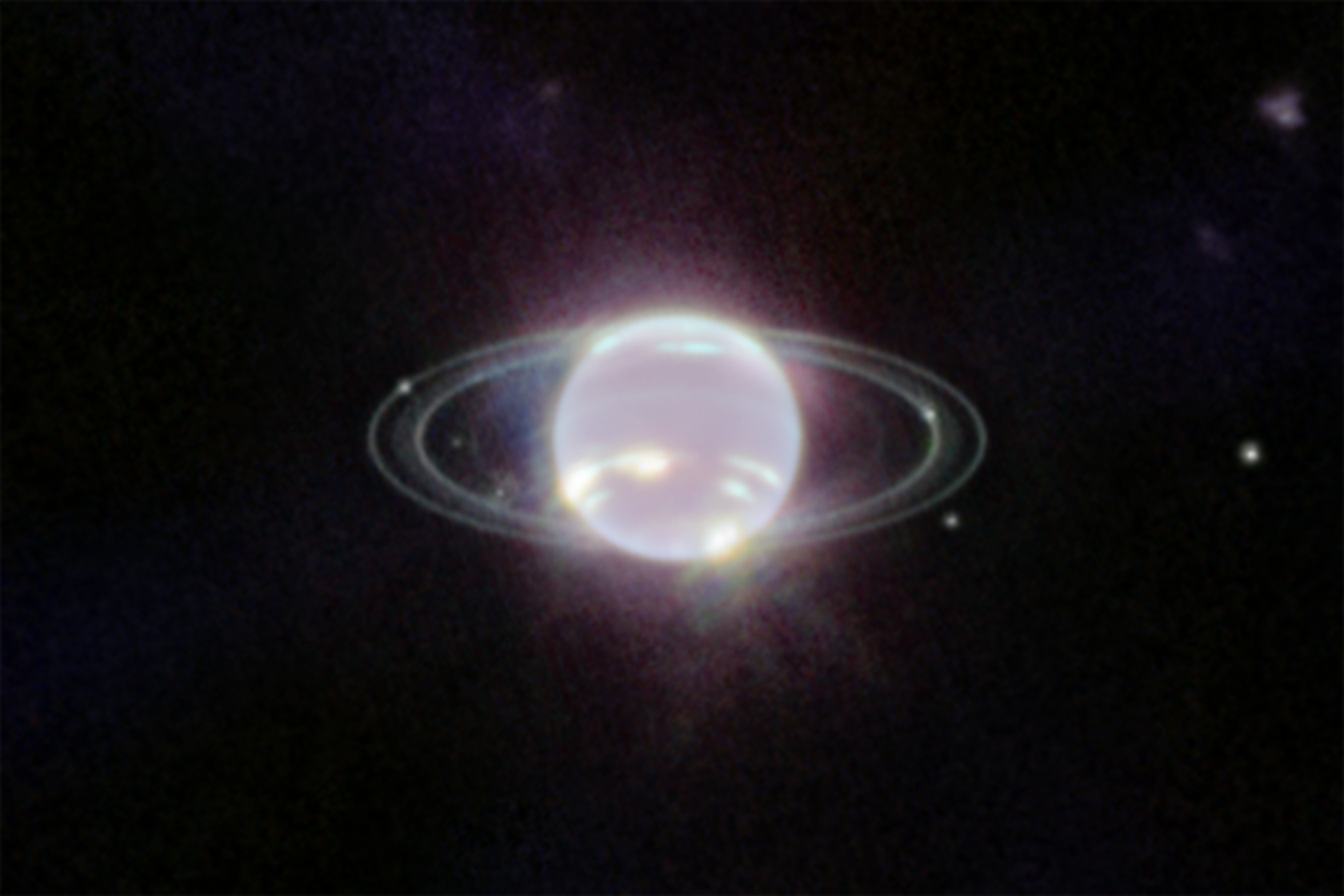
The paper identifies 36Ar as a crucial companion measurement because it is not produced in significant quantities by 40K decay. Its abundance would provide an independent estimate of the primordial argon inventory and help determine how much of the measured 40Ar could plausibly have originated inside the planet.
The authors therefore do not propose interpreting 40Ar alone. Future atmospheric probes could measure 40Ar together with 36Ar, N/H, 15N/14N, 13C/12C and carbon abundance below the methane cloud layers. Combined, these measurements would provide independent constraints on the volatile and refractory material incorporated during planetary formation.
Direct sampling matters because the relevant heavy noble gases and isotopic ratios cannot be adequately determined from remote observations alone. Voyager 2 remains the only spacecraft to have visited both ice giants at close range, encountering Uranus on January 24, 1986 and Neptune on August 25, 1989. It did not deploy an atmospheric probe at either planet.
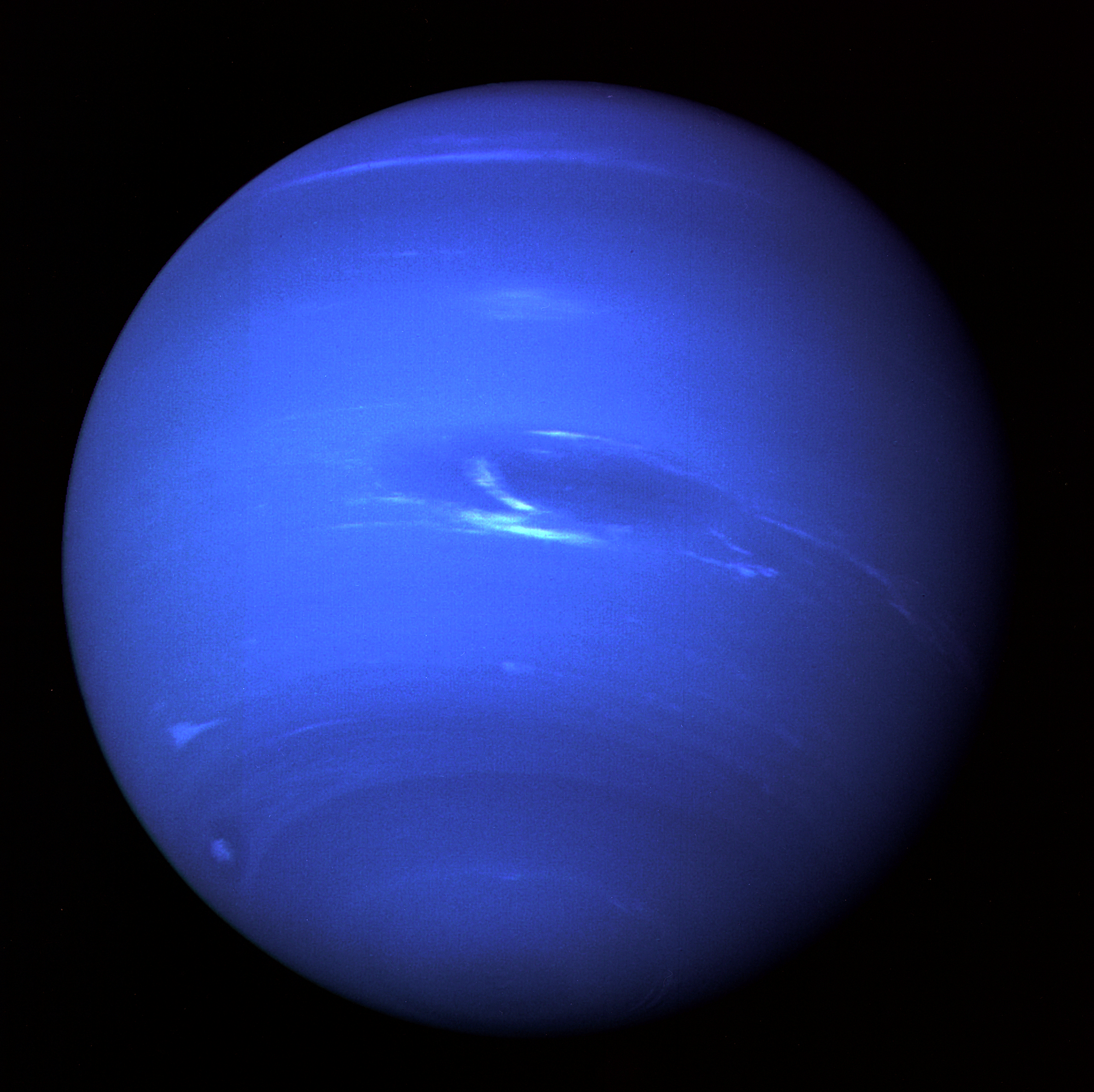
Voyager’s observations transformed knowledge of both planets but could not provide the noble-gas measurements needed for this test. An atmospheric entry probe carrying a mass spectrometer would be able to sample gases directly while descending through an ice giant’s atmosphere, separating measurements that cannot be obtained with the same fidelity from telescopes or an orbiter alone.
The calculations retain substantial model dependence. Disk irradiation changes the positions of the condensation fronts, Uranus and Neptune may have migrated while accreting solids from a broad range of distances, and the efficiency with which radiogenic argon travels from the interior into the observable atmosphere remains poorly known.
Accretion across a broad region of the disk could also smooth some of the extreme enrichment patterns produced by localized formation scenarios. The modeled values are therefore not predictions of the argon abundance that a future probe will necessarily measure. They define a range of physically plausible outcomes and show how different measurements would have to be interpreted.
The study also considers whether atmospheric temperatures could remove argon from the well-mixed atmosphere through condensation. Even at 100 times protosolar abundance, the calculated argon saturation temperature rises only to roughly 47–49 K, below the temperature minima in the Voyager radio-occultation profiles used by the authors. Only an extreme 1 000-times-protosolar case intersects the modeled atmospheric profiles near the tropopause.
A future measurement would therefore test two parts of planetary history at once. If primordial argon is weak and interior transport is sufficient, radiogenic 40Ar could constrain the rocky component. If primordial argon is strongly enriched, the same isotope would instead preserve information about the thermochemical environment in which the planets’ building blocks formed.
The central result is not that argon has already revealed what Uranus and Neptune contain. It is that the interpretation is more complicated, and potentially more informative, than a simple rock-versus-ice measurement. Combining noble gases, isotope ratios and deep atmospheric composition could allow future probes to separate the history written inside the planets from the chemical record inherited before the planets were fully assembled.
References:
1 Mousis, O., Hofstadter, M. D., Glein, C. R., Lunine, J. I., & Canup, R. M. (2026). Primordial and radiogenic argon 40 in Uranus and Neptune. The Planetary Science Journal, 7, 258. DOI: 10.3847/PSJ/aeb2ee
2 SwRI team studies interior composition, origins of ice giants – Southwest Research Institute – November 11, 2026
3 Planetary Voyage – NASA – accessed November 29, 2026
4 Uranus Wide (NIRCam Image) – NASA – December 18, 2023
5 Neptune Close Up (NIRCam) – NASA – September 21, 2022

Rishav Kothari is Editor-in-Chief of The Watchers, where he runs the newsroom and covers earthquakes, volcanoes, severe weather and space weather.
