
Why climate adaptation plans do not automatically become action
Climate adaptation is being constrained by more than a shortage of money. UNEP’s Adaptation Gap Report 2026 finds that institutional conditions also shape whether priorities become implemented measures, while developing countries received USD 28.2–31.7 billion in international public adaptation finance in 2024 against estimated needs of about USD 305 billion annually by 2035.
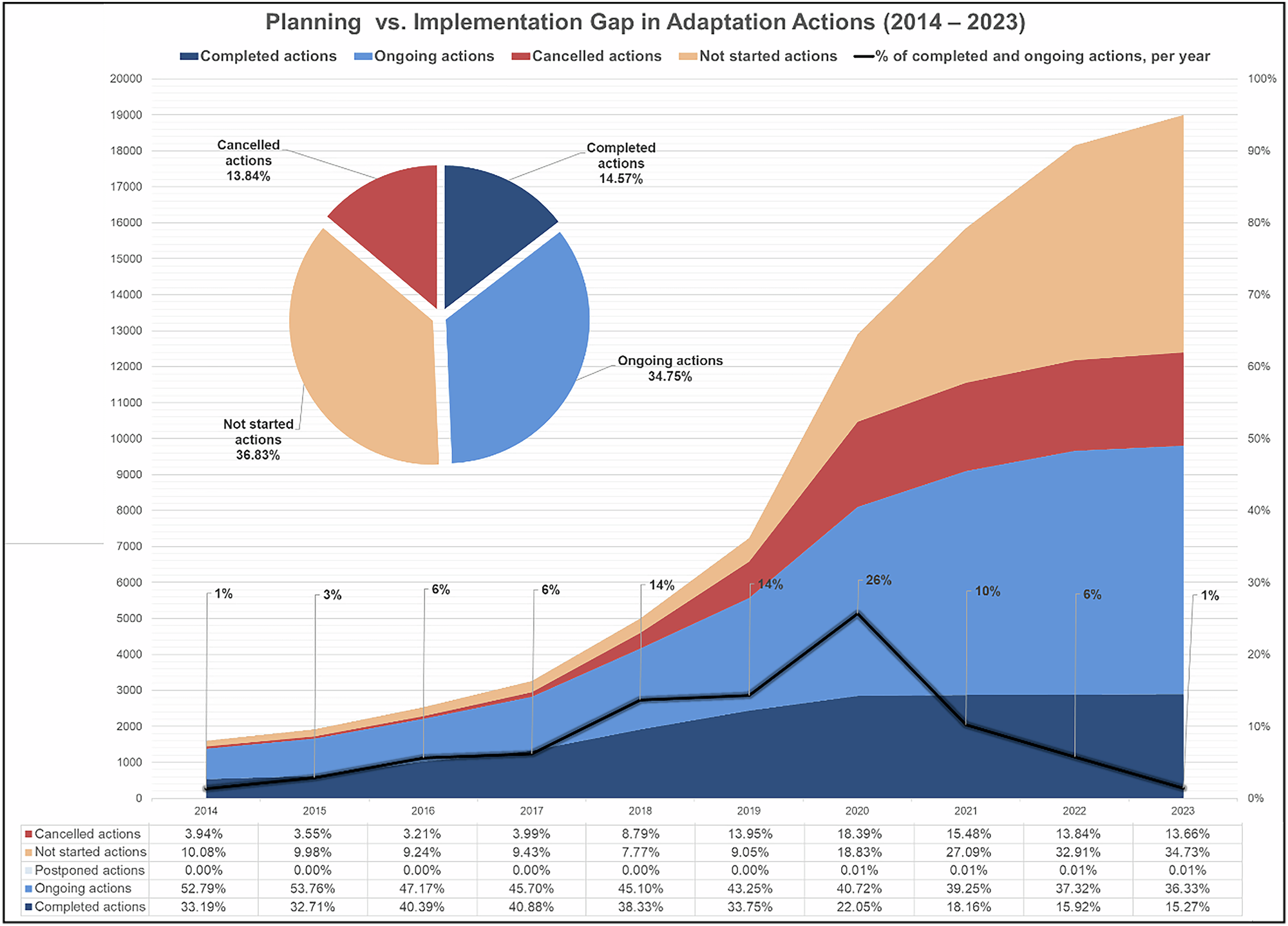
Planning versus implementation status of adaptation actions reported through the Global Covenant of Mayors between 2014 and 2023. Credit: Martínez Görbig et al. (2026), CC BY 4.0
The gap between climate-adaptation planning and implementation matters because adopting a plan does not itself reduce exposure to heat, flooding, drought or other climate hazards. Adaptation depends on institutions being able to turn identified priorities into funded projects, operational programmes and measures that function at national and local levels.
The United Nations Environment Programme (UNEP) examined that transition in Adaptation Gap Report 2026: Ready? Not. Climate impacts will not wait. Adaptation finance must rise., released on November 4, 2026. Alongside its assessment of finance, the report identifies eight groups of institutional factors that can enable or constrain implementation: legal and policy frameworks; mandates, roles and responsibilities; vertical and horizontal coordination; stakeholder engagement and participation; monitoring, evaluation and accountability; knowledge exchange and social learning; finance mobilization, management and allocation; and legacy and path dependencies.
| Adaptation finance indicator | UNEP 2026 assessment |
|---|---|
| International public adaptation finance in 2024 | USD 28.2–31.7 billion |
| Estimated developing-country needs | About USD 305 billion annually by 2035 |
| Finance under tripling scenarios | About USD 85–120 billion annually by 2035 |
| Share of estimated needs met by tripling | 20–29% |
Finance remains the largest measurable gap. International public adaptation finance from developed to developing countries reached USD 28.2–31.7 billion in 2024, only about USD 1 billion above the previous year. UNEP estimates that developing countries will require about USD 305 billion annually by 2035.
That estimate combines two different lines of evidence. Nationally determined contributions and national adaptation plans imply needs of USD 255–328 billion per year across 155 developing countries over the coming decade, with a central estimate of USD 286 billion per year in 2024 prices. A separate model-based assessment produces a central estimate of USD 320 billion per year. UNEP places the central value across the two approaches at about USD 305 billion annually by 2035.
The assessment largely excludes the private sector’s own adaptation requirements. UNEP estimates those needs separately and warns that including them could almost double the amount of adaptation finance required.
Even a major increase in international public finance would leave most estimated needs unmet. The COP30 Global Mutirão decision called for efforts to at least triple adaptation finance by 2035. Depending on the baseline used, UNEP calculates that this would increase annual international adaptation finance to roughly USD 85–120 billion and cover only 20–29% of estimated developing-country needs.

Finance alone does not establish whether an adaptation measure reaches implementation. UNEP defines implementation as the delivery or roll-out of an adaptation measure beyond the point at which it has merely been approved or financing has been secured. Institutional arrangements shape how responsibilities, resources and decision-making powers are distributed and whether adaptation priorities can move through that process.
Governments can strengthen those conditions through climate framework laws, clearer institutional mandates, coordination mechanisms across sectors and levels of government, policy-learning systems, stakeholder participation, monitoring and accountability arrangements, and dedicated mechanisms for mobilizing and managing climate finance. UNEP cautions that there is no universal institutional checklist because the same factor can enable or constrain implementation depending on context.
Peer-reviewed research published in 2026 shows the planning-to-implementation problem at municipal scale. Martínez Görbig et al. (2026) assembled a source dataset containing 19 954 adaptation actions reported by 1 596 Global Covenant of Mayors signatories across 32 European countries between 2014 and 2023.
Across the source database, more than 55% of actions reported by cities, towns and small towns were classified as completed or ongoing. The equivalent share for villages was 35.34%. More than 90% of completed or ongoing actions had begun shortly after approval, but implementation patterns differed substantially across settlement types.
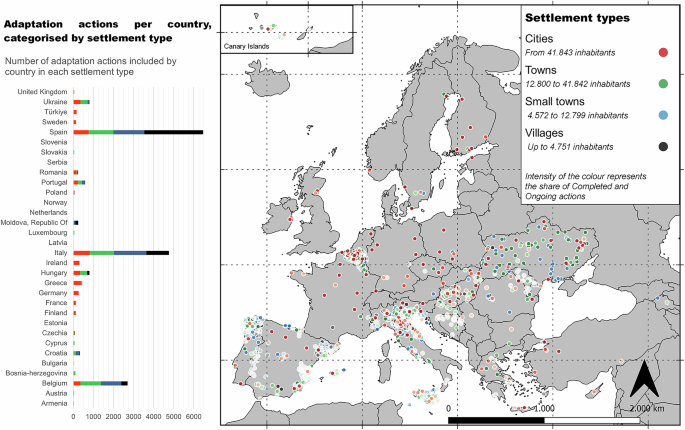
The statistical analysis is narrower than the full 19 954-action database. Only 3 640 observations, or 18.24% of the original dataset, contained complete information across the variables needed for the principal factor analysis. The researchers did not fill the missing values statistically because doing so would have meant inferring more than 80% of the dataset, which they judged could introduce substantial uncertainty and bias.
The geographic distribution also requires caution. Spain contributed 6 471 reported adaptation actions, Italy 4 761 and Belgium 2 704, while other countries contributed substantially fewer. Only 13 countries had sufficient complementary spatial information for the final analysis of implementation conditions.
Within the analytical data, social, institutional and economic variables were associated with whether measures were completed or ongoing. Educational level and participation by citizens and educational bodies were positively associated with implementation in the overall analysis, while transboundary management and the involvement of regional administrations in initiating actions also showed positive relationships. Private financing tended to increase implementation odds.
Keep reading
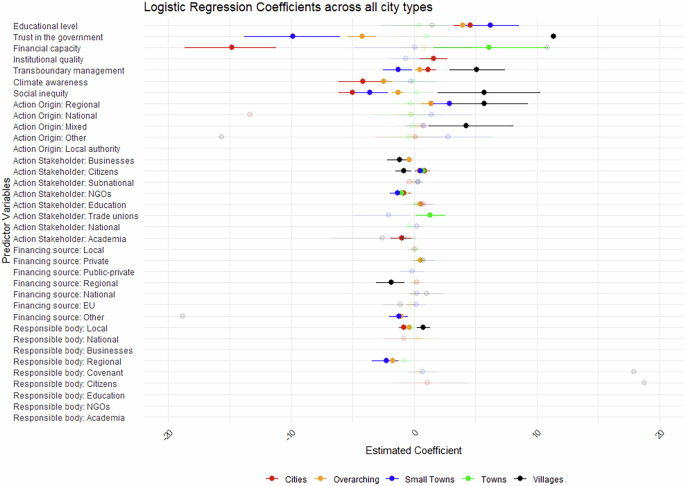
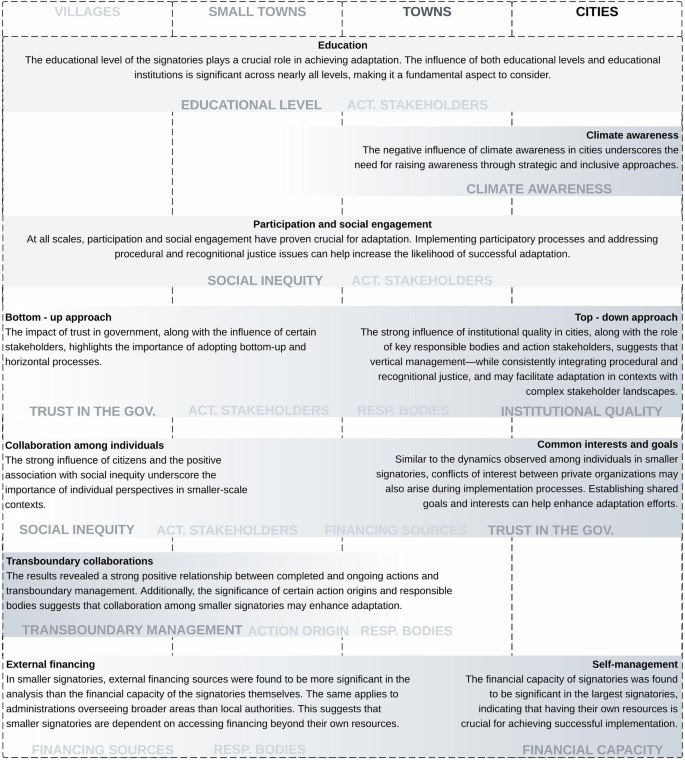
The relationships were not uniform. Financial capacity had a particularly strong positive association with completed or ongoing action in towns, while smaller settlements depended more heavily on external financing and cooperation with actors operating at other administrative levels. Some variables even changed direction between settlement types, showing why a factor associated with implementation in one administrative setting cannot automatically be treated as a general causal mechanism.
A second 2026 study documents a different implementation failure. Baek et al. (2026) examined heat-adaptation planning and implementation in large South Korean municipalities using a multi-site qualitative design based on interviews and planning documents. The researchers traced how standardized climate-risk information changed in usefulness as responsibility shifted from planning to implementation.
The vulnerability and risk assessments met formal planning requirements, but their outputs were often too coarse for later decisions over project location or budgeting. Staff rotation reduced familiarity with the underlying evidence, implementation frequently followed existing programmes and indicators, and pilot measures were rarely traceable directly back to the plans expected to guide them.
Baek et al. describe this as an evidence-transition failure. Climate information that is usable during the planning stage can lose decision relevance as responsibilities move through administrative handoffs. The finding does not establish that the same mechanism operates in every country, but it provides a documented example of how a technically completed planning process can become disconnected from implementation.
The European and South Korean studies therefore examine different parts of the same broader problem. One tests associations between implementation and socioeconomic, institutional and financial conditions across European municipalities; the other traces how climate information loses usability within a specific South Korean administrative process. Neither provides a universal causal model.
UNEP’s global assessment shows that governments are strengthening parts of the institutional environment. Climate framework laws, policy-learning platforms, cross-sector coordination and dedicated climate-finance mechanisms are among the measures identified in the report. The report’s institutional analysis draws on a systematic review of peer-reviewed literature published since 2020, a structured grey-literature search, additional expert-identified literature, document reviews and semi-structured interviews used in selected country examples.
Other financing channels are also expanding. South-South adaptation support through multilateral development banks and direct cooperation rose from USD 3.8 billion in 2019 to USD 9.6 billion in 2024. Private adaptation finance is growing as well, although UNEP estimates that private flows may reduce the financing gap for public-oriented adaptation needs by only 15–20%, because much private investment addresses the private sector’s own adaptation requirements or is ultimately financed within developing countries.
The remaining evidence gap is not simply the amount of finance available but how reliably institutions convert money and plans into functioning measures. The European research is constrained by incomplete and geographically uneven data, while the South Korean work examines a specific administrative system and heat-adaptation measures. Longer-term datasets that follow individual projects from planning through financing, implementation and operation would allow researchers to test which institutional conditions remain consistently associated with successful delivery across different settings.
References:
1 United Nations Environment Programme. (2026). Adaptation Gap Report 2026: Ready? Not. Climate impacts will not wait. Adaptation finance must rise. United Nations Environment Programme. DOI: 10.59117/20.500.11822/50093
2 Martínez Görbig, G., Flacke, J., Treville, A., Sliuzas, R., & Reckien, D. (2026). Empirical insights on the adaptation planning-implementation gap from the Global Covenant of Mayors European signatories. npj Urban Sustainability, 6, 66. DOI: 10.1038/s42949-026-00365-6
3 Baek, S., Kim, J., Park, C., & Lee, T. (2026). Evidence lost in transition: Climate-information continuity failures in South Korea’s local adaptation planning and implementation. Climate Services, 42, 100649. DOI: 10.1016/j.cliser.2026.100649

I’m a science journalist and researcher at The Watchers, contributing to the Epicenter edition, where I cover peer-reviewed scientific research and emerging discoveries across Earth and space sciences. With a background in astronomy and a passion for environmental science, I’ve worked in shark and coral conservation in Fiji, conducting reef and shark-behavior research, contributing to mangrove restoration, and earning PADI Open Water and Coral Reef Certifications. I bring a blend of scientific rigor and storytelling to illuminate the discoveries shaping our planet and beyond.
More reporting
- Record leatherback nesting in Ecuador raises questions about a shift in eastern Pacific nesting geography
- Machine-learning model projects much larger rise in cloud-to-ground lightning
- Atlantic circulation shifts repeatedly reshaped North Pacific oxygen minimum zones
- Seismic modelling resolves a distorted structure above Earth’s core–mantle boundary
