
Record leatherback nesting in Ecuador raises questions about a shift in eastern Pacific nesting geography
Eastern Pacific leatherbacks nested in numbers described by researchers as record-breaking along several Ecuadorian beaches during the 2025–26 season, more than 1 609 km (1 000 miles) from their principal nesting areas in Mexico and Costa Rica. More than 45 years of coastal records also show increased leatherback activity and nesting in Ecuador during recent La Niña episodes, adding evidence that the population’s reproductive geography varies with Pacific Ocean conditions without establishing ocean warming as the cause of the change.
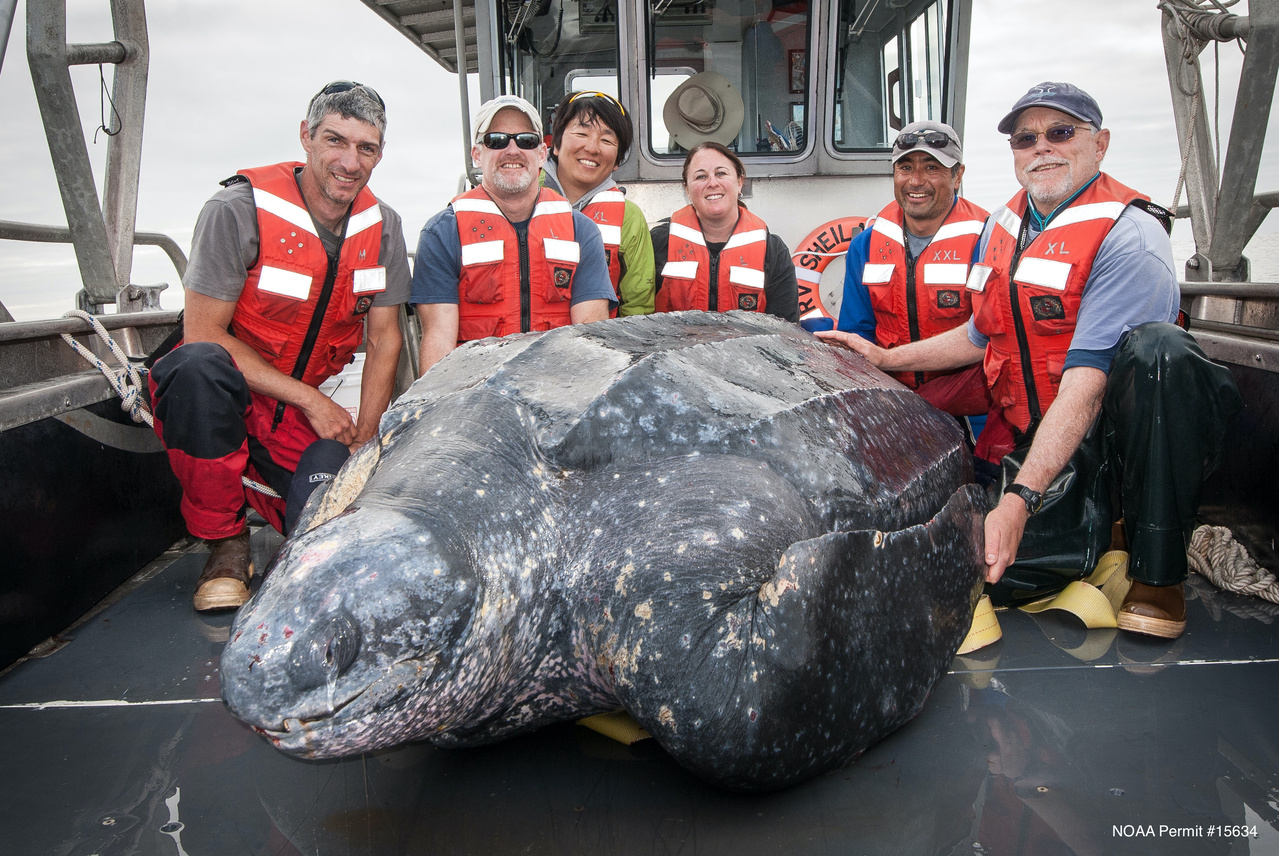
NOAA Fisheries researchers work with an adult leatherback aboard the R/V Sheila B. Leatherbacks are the world's largest turtles and are studied with tagging and other methods to understand their movements across the Pacific. Credit: NOAA Fisheries / Scott Benson. NOAA Permit #15634
Alava et al. (2026) examined more than 45 years of records from Ecuador’s coast covering reproductively mature female leatherbacks, nests, nesting attempts, hatching success and strandings. The researchers compared those observations with El Niño and La Niña episodes, recurring phases of Pacific climate variability associated with warmer and cooler sea-surface conditions in the eastern tropical Pacific.
The 2025–26 season stands out in that record. The study reports a record-breaking number of eastern Pacific leatherback nests across several Ecuadorian beaches, more than 1 609 km (1 000 miles) from the population’s principal nesting areas in Mexico and Costa Rica. Historically, observations of reproductive females on Ecuador’s beaches were considered rare or unusual, according to study co-author Juan José Alava of Simon Fraser University.
View the credited image at its source. A freshly hatched leatherback neonate moves toward the ocean within the Reserva Marina Puerto Cabuyal – Punta San Clemente, Manabí Province, Ecuador, in January 2021. Credit: Cristian Soledispa / Refugio de Vida Silvestre Isla Corazón y Fragatas
What the long record shows
The geographic change matters because eastern Pacific leatherbacks normally nest primarily along the Pacific coasts of Mexico and Costa Rica before migrating south toward feeding areas off South America. NOAA Fisheries reports that the eastern Pacific population has declined by more than 97% and that recent analyses continue to show declines at primary nesting beaches.
| Finding | What is supported | What is not established |
|---|---|---|
| 2025–26 nesting | The study reports a record-breaking number of nests on several Ecuadorian beaches. | The accessible sources do not establish that Ecuador has replaced the principal nesting grounds farther north. |
| La Niña relationship | Leatherback activity and nesting in Ecuador increased during recent cold La Niña episodes. | The association does not prove that La Niña caused the nesting increase. |
| Climate interpretation | The researchers interpret the pattern in the context of changing ocean conditions. | The observations do not demonstrate that anthropogenic warming caused a southward nesting shift. |
| Population status | Successful reproduction is occurring in Ecuador while the eastern Pacific population remains severely depleted. | The Ecuador observations alone do not demonstrate population recovery. |
The Ecuadorian observations therefore do not establish recovery of the eastern Pacific population. They document successful reproduction far from the principal nesting areas and an increase in Ecuadorian observations during part of the recent record.
Nesting increased during recent La Niña episodes
Records over the past decade show increased leatherback activity and nesting in Ecuador during cold La Niña episodes in the southeastern tropical Pacific. La Niña is the cool phase of the El Niño–Southern Oscillation (ENSO), when sea-surface temperatures across parts of the central and eastern tropical Pacific fall below the warmer conditions associated with El Niño.
The temporal association is scientifically important because the researchers were looking for environmental conditions that could help explain why leatherbacks were appearing more frequently on beaches well south of their principal nesting grounds. The observations connect the nesting record with ocean variability, but they do not isolate a single causal mechanism.
What the La Niña result does — and does not — mean
The study reports increased leatherback activity and nesting in Ecuador during recent La Niña episodes. That is an observed association in the record. It does not by itself show that cooler water caused individual turtles to choose Ecuador, nor does it demonstrate that long-term anthropogenic warming forced the population south. The researchers propose that leatherbacks may be adjusting reproductive behaviour as ocean conditions change, but that interpretation remains distinct from the observations themselves.
Reproductive performance at the Ecuadorian sites provides another part of the evidence. The study reports that nest yield, meaning the number of eggs laid in each nest, and hatching rates were comparable with those recorded at established nesting grounds farther north. Alava said some Ecuadorian nests produced more hatchlings than normally observed at those sites.
Bella’s 2026 nesting record
One female documented at Playa de Crucita in 2026 provided a detailed example of successful reproduction on Ecuador’s central coast. Researchers named the turtle Bella after tagging her during an unsuccessful nesting attempt in January.
Nearby streetlamps disoriented Bella as she moved inland. She crossed a rock breakwater, reached a sidewalk and returned to the ocean without laying eggs. Two nights later, she returned to a quieter section of beach and deposited 47 eggs.
Researchers later recorded 44 hatchlings from that clutch. The figures correspond to a hatching rate of about 93.6% for the nest.
| Bella observation | Verified value |
|---|---|
| Eggs in successful clutch described by SFU | 47 |
| Hatchlings from that clutch | 44 |
| Calculated clutch hatching rate | 93.6% |
| Total eggs recorded during 2026 season | 146 |
| Total hatchlings recorded | 134 |
| Reported overall hatching success | 91.8% |
| Number of nesting events | Four to five |
Researchers tracked Bella through four to five nesting events during 2026. One nest remained in place while the others were transferred to the San Jacinto hatchery. Across the season, 146 eggs produced 134 hatchlings, giving the reported overall hatching success of 91.8%.
Keep reading
A population that moves across an ocean
Leatherbacks are built for unusually long ocean movements. Unlike other sea turtles, they lack a rigid, hard shell; their carapace is covered by tough, flexible skin over connective tissue and bone. Their large body, extensive flippers and ability to retain metabolic heat allow adults to use a much broader thermal range than most reptiles.
Eastern Pacific leatherbacks nest along the Pacific coast of the Americas, primarily in Mexico and Costa Rica, then migrate south toward feeding areas off South America. Their movements expose them to conditions and human pressures across national jurisdictions and through open-ocean habitats far from their nesting beaches.
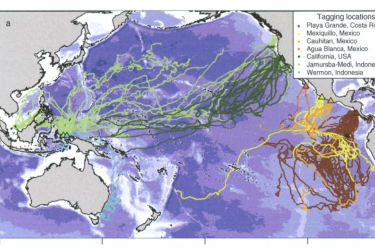
Satellite telemetry is one of the principal tools used to reconstruct those movements. A transmitter attached to a turtle sends location data when conditions allow, letting researchers identify migration corridors, feeding areas and places where turtles overlap with fishing activity or vessel traffic.
Successful nesting does not remove the population’s broader threats
NOAA Fisheries reports that eastern Pacific leatherbacks have declined by more than 97% in recent decades and that declines continue at primary nesting beaches. Fishing bycatch remains the most significant threat to Pacific leatherbacks across their migration corridors and feeding areas.
Other pressures include collection of turtles and eggs, coastal development, vessel strikes, pollution, marine debris and changing environmental conditions. On nesting beaches, artificial lights can discourage females from coming ashore or disorient turtles after they leave the water.
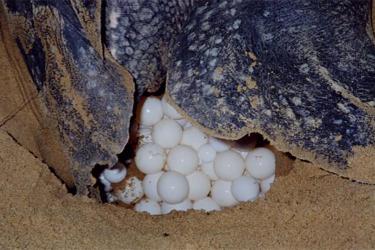
Bella’s encounter with artificial lighting and a rock barrier shows how successful nesting habitat can coexist with human-made obstacles. Her later successful nests demonstrate that the same coastal area can nevertheless produce hatchlings when a female reaches suitable sand and completes the nesting process.
Continued monitoring is central to determining whether Ecuador’s recent increase becomes a persistent part of eastern Pacific leatherback nesting geography rather than a short-lived cluster of observations.
Alava called for continued monitoring, reduced fisheries bycatch and coastal-zone management to protect nesting beaches in Ecuador. He also said conservation measures should involve coastal communities and incorporate local and traditional ecological knowledge.
The unresolved question
The central scientific question is whether the recent increase represents a persistent redistribution of nesting activity or a shorter-term pattern associated with ocean variability. The available record links increased Ecuadorian nesting with recent La Niña episodes, but it does not yet establish which environmental cues individual females respond to when selecting those beaches.
Future nesting seasons spanning different ENSO conditions will provide a stronger test. Repeated use of the same Ecuadorian beaches, reproductive success over multiple seasons and continued comparison with conditions in Mexico and Costa Rica would help establish whether Ecuador is becoming a consistently used part of the population’s reproductive geography.
References:
1 Alava, J. J., Briones, K., Soledispa, C., Miranda, C., Espinoza, E., Moreira, J., Darquea, J. J., Vallejo, F., Pesántez-Muñoz, J. F., Sócola, J., Moreira, J., Cruz, C., Intriago, M., Reyes, K., Miranda, A., Carvajal, R., Mizobe, C., Jiménez, P., Gaibor, N., Calle, N., & Barragán-Paladines, M. J. (2026). A new hope: Eastern Pacific leatherback (Dermochelys coriacea) nesting and stranding observations amidst a warming ocean show the value of Ecuador for species persistence. Chelonian Conservation and Biology. DOI: 10.2744/CCB-1686.1
2 Endangered leatherbacks finding new nesting beaches in Ecuador as Pacific Ocean warms, study finds – Simon Fraser University – November 9, 2026
3 Leatherback Turtle – NOAA Fisheries – Updated August 3, 2026

Rishav Kothari is Editor-in-Chief of The Watchers, where he runs the newsroom and covers earthquakes, volcanoes, severe weather and space weather.
More reporting
- Atlantic circulation shifts repeatedly reshaped North Pacific oxygen minimum zones
- Seismic modelling resolves a distorted structure above Earth’s core–mantle boundary
- Pacific climate variability shapes Arctic sea ice but cannot reliably time its ice-free transition
- NASA turns California lidar surveys into high-resolution maps of wildfire fuel structure
