
Two-Earth-mass planet model reproduces distant Solar System orbits standard models miss
A hypothetical planet about twice Earth’s mass reproduced several difficult-to-explain populations of objects beyond Neptune in 4.5-billion-year simulations of Solar System evolution. The result offers a single dynamical explanation for detached, highly inclined and extreme trans-Neptunian objects, but Planet X2 has not been detected and an important mismatch with Dark Energy Survey observations remains unresolved.
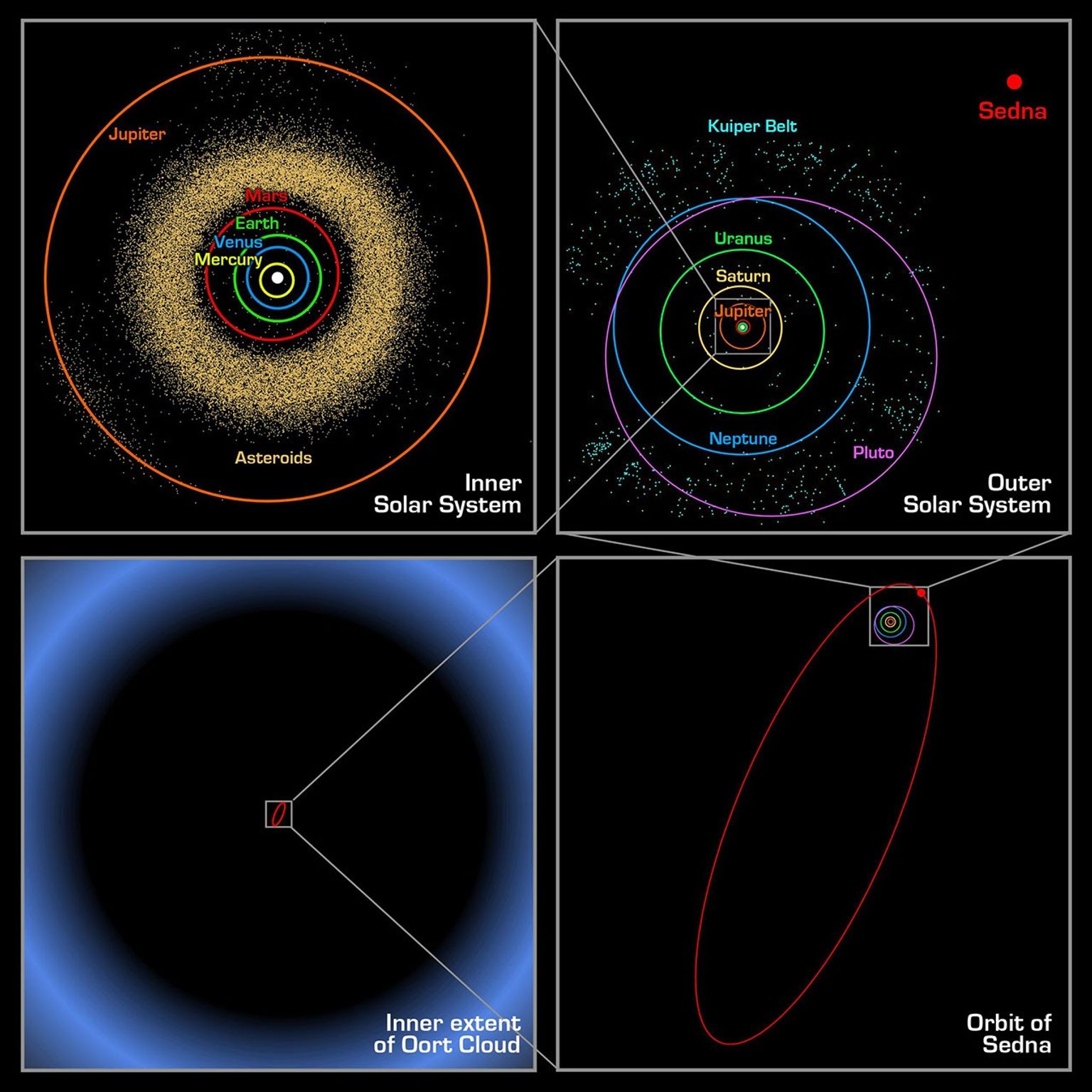
Four progressively wider views place Sedna's highly elongated orbit in context with the planets, Kuiper Belt and outer Solar System. Sedna belongs to the distant population that models of the Solar System beyond Neptune must account for. Credit: NASA/Caltech
Standard models of the outer Solar System reproduce much of the structure closer to Neptune but have difficulty accounting for several populations farther out, including objects whose orbits are detached from Neptune’s direct control, strongly inclined to the planetary plane or unusually extended. Those bodies preserve information about gravitational processes that operated during the Solar System’s formation and subsequent 4.5-billion-year evolution.
Lykawka et al. (2026) tested whether one additional gravitational influence could account for several of those populations at the same time. Their best-performing models contain a stable planet with about two Earth masses hundreds of astronomical units from the Sun. The object, designated Planet X2 (PX2), is a modeled planet rather than an observed one.
The study builds on models in which Neptune migrated outward through a primordial disk of planetesimals. Neptune’s migration was treated as grainy, meaning repeated gravitational interactions with massive bodies caused small irregular changes in its outward movement instead of a perfectly smooth displacement. Earlier migration models can reconstruct much of the trans-Neptunian architecture closer to Neptune, but they leave important populations beyond about 7.5 billion km (4.6 billion miles), or 50 AU, unexplained.
What does 1 AU mean?
One astronomical unit (AU) is the mean Earth-Sun distance, exactly 149 597 870.7 km (92 955 807 miles). A distance of 200 AU is therefore about 29.9 billion km (18.6 billion miles), while 500 AU is about 74.8 billion km (46.5 billion miles).
The unexplained objects include detached trans-Neptunian objects with perihelia above about 6 billion km (3.7 billion miles), or 40 AU. Perihelion is the point where an orbit comes closest to the Sun. An object with a sufficiently large perihelion can remain too distant for Neptune to produce the repeated close gravitational encounters that dominate the evolution of more conventional scattered objects.
The researchers also examined objects with orbital inclinations above 45°. Inclination measures how far an orbit is tilted relative to the main planetary plane. Producing a substantial population on highly tilted orbits requires a mechanism capable of redistributing orbital energy and angular momentum far beyond the comparatively flat architecture occupied by most of the major planets.
The simulations ran across 4.5 billion years and compared several dynamical scenarios. A control model contained the four known giant planets and Neptune’s migration. Other models added Mars- to Earth-mass planetary embryos scattered through the early Solar System, while another set retained a stable Earth-class planet on a distant orbit. The authors also included a representative Planet Nine configuration.
How the tested models differ
| Scenario | Additional body | Long-term outcome | Main result |
|---|---|---|---|
| Control | None beyond the known giant planets | Stable baseline | Reproduces much of the inner trans-Neptunian architecture but underproduces key distant populations |
| Primordial scattering planets | Mars- to Earth-mass embryos | Generally ejected or lost within a few to tens of millions of years | Does not simultaneously reproduce the detached, high-inclination and extreme populations |
| Planet X2 | 1–2 Earth masses; preferred cases about 2 Earth masses | Survives on a stable distant orbit through the simulations | Produces substantial detached, high-inclination and extreme populations while preserving much of the inner architecture |
| Planet Nine reference | 6.2 Earth masses | Stable distant perturber | Produces strong distant sculpting but a different orbital architecture from PX2 |
The temporary scattering-planet scenario failed as a general explanation. No scattering planet survived to the end of the 4.5-billion-year integrations. Median lifetimes varied by model but were generally measured in millions to tens of millions of years, with the bodies ultimately removed through gravitational ejection or collision with a giant planet or the Sun.
Among 200 scattering-planet runs, selected cases could reproduce individual features, but none simultaneously generated the full combination of detached, high-inclination and extreme populations required by the authors’ test. Once the extra bodies disappeared, the distant architecture became broadly similar to the control models.
Planet X2 produced a substantially different result because its gravitational influence remained present throughout the age of the Solar System. The best-performing cases used a planet with about two Earth masses and a semimajor axis of approximately 52.4–74.8 billion km (32.5–46.5 billion miles), equivalent to 350–500 AU.
A semimajor axis describes the overall scale of an elliptical orbit; it does not mean that the planet remains at that distance throughout its orbit. In the preferred models, PX2’s perihelion was around 29.9 billion km (18.6 billion miles), or 200 AU, placing even its closest modeled approach to the Sun far beyond Neptune.
The preferred configurations also placed the planet on a relatively low-inclination orbit of about 1°–15°. Models with an inclination of 30° became less favorable after the researchers applied a tentative constraint based on the small known population of Sedna-like objects.
| Preferred Planet X2 property | Model range | Metric and imperial scale |
|---|---|---|
| Mass | About 2 Earth masses | Model parameter; not directly measured |
| Semimajor axis | 350–500 AU | 52.4–74.8 billion km (32.5–46.5 billion miles) |
| Preferred perihelion | 200 AU | 29.9 billion km (18.6 billion miles) |
| Preferred inclination | 1°–15° | Low inclination relative to several alternative distant-planet configurations |
Under those configurations, Planet X2 generated substantial detached and high-inclination populations while reproducing orbital regions occupied by known extreme trans-Neptunian objects. The paper identifies Sedna, 2012 VP113 and 2015 BP519 among the extreme objects whose orbital niches appear in the simulated populations.
The extreme population provides one of the strongest contrasts with models lacking a permanent distant perturber. In the observational sample cited by the paper, 11 of 819 known objects beyond 50 AU met the study’s definition of an extreme trans-Neptunian object, an apparent fraction of 1.3%. The authors stress that observational bias makes the intrinsic fraction difficult to infer because objects with very large perihelia or inclinations are especially difficult to discover.
Control simulations produced a median extreme fraction of 0.5%, while the temporary scattering-planet models produced 0.7%. Planet X2 simulations generated much larger intrinsic extreme populations: 12.3%–35.1% in the one-Earth-mass models and 43.5%–67.8% in the two-Earth-mass models. Those are modeled intrinsic fractions and cannot be compared directly with the raw detected fraction without accounting for survey selection effects.
Our model reproduces several of the unusual orbital patterns observed among distant icy objects, although there are still differences between the model and observations that we need to investigate further.
Patryk Sofia Lykawka, Royal Astronomical Society research release
The PX2 simulations also generated a low-inclination detached population concentrated mainly beyond about 22.4–29.9 billion km (13.9–18.6 billion miles), or 150–200 AU. The control and scattering-planet models produced far fewer comparable objects at those distances, making this distant population one of the model’s testable signatures.
Closer to Neptune, the extra planet did not erase the architecture that migration models already reproduce. Within roughly 7.5–9 billion km (4.6–5.6 billion miles), or 50–60 AU, Planet X2 models remained close to the control model in orbital-distribution space and in major resonant population ratios.
That division is physically important. Neptune dominates much of the dynamical structure in the inner trans-Neptunian region, while a distant additional planet can slowly reshape more remote orbits over billions of years without strongly disturbing populations much closer to Neptune. The study therefore tests whether the two gravitational regimes can coexist within one evolutionary model.
What is actually observed, and what is modeled?
Observed: the orbits of known trans-Neptunian objects, including detached, highly inclined and extreme objects such as Sedna and 2012 VP113.
Modeled: the existence, mass and orbit of Planet X2, together with the long-term orbital populations produced by its simulated gravity.
Not observed: Planet X2 itself. The study reports no direct image, measured sky position or observationally determined orbit for the proposed planet.
The researchers did not compare the raw synthetic populations with telescope detections alone. Observational surveys do not discover every trans-Neptunian object with equal probability. Brightness, distance, orbital position, inclination, survey footprint and observing cadence all affect whether an object enters a catalog.
To account for those effects, the authors passed synthetic populations through the Dark Energy Survey Simulator. Preferred Planet X2 models produced detected inclination and perihelion distributions that satisfied the corresponding Dark Energy Survey comparisons under the statistical tests used in the paper.
The semimajor-axis distribution did not pass the same test. Across the models examined, the simulated survey produced too few detections at larger semimajor axes within the evaluated region from about 9–37.4 billion km (5.6–23.2 billion miles), or 60–250 AU. The authors identify the discrepancy as an area requiring further model refinement.
Keep reading
One possibility considered in the paper is that assumptions about the primordial population need revision. A more extended primordial scattered disk could alter how many objects ultimately populate the distant regions sampled by modern surveys. The paper presents that possibility as a route for future modeling rather than an established explanation for the discrepancy.
The detected high-inclination population carries another limitation. Objects on distant, strongly tilted orbits are difficult for surveys to find because they spend much of their orbital periods away from heavily observed parts of the sky. The known sample remains small enough that additional discoveries can materially change the statistical constraints imposed on competing models.
Planet X2 and Planet Nine are different hypotheses
Planet X2 differs substantially from the better-known Planet Nine hypothesis. The representative Planet Nine configuration in the study used a 6.2-Earth-mass planet with a semimajor axis of about 56.8 billion km (35.3 billion miles), or 380 AU, a perihelion of about 44.9 billion km (27.9 billion miles), or 300 AU, and an inclination of 16°.
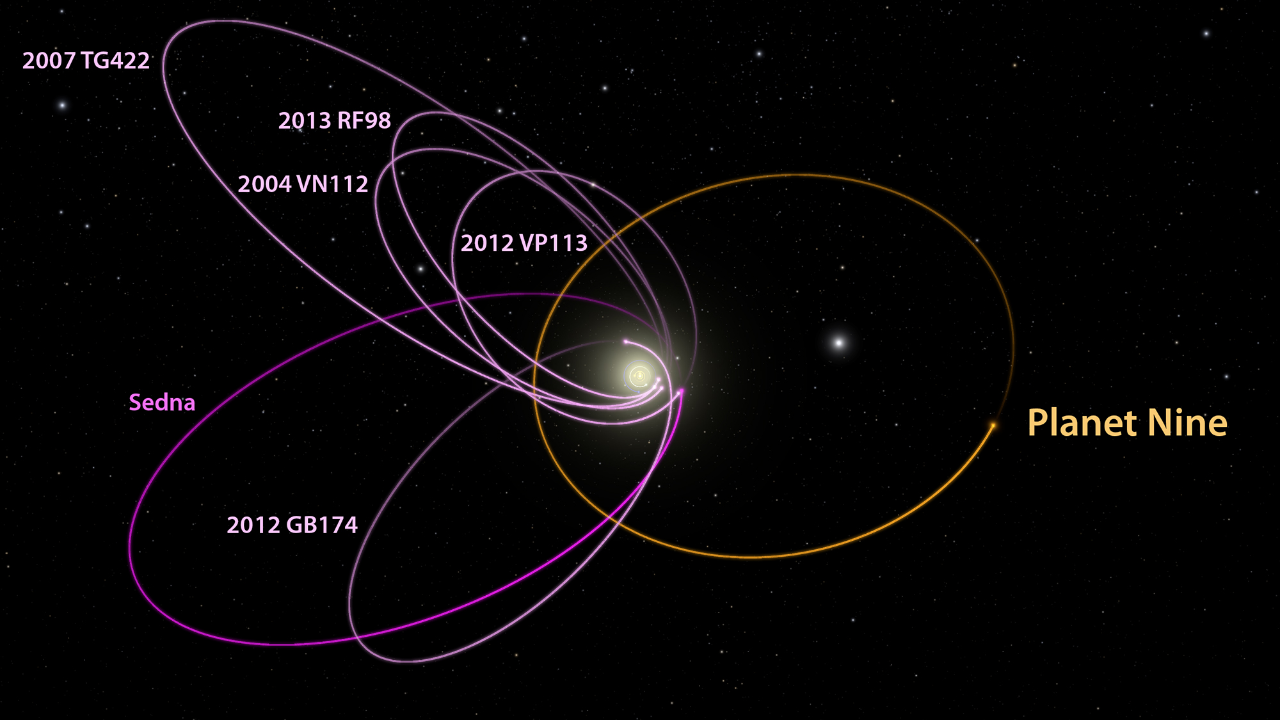
PX2 therefore occupies a different dynamical parameter space. Its preferred mass is lower, while its modeled orbit has a smaller perihelion than the Planet Nine reference case. The new study does not establish that Planet X2 replaces Planet Nine, and it does not eliminate all competing explanations for the distant Solar System.
Early stellar encounters are among the alternative mechanisms discussed in the scientific literature. A sufficiently close passage by another star during the Sun’s early history can reshape distant small-body orbits, although the resulting inclination and perihelion distributions differ from those generated by different planetary perturbers. A larger sample of Sedna-like and high-inclination objects will provide stronger tests of those alternatives.
The central evidentiary boundary remains unchanged: Planet X2 has not been detected. The researchers inserted the hypothetical object into N-body simulations and examined the populations generated by its gravity. The paper reports no telescope image of Planet X2, no measured sky position and no directly determined orbit for an undiscovered world.
The result is evidence about the performance of a dynamical model rather than direct observational evidence of the planet itself. Among the mechanisms tested in the study, the Planet X2 scenario reproduced a broader combination of distant trans-Neptunian populations than the temporary scattering-planet scenarios while preserving much of the inner architecture already explained by Neptune’s migration.
Rubin provides the next observational test
View the credited image at its source. NSF–DOE Vera C. Rubin Observatory on Cerro Pachón, Chile, at sunset in May 2024. Its Legacy Survey of Space and Time can greatly expand the sample of distant Solar System objects used to test Planet X2’s predicted orbital populations. Credit: Olivier Bonin/SLAC National Accelerator Laboratory
The Vera C. Rubin Observatory gives researchers one of the strongest ways to test the Planet X2 scenario observationally. The Legacy Survey of Space and Time repeatedly scans the southern sky, allowing large numbers of moving Solar System objects to be identified and their orbits measured through repeated observations.
The PX2 calculations predict distinctive detached, highly inclined and extreme populations beyond about 15 billion km (9.3 billion miles), or 100 AU. As Rubin increases the number of characterized distant objects, researchers can compare those orbital distributions with the synthetic populations produced by the model.
As the Rubin Observatory surveys the sky, we will find new clues that help us understand the distant reaches of the Solar System – and whether another planet is still waiting to be discovered.
Jonathan Horner, Royal Astronomical Society research release
A direct search for Planet X2 is a separate test. In the preferred simulations, the planet never approaches the Sun closer than about 29.9 billion km (18.6 billion miles), or 200 AU. Its apparent brightness would also depend on physical properties that are not established by the dynamical simulations, including size, reflectivity and its location along the proposed orbit.
What observations would strengthen or weaken Planet X2?
Strengthen the case: larger observational samples that reproduce the detached, high-inclination, low-inclination distant and extreme orbital distributions predicted by the best-performing PX2 models, or a direct detection of a planet within a compatible mass and orbital range.
Weaken the case: future surveys showing that the predicted distant populations are absent, improved bias-corrected distributions incompatible with the PX2 simulations, or another dynamical mechanism reproducing the observations more completely without requiring an additional planet.
The study therefore narrows a testable region of parameter space rather than completing the search. Its preferred models place an approximately two-Earth-mass planet on a distant, stable orbit with a semimajor axis of 350–500 AU, but the DES semimajor-axis discrepancy and the small observed samples at the most distant and highly inclined extremes remain unresolved.
The paper was published in Monthly Notices of the Royal Astronomical Society on November 23, 2026. Its authors are Patryk Sofia Lykawka, Pedro Bernardinelli and Jonathan Horner. The hypothesis can now be tested against an expanding observational census of the outer Solar System, while Planet X2 itself remains an undetected object introduced into numerical simulations.
References:
1 Lykawka, P. S., Bernardinelli, P., & Horner, J. (2026). Signatures of an Earth-class planet in the distant Solar system. Monthly Notices of the Royal Astronomical Society, 553(3), stag2033. DOI: 10.1093/mnras/stag2033
2 Could astronomers be closing in on a hidden planet beyond Neptune? – Royal Astronomical Society – November 23, 2026
3 Could astronomers be closing in on a hidden planet beyond Neptune? – University of Southern Queensland – November 23, 2026

Rishav Kothari is Editor-in-Chief of The Watchers, where he runs the newsroom and covers earthquakes, volcanoes, severe weather and space weather.
More reporting
- Euclid finds massive black hole 630 million years after the Big Bang, pushing quasar frontier beyond redshift 8
- Pacific climate variability shapes Arctic sea ice but cannot reliably time its ice-free transition
- NASA turns California lidar surveys into high-resolution maps of wildfire fuel structure
- Fiber-optic sensing reveals hidden rupture stages inside a small California earthquake
