
Atlantic circulation shifts repeatedly reshaped North Pacific oxygen minimum zones
A 55 000-year reconstruction indicates that low-oxygen waters across the North Pacific repeatedly expanded during abrupt glacial warmings and contracted during Heinrich events, when Atlantic overturning weakened. The evidence reveals a powerful cross-basin circulation control on Pacific oxygenation and shows why the future of the ocean’s oxygen minimum zones cannot be inferred from warming alone.
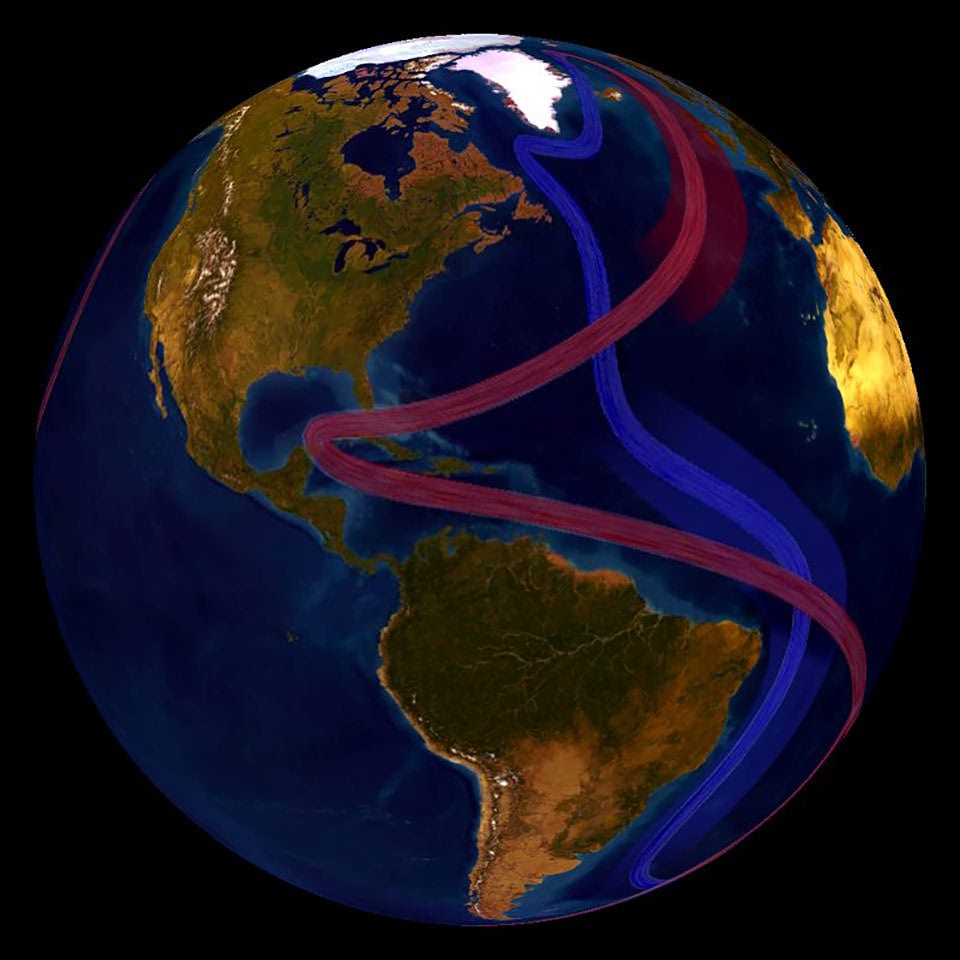
Warm surface water and colder deep water form part of the large-scale ocean circulation system linking ocean basins. AMOC is the Atlantic component of this broader overturning system. Credit: NOAA/National Ocean Service, Science on a Sphere.
Ocean warming generally reduces the amount of oxygen seawater can hold and strengthens stratification, restricting transport of oxygen from the surface into the ocean interior. That has made expansion of low-oxygen waters a major expectation of climate change, but temperature is only one control. Ocean circulation also determines where oxygen-rich water reaches the interior, while biological production influences how quickly that oxygen is consumed.
The new reconstruction shows that circulation can reorganize North Pacific oxygen conditions across thousands of kilometers. Tetard et al. (2026) found that the eastern North Pacific oxygen minimum zone repeatedly expanded during warm Dansgaard-Oeschger events but contracted during Heinrich events associated with weakened Atlantic Meridional Overturning Circulation (AMOC). Idealized Earth-system experiments reproduced the same direction of change by altering Atlantic overturning and following the response of Pacific intermediate-water ventilation.
Where the low-oxygen water is concentrated
Oxygen minimum zones are subsurface regions where dissolved oxygen falls to very low concentrations. Tetard and colleagues define the core of an oxygen minimum zone as water containing less than 0.5 ml L−1 of dissolved oxygen, around one tenth of a typical open-ocean concentration.
These zones are concentrated mainly at depths of about 200 to 1 000 m (656 to 3 281 feet), where oxygen supplied by circulation competes with oxygen consumption during decomposition of sinking organic matter. Modern oxygen minimum zones occupy more than 30 million km2 (11.6 million mi2) globally, including more than 20 million km2 (7.7 million mi2) in the eastern and western North Pacific.
View the credited image at its source. Dissolved oxygen at 800 m (2 625 feet) depth across the North Pacific. Yellow points mark sediment-core locations used in the study. The map shows the broad low-oxygen region extending across much of the basin. Credit: Kyushu University / research team.
How to read the evidence in this article
Reconstructed: past oxygen concentrations inferred from fossil benthic-foraminiferal assemblages preserved in sediment cores.
Modeled: oxygen and circulation changes produced by idealized cGENIE Earth-system experiments after Atlantic forcing was altered.
Projected: future changes reported by a separate ensemble of coupled climate models under a high-emissions scenario.
These evidence categories are related but are not interchangeable. A palaeoclimate reconstruction is not a direct observation of ancient seawater, and an idealized experiment is not a deterministic forecast of the twenty-first century.
A 55 000-year record from the seafloor
The researchers reconstructed bottom-water oxygen conditions from 2 569 benthic-foraminiferal assemblage measurements in 11 sediment cores spanning the subarctic and eastern North Pacific. Benthic foraminifera are single-celled organisms living on or within seafloor sediment. Different species tolerate different oxygen conditions, so changes in fossil communities can be used to estimate the oxygen conditions under which those communities lived.
The method does not directly measure ancient seawater. It converts the relative abundance of species associated with anoxic, dysoxic, suboxic and oxic environments into quantitative estimates of bottom-water oxygen. The expanded calibration used by the study can estimate concentrations across roughly 0.02 to 6.62 ml L−1, allowing the same approach to cover severe oxygen depletion as well as relatively well-oxygenated water.
How the foraminiferal oxygen proxy works
Benthic foraminiferal species differ in their tolerance of low oxygen. The researchers classify assemblages according to the oxygen environments favored by their constituent species, then use calibrated transfer functions to estimate dissolved oxygen from those assemblages.
The calibration draws on modern oxygen-deficient environments, global benthic-foraminiferal records and modern dissolved-oxygen datasets. The resulting values remain proxy estimates and carry uncertainty, but they allow oxygen changes to be reconstructed at locations and times for which no instrumental measurements exist.
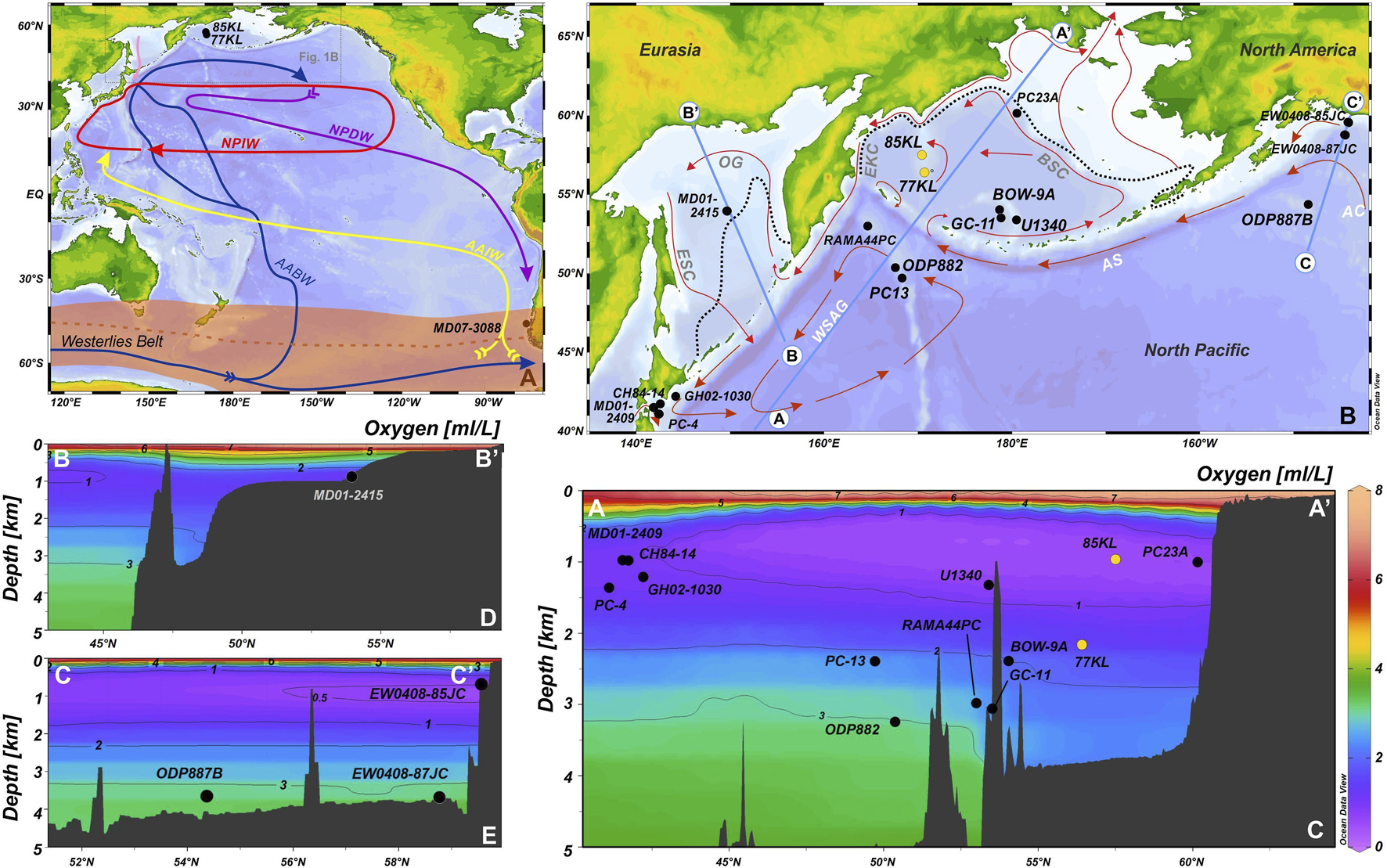
The reconstructed records show a repeated millennial-scale relationship between Northern Hemisphere climate shifts and oxygen conditions in the North Pacific. Warm Dansgaard-Oeschger events were generally associated with stronger oxygen depletion and geographic expansion of the eastern North Pacific oxygen minimum zone, while cold Heinrich events were associated with greater oxygenation and contraction of its low-oxygen core.
| Evidence | Verified result | Evidence status |
|---|---|---|
| Study record | 2 569 measurements from 11 sediment cores over 55 000 years | Proxy reconstruction |
| Dansgaard-Oeschger events | OMZ core expanded from about 3 000 km (1 864 miles) to at least 6 000 km (3 728 miles) | Reconstructed |
| Heinrich events | OMZ core contracted to about 1 000–2 000 km (621–1 243 miles) | Reconstructed |
| H3 and H4 | Defined OMZ core virtually disappeared as reconstructed oxygen rose above 0.5 ml L−1 | Reconstructed |
| Atlantic-Pacific timing | Maximum lag estimated at a few hundred years | Chronological constraint |
| cGENIE response | Pacific oxygen response emerged after several hundred years | Idealized model experiment |
During Dansgaard-Oeschger warming episodes, the reconstructed oxygen-minimum-zone core expanded along the study transect from about 3 000 km (1 864 miles) to at least 6 000 km (3 728 miles). During the early Holocene, and potentially during several Dansgaard-Oeschger events, low-oxygen conditions extended across distances approaching 10 000 km (6 214 miles).
Heinrich events produced the opposite pattern. During these cold intervals, the eastern North Pacific oxygen-minimum-zone core contracted to roughly 1 000 to 2 000 km (621 to 1 243 miles). During Heinrich events 3 and 4, reconstructed oxygen concentrations rose above the study’s 0.5 ml L−1 threshold across enough of the transect that the defined oxygen-minimum-zone core virtually disappeared.
The chronology does not resolve an exact Atlantic-to-Pacific transmission time. Taking age-model uncertainty and measurement density into account, the researchers estimate that the eastern North Pacific oxygen changes occurred within a maximum of a few hundred years of the corresponding North Atlantic changes.
Why the Atlantic can change Pacific oxygen
The proposed physical connection runs through the global overturning circulation. During Heinrich events, major freshwater and iceberg discharges into the North Atlantic were associated with weakening of the AMOC. Previous proxy records and model experiments have linked weaker Atlantic overturning with stronger Pacific overturning and greater formation of North Pacific Intermediate Water.
Intermediate water carries relatively cold, oxygen-rich water from regions where it formed into the ocean interior. Stronger formation renews intermediate depths more rapidly, shortening the time since the water was last exposed to the atmosphere and increasing the oxygen available to the eastern North Pacific.
Tetard et al. interpret the reconstructed pattern as an Atlantic-Pacific overturning seesaw. Weaker Atlantic overturning during Heinrich-type conditions corresponds to stronger Pacific intermediate-water ventilation. Stronger Atlantic overturning during Dansgaard-Oeschger-type conditions corresponds to weaker Pacific ventilation and more extensive oxygen depletion.
The model tests the mechanism
The researchers tested the proposed relationship with cGENIE, an Earth-system model of intermediate complexity. The experiments were deliberately idealized. Rather than attempting to recreate each prehistoric event in detail, the team altered North Atlantic salinity to strengthen or weaken Atlantic overturning and examined how circulation and dissolved oxygen responded in the Pacific.
In the Heinrich-type experiment, freshwater added to the North Atlantic weakened Atlantic overturning, strengthened cold and well-oxygenated North Pacific Intermediate Water and increased oxygenation in the eastern North Pacific. In the Dansgaard-Oeschger-type experiment, stronger Atlantic overturning weakened Pacific intermediate-water ventilation and expanded low-oxygen conditions.
The model tracked eastern North Pacific oxygen at around 825 m (2 707 feet) depth and produced a response to the Atlantic perturbation after several hundred years. That timescale is broadly consistent with what can be resolved from the sediment chronology, but the authors caution that ocean-dynamic responses depend on model structure and that cGENIE represents physical circulation at relatively low spatial resolution.
What the model can and cannot establish
The simulations test whether altering Atlantic overturning can physically produce the direction of Pacific oxygen change reconstructed from the sediment record. They do not establish that every Heinrich or Dansgaard-Oeschger event followed the same detailed pathway.
The model also does not by itself forecast twenty-first-century Pacific oxygen levels. Future conditions include sustained greenhouse warming, changes in stratification, circulation, nutrient supply and marine biology that differ from the imposed palaeoclimate experiments.
Biological production amplified the oxygen response. North Pacific primary production increased by as much as 18% in the Dansgaard-Oeschger-type simulation. More production sends additional organic material into deeper water, where respiration consumes oxygen as that material decomposes.
The Heinrich-type experiment produced the reverse basin-scale response, with North Pacific primary production declining by about 10%. When the researchers repeated the experiments while keeping export production fixed, the main geographic oxygen pattern remained, although its magnitude was somewhat smaller. The comparison supports circulation as the first-order control in these experiments and biological production as an amplifier.
The longer glacial-to-Holocene shift
The model produces a similar competition across the longer transition between the Last Glacial Maximum and the Holocene. In the Holocene simulation, Atlantic overturning reaches about 14 Sv while Pacific overturning is about 0.6 Sv. One sverdrup (Sv) equals 1 million m3 of water per second (35.3 million ft3 per second).
Keep reading
In the Last Glacial Maximum simulation, Pacific overturning reaches about 3.4 Sv, producing a better-ventilated North Pacific and a more restricted eastern North Pacific oxygen minimum zone. North Pacific export production then rises by as much as 61% from the Last Glacial Maximum to the Holocene simulation, increasing oxygen consumption at the same time that Pacific intermediate-depth ventilation weakens.
The reconstructed geographic changes are not equally constrained everywhere. Core coverage is sparse across parts of the transect, particularly across a roughly 2 000 km (1 243-mile) gap between approximately 3 000 and 5 000 km (1 864 and 3 107 miles) along the investigated section. Age-model uncertainty also grows in parts of the older record.
What this means for future ocean deoxygenation
The palaeoclimate results matter because modern warming pushes ocean oxygen in more than one direction. Warmer seawater holds less dissolved oxygen, while stronger stratification reduces downward transport from the surface. Both processes favor deoxygenation.
A weaker AMOC can operate in the opposite direction in the mechanism examined by Tetard et al. by invigorating Pacific intermediate-water ventilation. The resulting regional oxygen response therefore depends on the balance between warming, stratification, circulation, biological productivity and oxygen consumption.
| Process | Effect on oxygen | Physical reason |
|---|---|---|
| Ocean warming | Generally lowers oxygen | Warm seawater holds less dissolved oxygen |
| Stronger stratification | Generally lowers interior oxygen | Reduces vertical exchange between surface and deeper water |
| Stronger intermediate-water ventilation | Raises oxygen regionally | Renews intermediate depths with younger, oxygen-rich water |
| Higher export production | Lowers subsurface oxygen | More sinking organic matter increases respiratory oxygen consumption |
| Lower export production | Reduces oxygen demand | Less sinking organic matter is available for remineralization |
The paper compares its palaeoclimate results with a previously published ensemble of 14 CMIP6-class Earth-system models run under the high-emissions SSP5-8.5 scenario. That analysis found an important distinction between the broad Pacific oxygen minimum zone and its most oxygen-depleted core: broader hypoxic waters can expand while the severely depleted core contracts.
For the core threshold used by Tetard et al., below 0.5 ml L−1, the coupled-model analysis found eastern tropical Pacific oxygen increases of as much as 0.05 ml L−1 between 2000 and 2100 in parts of the ensemble. Stronger intermediate-water ventilation and reduced export productivity produced local oxygen gains large enough to outweigh the direct modeled oxygen loss from warming in those regions.
The result varies substantially among models. Differences in ocean circulation, marine biogeochemistry and the ability to reproduce the historical oxygen minimum zone lead to different regional futures. The palaeoclimate reconstruction therefore provides evidence that circulation can oppose warming-driven oxygen loss in some settings; it does not establish that future AMOC weakening will reverse North Pacific deoxygenation as a whole.
Does the study predict that future AMOC weakening will oxygenate the Pacific?
No single basin-wide outcome follows from the study. The palaeoclimate reconstruction shows that weak Atlantic overturning repeatedly coincided with a smaller Pacific oxygen-minimum-zone core in the past, and the experiments provide a mechanism through stronger Pacific ventilation.
Twenty-first-century conditions combine that circulation response with greenhouse warming, reduced oxygen solubility, stronger stratification and changing biological productivity. The expected response is therefore spatially heterogeneous rather than a simple basin-wide increase or decrease in oxygen.
A second 2026 study shows why geography matters
A separate Nature Geoscience study published on November 19, 2026 provides another constraint on how broadly the new result should be generalized. Lacerra et al. reconstructed about 265 000 years of conditions at the southern margin of the eastern tropical North Pacific oxygen-deficient zone using nitrogen isotopes preserved within foraminiferal shells.
That record showed comparatively little glacial-to-interglacial movement of the southern tropical boundary, although shorter changes occurred during deglaciations and periods of orbital forcing. The study therefore describes a part of the Pacific low-oxygen system that behaved differently from the broad subarctic and eastern North Pacific reconstruction reported by Tetard et al.
The results are not a simple contradiction. The studies examine different geographical sectors, different oxygen thresholds, different proxies and different timescales. Together they point toward a Pacific oxygen system that changes shape regionally rather than behaving as one coherent body whose boundaries move uniformly north or south.
What remains unresolved
The largest remaining limitation is spatial coverage. The reconstruction can resolve major basin-scale patterns from the available cores, but the authors identify equatorial and sparsely sampled parts of the transect as priorities for future sampling. Better chronological control would also tighten estimates of how rapidly Pacific oxygen conditions responded to Atlantic circulation changes.
Higher-resolution coupled models provide the other test. The cGENIE experiments show that the proposed circulation pathway is physically capable of producing the reconstructed sign of change, but they simplify ocean dynamics. Comparing the mechanism across models that represent intermediate-water formation, productivity and oxygen cycling differently will determine how robust the Atlantic-Pacific coupling remains under twenty-first-century forcing.
The central result is therefore narrower, but stronger, than a claim that warming either expands or shrinks Pacific low-oxygen waters. Across the past 55 000 years, changes in Atlantic overturning repeatedly coincided with major reorganizations of North Pacific oxygenation, and the simulations provide a physically consistent pathway linking the two basins. The unresolved question is how strongly that circulation pathway will compete with warming and stratification in the future ocean.
References:
1 Tetard, M., Pohl, A., Okazaki, Y., Ridgwell, A., Ovsepyan, E., & Beaufort, L. (2026). Last glacial North Pacific oxygenation due to North Atlantic circulation changes. Nature Geoscience. DOI: 10.1038/s41561-026-02122-x
2 北太平洋への酸素供給は海洋大循環によって変動する – Kyushu University – November 23, 2026
3 Busecke, J. J. M., Resplandy, L., Ditkovsky, S. J., & John, J. G. (2022). Diverging fates of the Pacific Ocean oxygen minimum zone and its core in a warming world. AGU Advances, 3, e2021AV000470. DOI: 10.1029/2021AV000470
4 Lacerra, M. L., Villacorta, S., Akiba, S., Farmer, J. R., Wang, X. T., Oleynik, S., Studer, A. S., Martínez-García, A., Haug, G. H., & Sigman, D. M. (2026). Insensitivity of the North Pacific oxygen-deficient zone to recent ice age cycle climate changes. Nature Geoscience. DOI: 10.1038/s41561-026-02143-6
5 Ovsepyan, E., Ivanova, E., Tetard, M., Max, L., & Tiedemann, R. (2021). Intermediate- and deep-water oxygenation history in the subarctic North Pacific during the last deglacial period. Frontiers in Earth Science, 9, 638069. DOI: 10.3389/feart.2021.638069
6 What is the Atlantic Meridional Overturning Circulation (AMOC)? – NOAA National Ocean Service – Updated September 23, 2026

Rishav Kothari is Editor-in-Chief of The Watchers, where he runs the newsroom and covers earthquakes, volcanoes, severe weather and space weather.
More reporting
- NASA turns California lidar surveys into high-resolution maps of wildfire fuel structure
- Fiber-optic sensing reveals hidden rupture stages inside a small California earthquake
- When atmospheric phenomena overlap, extreme rainfall intensifies under greenhouse warming
- Rapid ice-loss events could accelerate Arctic transition toward first ice-free summer
