
Asteroid 44 Nysa may have three connected lobes and a small satellite
High-resolution observations of main-belt asteroid (44) Nysa have resolved two neck-like valleys that researchers interpret as evidence for a possible three-lobed primary, while the same observing campaign revealed a small satellite. The observations narrow a long-standing uncertainty over Nysa’s shape, but the researchers have not yet determined whether its primary is a contact-trinary body assembled from connected components or an exceptionally irregular coherent object.
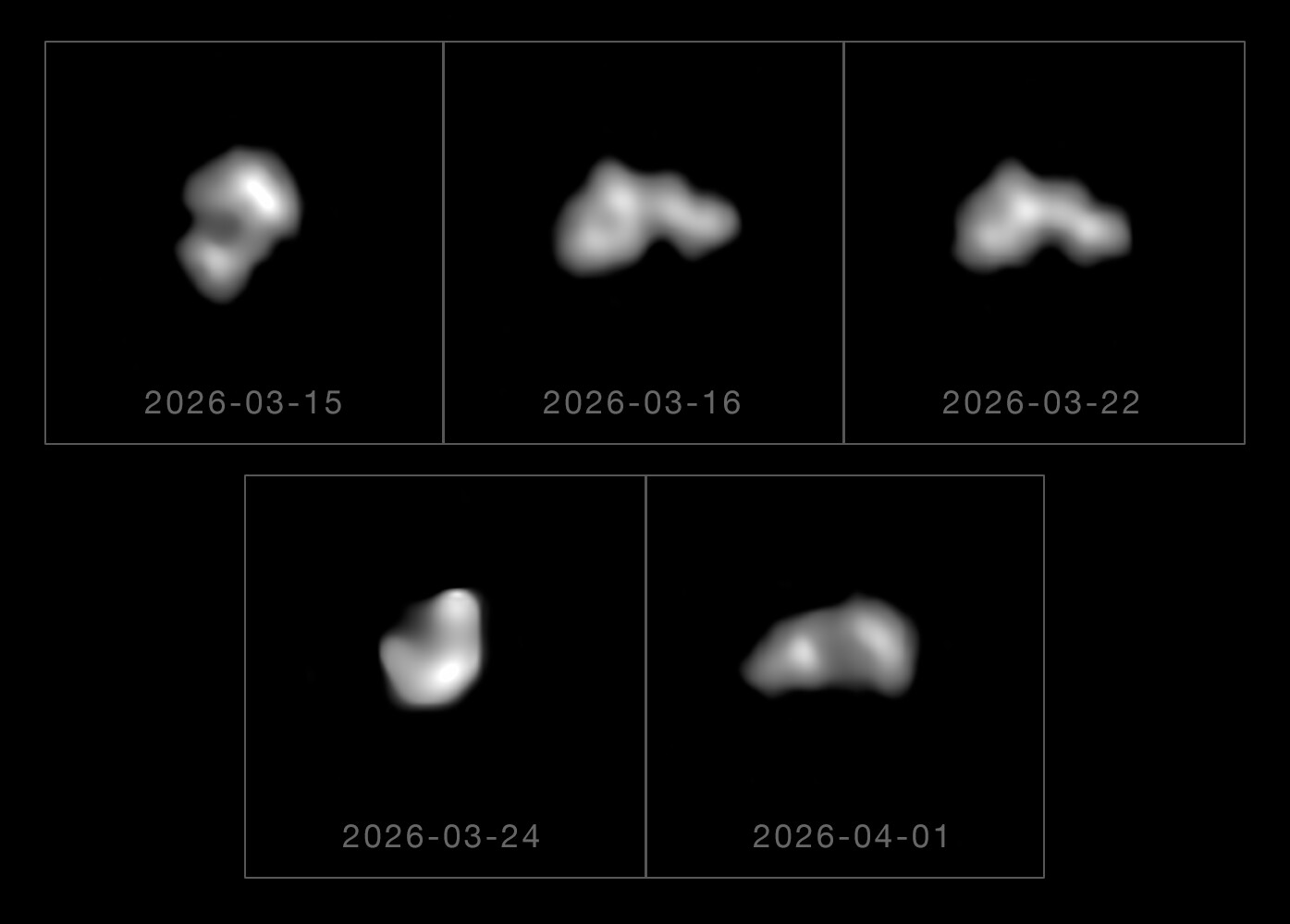
Adaptive-optics observations of asteroid (44) Nysa from several viewing geometries. The changing orientation exposes the asteroid’s strongly irregular outline and narrow regions interpreted as possible necks between lobes. Credit: ESO/K. Minker et al.
Earlier observations had shown that Nysa was elongated and structurally complex without establishing its morphology. Hubble Space Telescope measurements, radar observations, stellar occultations and light-curve inversion had variously pointed to a concavity, an elongated body or a possible two-lobed structure. The 2026 observations added disk-resolved images capable of separating features on the asteroid itself rather than inferring its shape only from changes in brightness.
Minker et al. (2026) observed Nysa with SHARK-VIS on the Large Binocular Telescope in Arizona and SPHERE/ZIMPOL on the European Southern Observatory’s Very Large Telescope in Chile. Both instruments use adaptive optics, which measures and corrects atmospheric distortion so that ground-based telescopes can recover much sharper views of small astronomical targets.
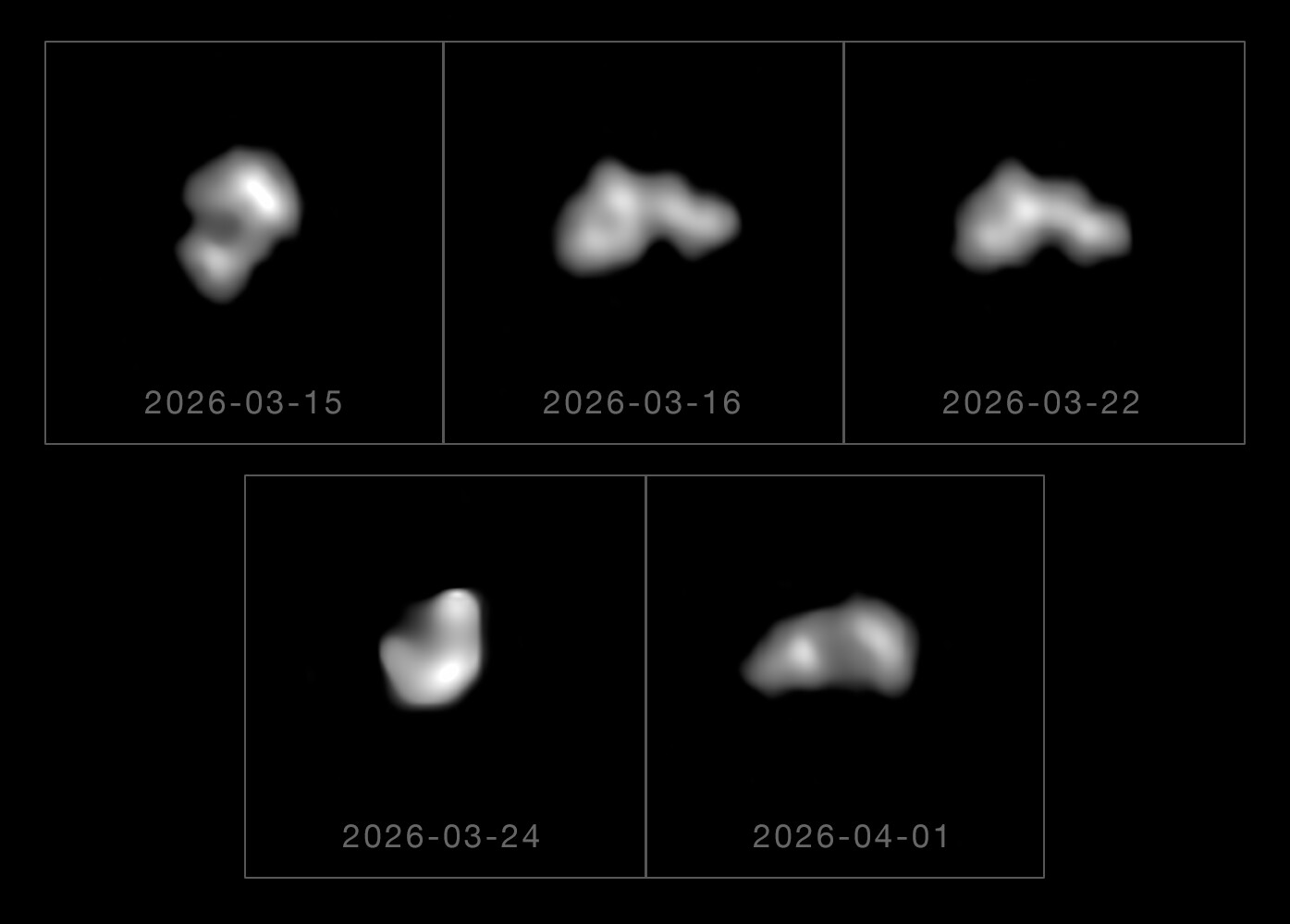
The images revealed two valleys that remained consistent with Nysa’s rotation and were visible from multiple geometries. They appear to cross the asteroid around its narrowest axis. The researchers interpret the features as colli, or necks joining contact fragments. Under that interpretation, one neck separates Nysa’s two main lobes while the other divides the smaller lobe, producing three lobes connected by two necks.
The interpretation is not unique. The study concludes that Nysa is a binary system most likely consisting of either a contact-trinary primary or a highly irregular coherent primary, accompanied by a small satellite. The images establish an unusually complex morphology, but they do not by themselves prove that three previously separate bodies merged to create the present asteroid.
What the observations establish — and what remains uncertain
The observations directly resolve two valley-like features and multiple edge indentations on Nysa, while the three-dimensional reconstruction is consistent with three lobes and two necks. Interpreting the valleys as physical boundaries between contact fragments is a researcher interpretation rather than a directly observed internal structure. A single, extremely irregular coherent body remains an alternative explanation.
The team reconstructed the asteroid with the All-Data Asteroid Modeling algorithm (ADAM), combining disk-resolved images with photometric light curves. A light curve records how an object’s brightness changes as it rotates. Those variations constrain shape and orientation, while resolved images provide spatial information about contours and surface features. The final model fits both types of data and is also consistent with several independent stellar-occultation measurements that were not used directly to construct the model.
The model gives Nysa a rotation period of about 6.42 hours and a volume-equivalent diameter of about 75 km (47 miles). That diameter describes the size of a sphere having the same modeled volume as the highly irregular asteroid rather than the distance across every viewing direction.
| Measured or derived property | Verified value | What it represents |
|---|---|---|
| Primary diameter | About 75 km (47 miles) | Volume-equivalent diameter from the shape model |
| Rotation period | About 6.42 hours | Time for Nysa to complete one rotation |
| Satellite separation, February 15 | 180 km (112 miles) | Projected separation in the sky plane |
| Satellite separation, March 21 | 170 km (106 miles) | Projected separation in the sky plane |
| Satellite diameter | 1 ± 0.5 km (0.62 ± 0.31 miles) | Estimate assuming the satellite and primary have the same albedo |
| Brightness difference | About 9 magnitudes | Difference between the primary and faint companion |
Photometric observations came from several smaller observatories as well as the large adaptive-optics facilities. University of Central Florida doctoral students Rhiannon Hicks and Daejhanae Smith observed Nysa from Robinson Observatory on February 22, 2026, for about 7.5 hours. The peer-reviewed paper lists 823 photometric points from that session, while UCF described the observing run as roughly eight hours and more than 800 images.
The students had selected Nysa independently for an Advanced Observational Astronomy project and were unaware of the larger observing campaign. Their light curve reproduced unequal maxima and minima seen in earlier datasets and was later incorporated into the wider modeling effort. UCF reported that the observations consisted of repeated 30-second exposures used to follow Nysa through a complete rotation.
The same high-resolution campaign uncovered another component of the system. Researchers detected a faint point source around Nysa in Large Binocular Telescope data obtained on February 15 and March 21. They recovered it using two independent processing methods: residuals from blind deconvolution, which models and removes the bright halo around the asteroid, and a principal-component/angular-differential-imaging analysis adapted from techniques used to detect faint exoplanets.
View the credited image at its source. SHARK-VIS observation of asteroid (44) Nysa on February 15, 2026. The small satellite S/2026 (44) 1 is marked with a pink arrow. Credit: Lowell Observatory / research team.
The source remained present in a coordinate frame centered on Nysa for more than three hours during each observing epoch while moving across the sky with the asteroid. That behavior allowed the team to reject a fixed background object as the explanation. Its projected separation measured 180 km (112 miles) in February and 170 km (106 miles) in March.
Keep reading
The companion was about nine magnitudes fainter than Nysa. Assuming that the primary and satellite have the same albedo, or fraction of incident light reflected from their surfaces, the study estimates the satellite’s diameter at 1 ± 0.5 km (0.62 ± 0.31 miles). The paper does not present a complete orbit for the companion; additional work on its dynamics is intended to improve estimates of the system’s mass and density.
The primary’s morphology leaves its formation history unresolved. One possibility is that Nysa began as a single coherent object that was heavily reshaped by impacts. Another is that several large components from the same parent body came together at low velocity and remained in contact, forming the valleys now interpreted as necks.
The observations provide one compositional constraint. The researchers detected no color variation between Nysa’s lobes above a 5% level in the observed filters. If the lobes are separate contact fragments, their similar surface colors favor material derived from the same parent body rather than unrelated asteroids with markedly different surface compositions.
A simple catastrophic breakup at Nysa’s present location also presents a problem. A collision capable of producing several large fragments that subsequently reaccumulated should have created additional debris. The study notes that no sufficiently large enstatite-rich dynamical family has been identified around Nysa to provide evidence for such a recent disruption in its current orbital neighborhood.
The authors therefore consider scenarios in which Nysa’s unusual structure formed earlier. One possibility is a hit-and-run collision that severely deformed or fragmented a differentiated parent body before pieces reassembled through low-velocity encounters. The present observations cannot distinguish that history from other impact-driven explanations.
Future work on the satellite could help narrow the possibilities. Better knowledge of its dynamics can constrain the mass of the primary and, combined with Nysa’s modeled volume, improve the density estimate. The study identifies density, long-term stability and formation modeling as important tests of whether the object is a rigid coherent body or a system assembled from contact fragments.
The timing of the research is separate from the later institutional story that brought the work back into public attention. The research preprint appeared in late July 2026, Lowell Observatory announced the morphology and satellite findings on July 29, and the peer-reviewed paper was published online in Astronomy & Astrophysics on August 27. UCF’s November 10 release focused on how its graduate students’ classroom observing project contributed to the larger study.
References:
1 Minker, K., Berdeu, A., Li Causi, G., Hanuš, J., Marsset, M., Conrad, A., Pedichini, F., Antoniucci, S., Vaccari, P., Moskovitz, N., Carry, B., Polakis, T., Ferrais, M., Jehin, E., Bonamico, R., Hicks, R., Smith, D., Miftah, M. A., & Marini, E. (2026). Unmasking (44) Nysa: Evidence for a trilobate structure. Astronomy & Astrophysics, 712, L26. DOI: 10.1051/0004-6361/202661603
2 PRESS RELEASE: ASTEROID (44) NYSA MAY BE THE FIRST-KNOWN THREE-LOBED WORLD – Lowell Observatory – July 29, 2026
3 Unmasking an unusual asteroid – European Southern Observatory – August 3, 2026
4 UCF Graduate Students’ Class Project Helps Reveal Unusual Shape of Large Asteroid – University of Central Florida – November 10, 2026

I’m a science journalist and researcher at The Watchers, contributing to the Epicenter edition, where I cover peer-reviewed scientific research and emerging discoveries across Earth and space sciences. With a background in astronomy and a passion for environmental science, I’ve worked in shark and coral conservation in Fiji, conducting reef and shark-behavior research, contributing to mangrove restoration, and earning PADI Open Water and Coral Reef Certifications. I bring a blend of scientific rigor and storytelling to illuminate the discoveries shaping our planet and beyond.
More reporting
- Euclid image reveals how faint the star system behind SN 2024vjm had to be
- Two-Earth-mass planet model reproduces distant Solar System orbits standard models miss
- Hera finds DART transformed Dimorphos in ways Earth-based observations could not resolve
- NASA selects 302 small-business projects for lunar power, robotics and surface infrastructure
