
Euclid image reveals how faint the star system behind SN 2024vjm had to be
A pre-explosion image from ESA’s Euclid mission has placed unusually tight limits on the stellar system that produced SN 2024vjm, an exceptionally faint Type Iax supernova in NGC 6744. The observations show that the progenitor system was fainter than previous Type Iax candidates, while the weak explosion produced slow, dense ejecta that help explain why the faintest members of this supernova subclass can fade more slowly than brighter ones.
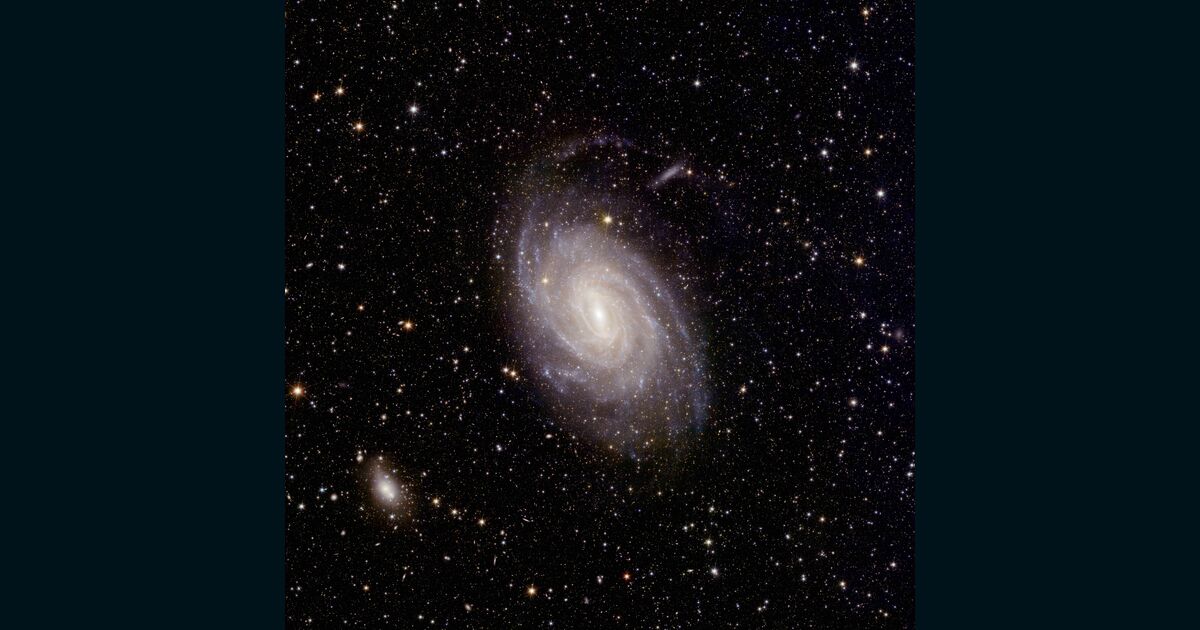
Euclid image of the spiral galaxy NGC 6744, host of SN 2024vjm, released in May 2024. This wider galaxy image does not mark the explosion site. Credit: ESA/Euclid/Euclid Consortium/NASA, image processing by J.-C. Cuillandre (CEA Paris-Saclay), G. Anselmi. CC BY-SA 3.0 IGO or ESA Standard Licence.
BlackGEM recorded SN 2024vjm at 23:59:05 UTC on September 13, 2024, as a new point of light in NGC 6744. The Transient Name Server lists a discovery magnitude of 18.82 in the BlackGEM q-band and classifies the object as a Type Iax supernova.
View the credited image at its source. NGC 6744, the host galaxy of SN 2024vjm, imaged by the BlackGEM optical telescope array. Cyan crosshairs mark the position of the supernova. Credit: BlackGEM telescope array
The transient was extraordinarily faint for a supernova. Follow-up spectroscopy showed low expansion velocities and spectral characteristics that placed it in the Type Iax subclass, a diverse group of thermonuclear explosions related to normal Type Ia supernovae but generally less energetic and less uniform.
Zimmerman et al. (2026) describe SN 2024vjm as possibly the faintest supernova observed to date. The important result is not only how faint the explosion was. The researchers were also able to examine what existed at the same position before the supernova because ESA’s Euclid mission had imaged the field before the explosion.
View the credited image at its source. BlackGEM observations of the SN 2024vjm field before the explosion, after the transient appeared, and after subtraction of the earlier field. The difference image isolates the new source. Credit: Weizmann Institute of Science / BlackGEM
The Euclid observation was obtained about 11 months before the supernova appeared. No bright object was detected at the precisely determined explosion position. Instead of identifying the progenitor directly, that non-detection allowed the team to calculate how luminous a stellar system could have been while remaining invisible in the Euclid data.
The resulting upper limit is fainter than previous candidate progenitor systems associated with Type Iax supernovae. The Nature Astronomy paper also finds that the limit provides strong arguments against a massive-star origin. The observation therefore removes a substantial range of bright stellar systems from the possible progenitor population without identifying one unique surviving configuration.
View the credited image at its source. BlackGEM and Euclid observations locate SN 2024vjm within NGC 6744 and identify the explosion position in the pre-explosion Euclid field. The published scale bars represent 5 kpc (about 16 300 light-years) in the galaxy views and 50 pc (about 163 light-years) in the close-up. Credit: Zimmerman et al. (2026), Nature Astronomy
The constraint is important because one of the best-known Type Iax progenitor candidates looks very different. A luminous blue source was identified in pre-explosion images at the position of the brighter Type Iax supernova SN 2012Z. That source is compatible with models in which a white dwarf undergoes a thermonuclear deflagration without being completely disrupted, potentially while accompanied by a luminous donor star.
A comparably bright system at the position of SN 2024vjm would have been visible in the Euclid data. None was detected. The result shows that progenitor configurations used to explain brighter Type Iax events cannot simply be extended unchanged to the faintest explosions.
View the credited image at its source. The progenitor-system luminosity limit for SN 2024vjm compared with stellar populations, evolutionary tracks and previous Type Iax progenitor candidates. Systems within the excluded region would have been bright enough to appear in the pre-explosion observations. Credit: Zimmerman et al. (2026), Nature Astronomy
The Euclid non-detection remains compatible with several faint white-dwarf configurations, including systems containing a low-luminosity companion or another white dwarf. Those configurations are interpretations of the allowed parameter space rather than direct detections. The firm observational result is that the progenitor system must have been fainter than previous Type Iax candidate progenitors.
| Verified quantity | SN 2024vjm | Physical meaning |
|---|---|---|
| Discovery | 23:59:05 UTC on September 13, 2024 | BlackGEM discovery record |
| Discovery magnitude | 18.82 in BG-q | Apparent brightness in the discovery observation |
| Host galaxy | NGC 6744 | Galaxy containing the transient |
| TNS classification | SN Iax (02cx-like) | Faint thermonuclear supernova subclass |
| Early ejecta speed | about 3 000 km/s (1 864 mi/s) | Substantially slower than ordinary supernova ejecta |
| Photospheric velocity at 8.7 days | 1 471 km/s (914 mi/s) | Expansion speed inferred from the spectrum |
| Photospheric velocity at 32.8 days | 673 km/s (418 mi/s) | Continued low-velocity evolution |
The post-explosion observations supplied a second constraint. Radboud University reports that early spectra showed material expanding at around 3 000 km/s (1 864 mi/s), compared with more than 10 000 km/s (6 214 mi/s) for ordinary supernova explosions. Measurements shown in the peer-reviewed study give inferred photospheric velocities of 1 471 km/s (914 mi/s) at 8.7 days and 673 km/s (418 mi/s) at 32.8 days.
Expansion velocity determines how quickly supernova debris spreads into space. Fast ejecta occupy a rapidly increasing volume and become less dense. SN 2024vjm expanded unusually slowly, so its material remained comparatively dense for longer.
View the credited image at its source. Thermonuclear diagnostics and ejecta evolution of SN 2024vjm. The figure combines its bolometric light curve, Co II spectral features, radioactive-energy deposition calculations and declining photospheric velocity. Credit: Zimmerman et al. (2026), Nature Astronomy
The researchers tested the thermonuclear interpretation using several independent diagnostics. The study follows the bolometric luminosity, identifies spectral features produced by singly ionized cobalt and compares the light emitted by the supernova with energy deposited through the radioactive decay chain associated with nickel-56 and cobalt-56.
Radioactive decay supplies much of the energy visible after a thermonuclear supernova. Nickel-56 synthesized during the explosion decays to cobalt-56 and then iron, releasing energy into the expanding ejecta. When that material is dense, more of the radioactive energy is absorbed and re-emitted as light. As the ejecta expand and become transparent, a larger fraction escapes without powering the observed luminosity.
SN 2024vjm remained dense because its ejecta expanded slowly. The University of Turku reports that the explosion expelled only around 10% of the Sun’s mass. The weak acceleration and low expansion velocity allowed the ejecta to retain radioactive energy for longer than a more rapidly expanding cloud would.
That behaviour explains one of the most counterintuitive features of the event: SN 2024vjm was exceptionally faint but did not fade as rapidly as its low peak luminosity might suggest.
Normal Type Ia supernovae follow a relation in which intrinsically brighter events generally decline more slowly after maximum light. Known as the Phillips relation, this correlation is part of the reason Type Ia supernovae can be standardized for cosmological distance measurements.
Keep reading
View the credited image at its source. Peak absolute magnitude compared with the decline in brightness over 15 days for Type Iax supernovae. SN 2024vjm lies among the faint events, which follow a different luminosity-decline trend from the brighter Type Iax population. Credit: Zimmerman et al. (2026), Nature Astronomy
The faint Type Iax events examined by Zimmerman and colleagues follow a different trend. Their comparison of peak luminosity with the decline over the following 15 days separates the faint and bright Iax populations. At the low-luminosity end, the faintest events can decline more slowly than brighter members of the same subclass.
The physical explanation proposed by the researchers is tied to density. A weaker explosion accelerates the ejecta less strongly. The material therefore expands more slowly, remains denser and traps radioactive energy for longer. The amount of radioactive material controls how much energy is available, while ejecta mass, velocity and density determine how quickly that energy escapes.
What the observations establish — and what remains unresolved
Established by the observations: SN 2024vjm is a faint Type Iax supernova; its progenitor system was below the Euclid detection limit; that limit is fainter than previous Type Iax candidate progenitors; its ejecta expanded unusually slowly; and its post-explosion evolution is consistent with a thermonuclear event.
Still unresolved: the observations do not uniquely identify the binary configuration that produced SN 2024vjm, and they do not establish that every faint Type Iax supernova follows the same progenitor channel.
The brightness of SN 2024vjm also requires careful wording. The peer-reviewed paper describes it as possibly the faintest supernova observed to date. University of Turku material says it was about 300 times fainter than a typical Type Ia supernova, while Radboud University gives a broader estimate of roughly 100 to 300 times fainter than a typical supernova. Because those institutional comparisons are not identical, the qualified wording from the research paper is the safer general description.
The observing campaign extended far beyond the discovery telescope. The study combines ground-based photometry and spectroscopy with Euclid observations, data from the NASA/ESA/CSA James Webb Space Telescope and Very Large Telescope/MUSE archival observations. The research team followed the transient over many months, allowing the early explosion and later radioactive-energy release to be examined within the same physical framework.
The underlying photometry and spectra are available through WISeREP. JWST observations are archived through the Mikulski Archive for Space Telescopes, Euclid Early Release Observation data are available through ESA, and the MUSE observations are available through the European Southern Observatory archive. The authors also released the analysis scripts used in the study.
Pre-explosion imaging gives SN 2024vjm unusual value because most supernova progenitors are investigated only after the explosion has occurred. Researchers then have to reconstruct the original system from its ejecta, environment and theoretical models. Archival imaging of the exact site can instead exclude stars and binaries that would have been bright enough to see beforehand.
For SN 2024vjm, the evidence constrains the problem from both directions. Euclid limits the luminosity of the system that existed before the explosion, while the later spectra and light curve describe the weak thermonuclear event it produced. The two independent datasets substantially narrow the range of viable progenitors without yet selecting a single configuration.
The remaining question is whether SN 2024vjm represents a separate progenitor population at the faint end of the Type Iax class or one extreme outcome within a broader family of white-dwarf systems. Resolving that distinction will require more faint Type Iax events with deep images taken before explosion and similarly complete follow-up afterward.
References:
1 Zimmerman, E. A., Gal-Yam, A., Groot, P. J., Ofek, E. O., van Roestel, J., Pastorello, A., Valenti, S., Ravi, A. P., Chen, P., Schulze, S., Blagorodnova, N., Wavasseur, M., Gómez-Muñoz, M. A., Tranin, H., de Wet, S., Leloudas, G., Vreeswijk, P. M., Kwok, L. A., Schwab, M., … Zang, W. (2026). A faint progenitor system for the faint Iax supernova 2024vjm. Nature Astronomy. DOI: 10.1038/s41550-026-03024-z
2 Exceptionally feeble supernova explosion from a feeble star – University of Turku – November 27, 2026
3 The faintest supernova ever observed refuses to go out – Radboud University – November 26, 2026
4 Slow Burn: The Faintest Supernova Ever Observed Refused to Fade – Weizmann Institute of Science – November 26, 2026
5 SN 2024vjm – Transient Name Server – discovery record, September 2024

Rishav Kothari is Editor-in-Chief of The Watchers, where he runs the newsroom and covers earthquakes, volcanoes, severe weather and space weather.
More reporting
- Straight-edged craters expose Pluto’s buried tectonic history
- Two-Earth-mass planet model reproduces distant Solar System orbits standard models miss
- Hera finds DART transformed Dimorphos in ways Earth-based observations could not resolve
- NASA selects 302 small-business projects for lunar power, robotics and surface infrastructure
