
Euclid opens its first major survey dataset for a 3D map of the dark Universe
ESA’s Euclid mission has opened its first major survey-scale dataset, giving astronomers images, spectra and distance measurements across approximately 1 900 deg² of sky. Released on November 12, 2026, DR1-Foundation contains more than 900 million galaxies and spectra from more than 160 million sources, moving Euclid from demonstration observations toward the three-dimensional survey needed to trace how galaxies and matter are distributed across the Universe.
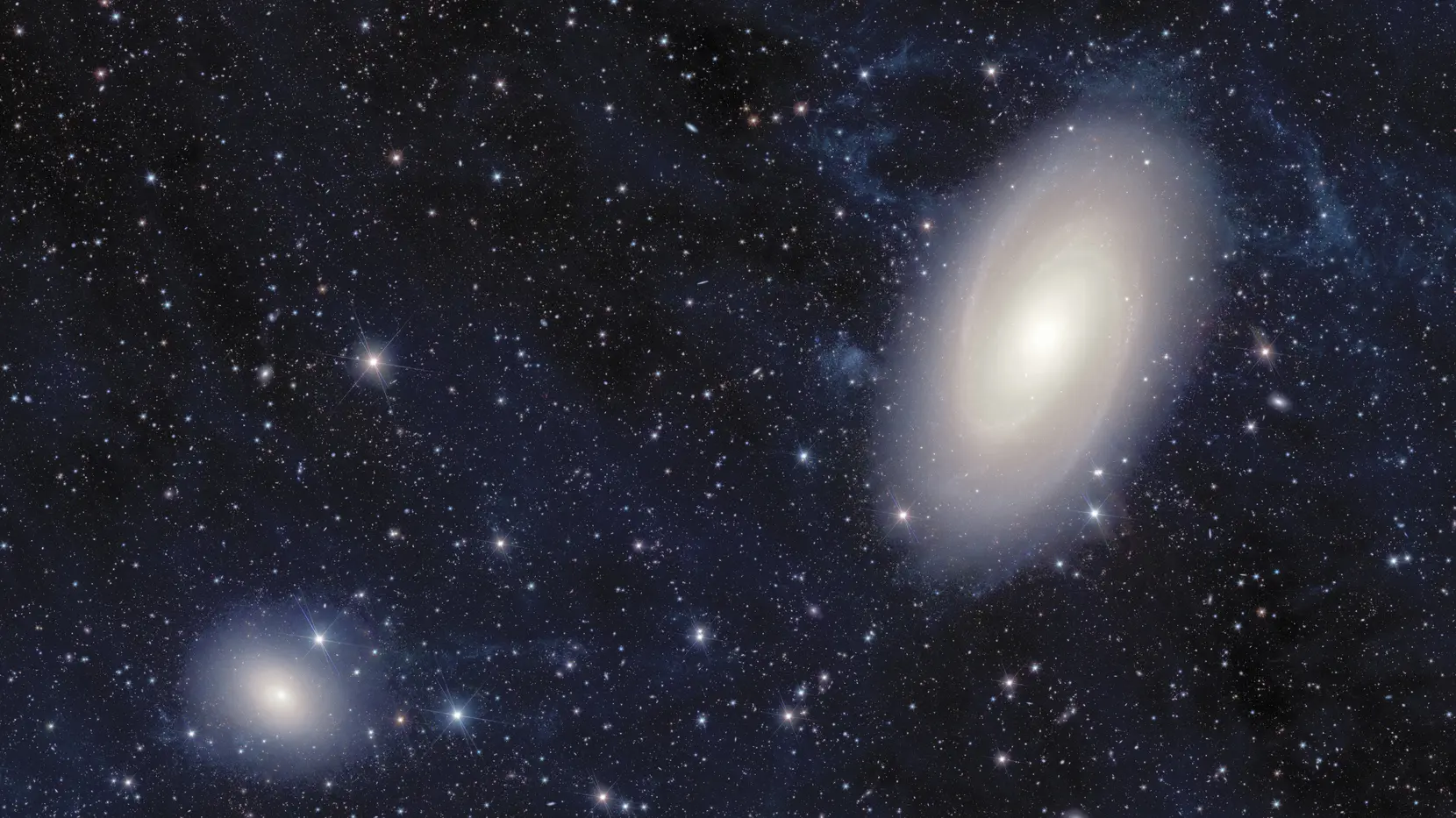
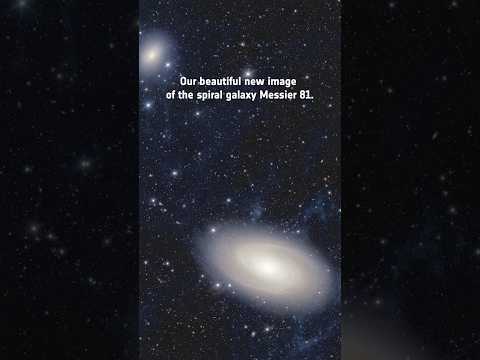
Messier 81, upper right, and NGC 3077, lower left, within Euclid’s northern survey. The Messier 81 group lies around 12 million light-years away. Wispy foreground structures are Galactic cirrus belonging to the Milky Way. Credit: ESA/Euclid/Euclid Consortium/NASA, image processing by J.-C. Cuillandre and E. Bertin
DR1-Foundation contains around 13 months of observations and marks Euclid’s first substantial public mission-data release. The Euclid Wide Survey portion covers approximately 1 900 deg², equivalent to about 9 500 full Moons, and contains light from more than one billion celestial objects.
The scientific importance of the release lies less in the size of any single image than in the transition to a common survey dataset from which cosmic structure can be reconstructed. Euclid combines wide-field imaging with spectroscopy, allowing astronomers to locate galaxies across the sky, estimate or measure their distances and eventually compare their distribution with the matter that distorts their light. DR1-Foundation establishes that observational base, but it does not yet contain the complete weak-lensing shape products required for Euclid’s principal cosmological analyses.
| DR1-Foundation metric | Verified value |
| Wide Survey area | Approximately 1 900 deg² |
| Share of planned Wide Survey | About 14% |
| Observing span represented | Around 13 months |
| Galaxies | More than 900 million |
| Strong-lens candidates | Around 15 000 |
| Quasar candidates | More than 60 million |
| Spectra | More than 160 million sources |
| Wide Survey data volume | Around 1.7 million GB (1.7 PB) |
| Northern mosaic | 367 deg², 740 observations, nearly 500 gigapixels |
| Southern principal mosaic | 148 deg², 370 observations |
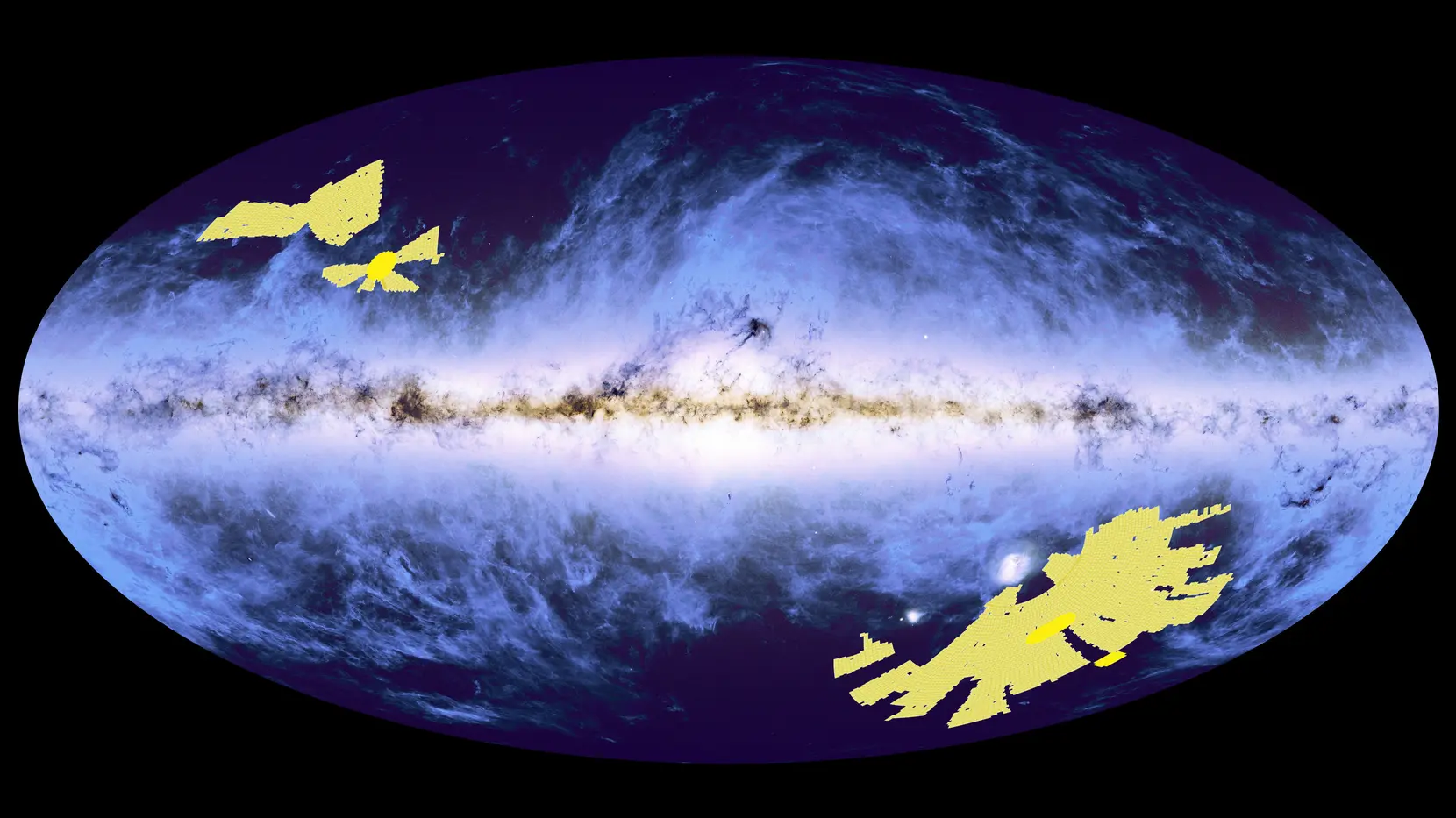
The release includes more than 900 million galaxies, around 15 000 strong gravitational-lens candidates, more than 60 million quasar candidates and spectra from more than 160 million sources. ESA reports around 1.7 million GB (1.7 PB) of data from the Euclid Wide Survey component of DR1-Foundation.
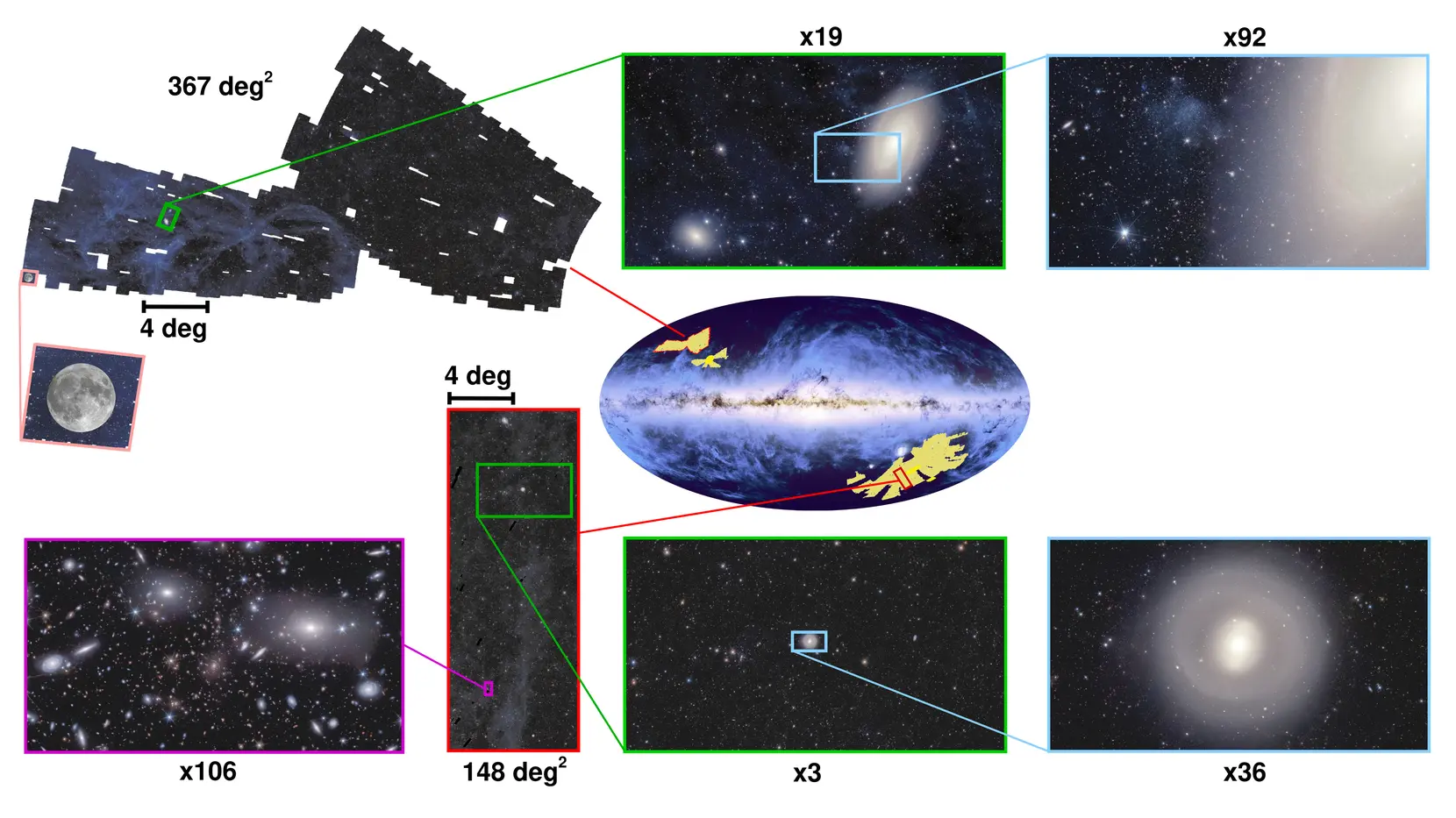
One of the release’s most striking products is the northern sky mosaic. It combines 740 observations collected during autumn 2024 and spring 2025, covers 367 deg² and contains nearly 500 gigapixels. A second principal mosaic covers 148 deg² of southern sky and combines 370 observations gathered over 18 observing days.
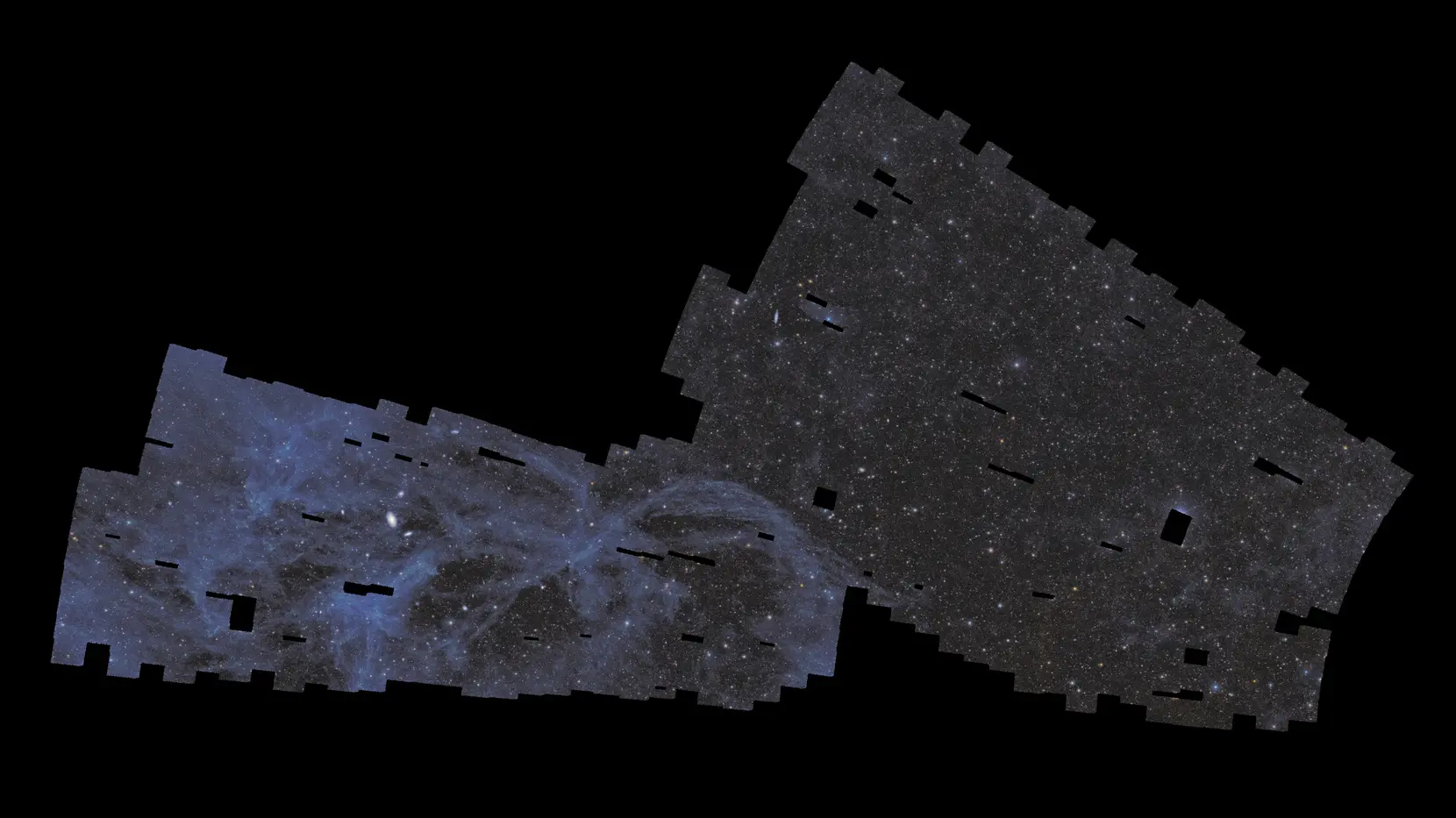
The northern mosaic is not equivalent to the entire DR1-Foundation dataset. Euclid’s observations are processed into calibrated images, catalogues, spectra and redshift measurements that can be compared within a common survey system. The large mosaic is therefore a visible representation of part of a much broader scientific data structure rather than a conventional single photograph.
Euclid observes through two complementary instruments. VIS records high-resolution visible-light images used to characterise the shapes and structures of astronomical sources. NISP, the Near-Infrared Spectrometer and Photometer, records near-infrared photometry and spectroscopy, adding information about source brightness, spectral features and distance.
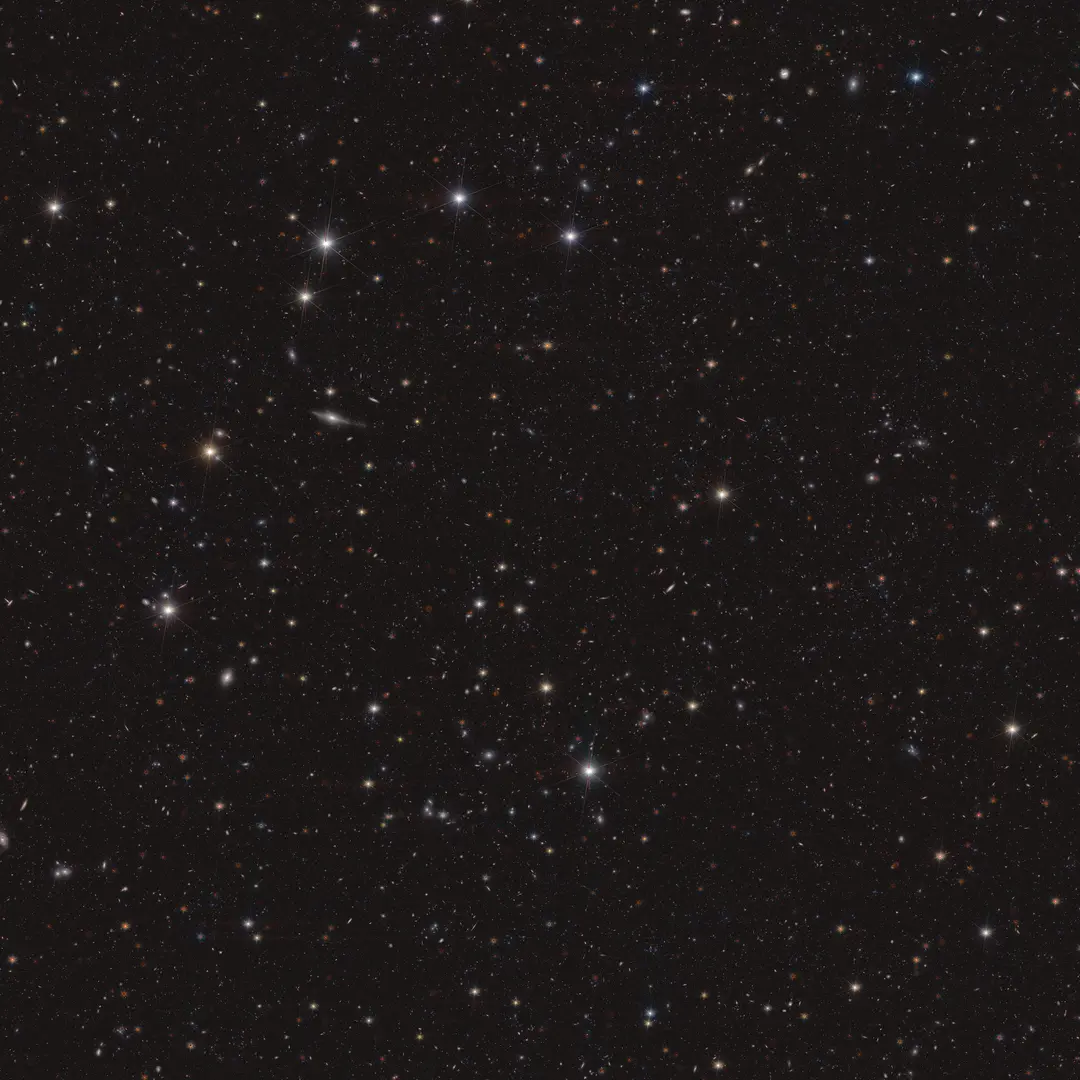
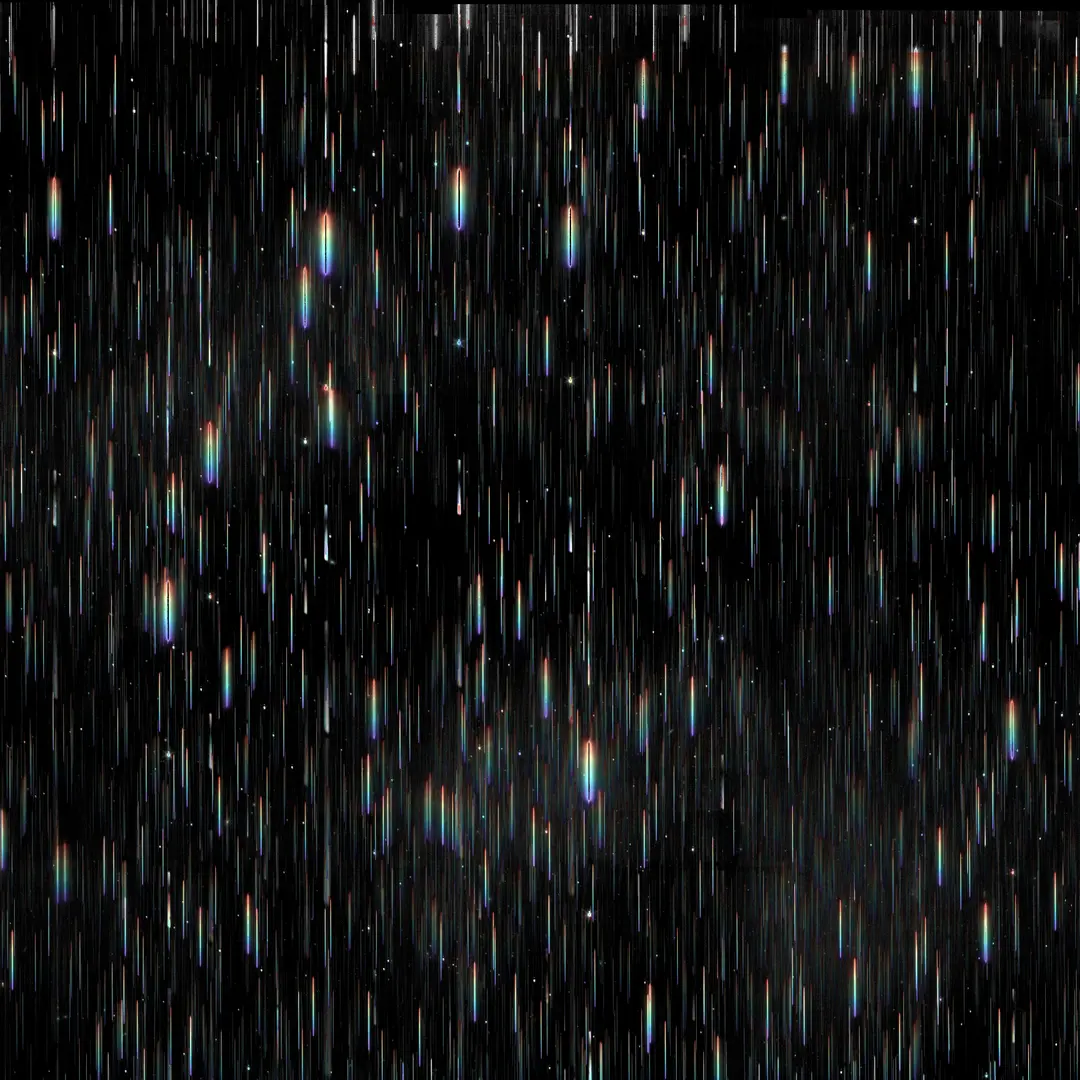
Spectroscopy supplies one route to the third dimension. Euclid disperses incoming light by wavelength, producing spectra in which characteristic emission or absorption features appear at defined positions. As the Universe expands, features from distant galaxies are shifted toward longer wavelengths. Measuring this redshift allows astronomers to determine how far along the line of sight a galaxy lies.
DR1-Foundation contains spectra from more than 160 million sources. Euclid researchers can search these spectra for features including hydrogen-alpha emission from star-forming regions in distant galaxies. Measuring the wavelength shift of such features allows galaxies to be placed at different distances within the cosmic web rather than only at positions projected across the two-dimensional sky.
What DR1-Foundation contains — and what is still to come
Available in DR1-Foundation: visible and near-infrared images, catalogues, spectra, photometric redshifts, spectroscopic redshifts, Wide Survey coverage across approximately 1 900 deg², Deep Field observations and calibration products.
Planned for the completion of DR1: galaxy-shape measurements, weak-lensing selection functions, galaxy-clustering selection functions, cluster-detection selection functions, cluster catalogues and higher-level products used to derive cosmological results.
Gravitational lensing provides another way of tracing matter. Gravity changes the path of light travelling through space. When enough mass lies between a distant source and the observer, the foreground mass acts as a lens and alters the apparent form of the background object.
Strong gravitational lensing produces readily visible effects such as arcs, rings and multiple images. DR1-Foundation contains around 15 000 strong-lensing candidates. ESA describes the collection as the largest strong-lens catalogue assembled so far and larger than previous strong-lensing catalogues combined.
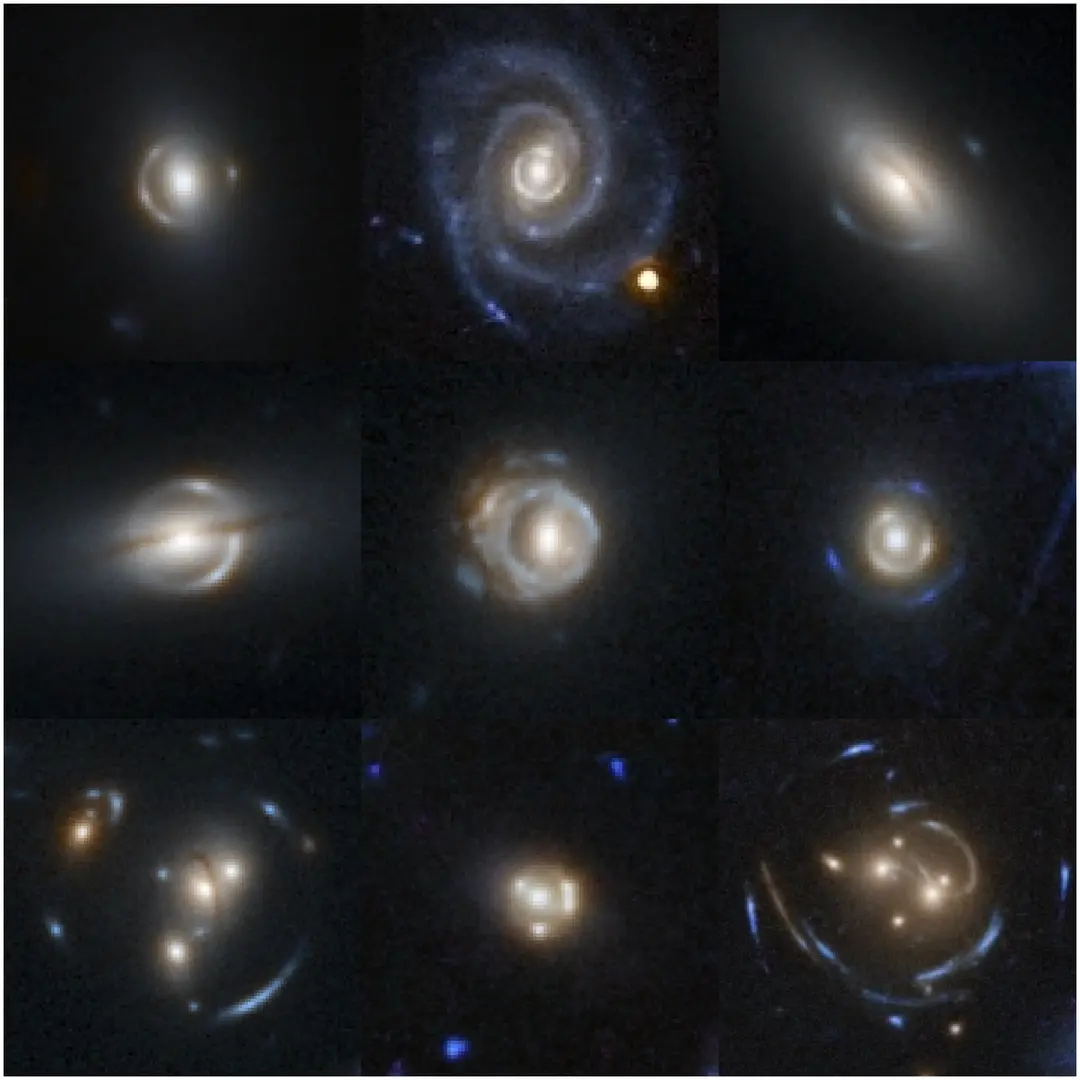
Strong lenses allow astronomers to constrain the total gravitational mass of foreground systems because stars, dark matter and central black holes all contribute to the bending of background light. The lenses can also magnify distant galaxies that would otherwise be too faint or too small to study in comparable detail.
Euclid’s principal cosmological programme also relies on weak gravitational lensing, a subtler effect in which the apparent shapes of large populations of galaxies are distorted by intervening matter. The distortion of any one galaxy is extremely small, so the signal is extracted statistically by measuring coherent patterns across enormous samples.
Euclid Collaboration: Mellier et al. (2025) describes weak lensing and galaxy clustering as central cosmological probes for the mission. Euclid is designed to combine high-resolution optical imaging with near-infrared imaging and spectroscopy over roughly 14 000 deg² of extragalactic sky. Those observations are intended to track both the geometry of cosmic expansion and the growth of large-scale structure.
The weak-lensing cosmology stage must not be confused with the products already released. ESA and the Euclid Consortium state that DR1-Foundation includes images, catalogues, spectra and photometric and spectroscopic redshifts, while the later completion of DR1 will add shape measurements and other higher-level products needed for the principal cosmological analyses.
DR1-Foundation establishes the observational foundation for Euclid’s later cosmological analysis; it is not the completed three-dimensional map or the mission’s final measurement of dark matter and dark energy.
That distinction defines the current scientific stage of the mission. Galaxy positions and redshifts can begin locating luminous matter within three-dimensional structure, while the later shape measurements will supply the statistical lensing signal needed to trace the projected matter distribution. The combined analyses are designed to test how structure grew as the Universe expanded.
Keep reading
The Wide Survey also contains astronomical structures at very different distances. In the northern survey, the Messier 81 galaxy group lies around 12 million light-years from Earth. Euclid’s resolution is sufficient to distinguish individual stars in Messier 81 when the full-resolution data are examined.
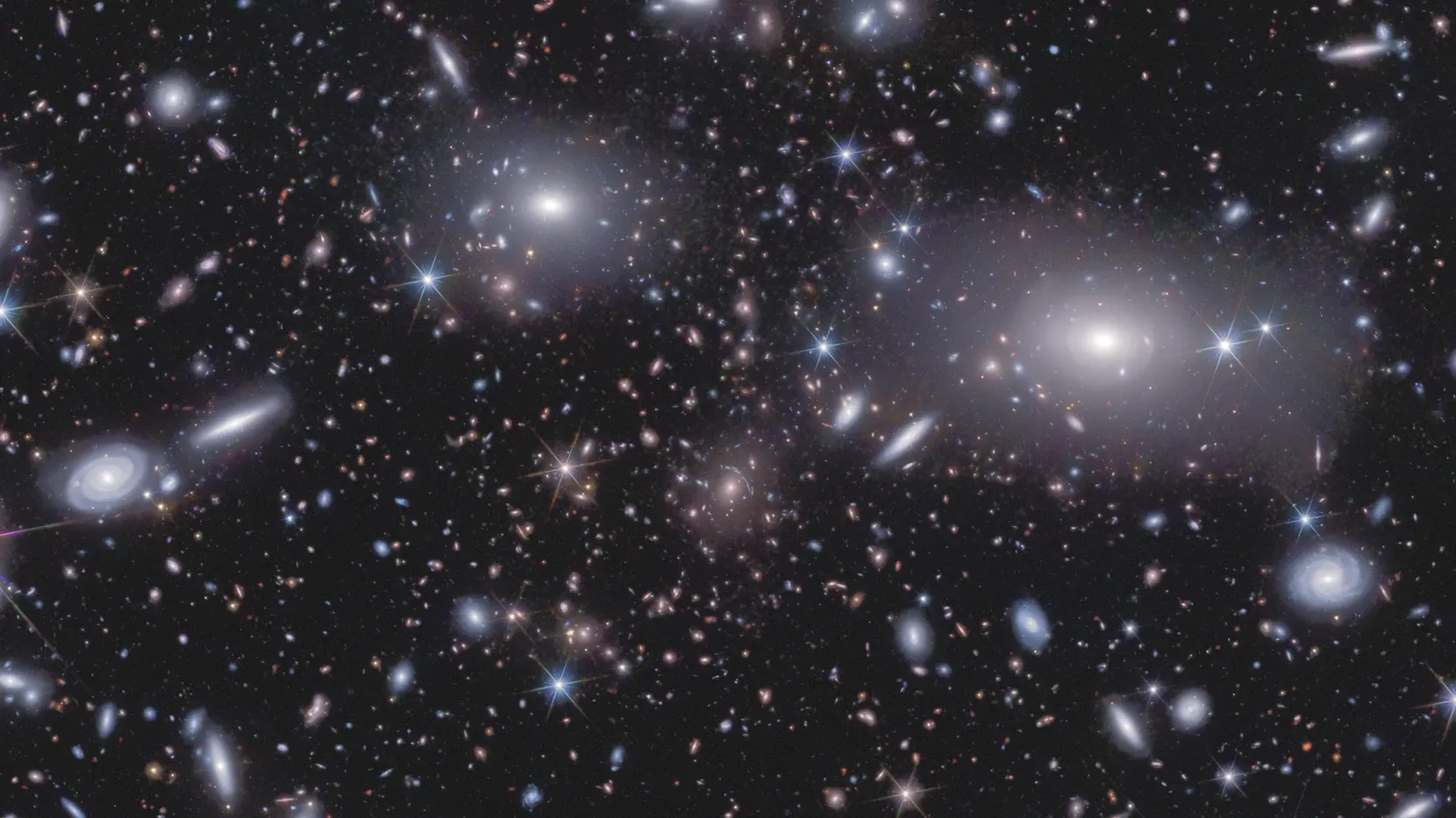
Euclid’s southern survey includes the Horologium supercluster, located around 800 million light-years away and made up of more than 30 smaller galaxy clusters. The southern principal mosaic covers 148 deg², around 740 times the apparent area of the full Moon.
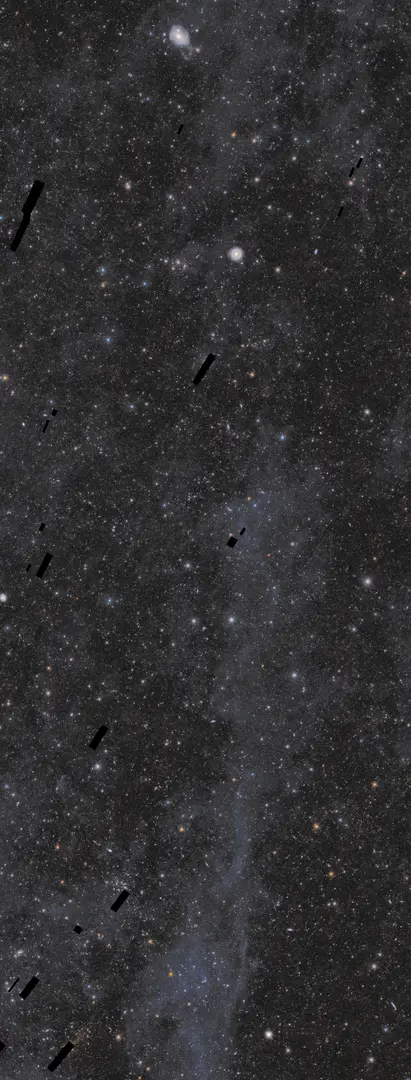
One of the richest members of the Horologium supercluster is Abell 3128, a cluster containing hundreds of galaxies at a distance of around 800 million light-years. Euclid’s high-resolution view also captures another galaxy cluster, ACT-CL J0330-5227, along nearly the same line of sight even though the two clusters are separated by around 5 billion light-years in physical distance.
The approximately 1 900 deg² included in DR1-Foundation represent about 14% of Euclid’s planned Wide Survey. The mission paper describes a final extragalactic survey of roughly 14 000 deg². The November release therefore substantially increases the amount of Euclid survey data available for scientific analysis while still covering only a minority of the mission’s planned area.
ESASky provides interactive visual exploration of Euclid observations alongside other astronomical datasets. Euclid Data Space connects data discovery, visualisation and analysis tools, including the Euclid Science Archive and ESA Datalabs, so researchers can work with large datasets without transferring the complete archive to local systems.

Euclid began routine science observations on February 14, 2024. Earlier public releases demonstrated the telescope’s imaging quality and sampled smaller survey areas. DR1-Foundation moves the mission into a different regime by providing a common dataset containing hundreds of millions of galaxies, large spectroscopic samples and rare systems such as strong gravitational lenses across a much wider footprint.
The mission’s broader objective is to investigate how visible galaxies, total matter and cosmic expansion relate to one another over roughly the last 10 billion years of cosmic history. Dark matter is inferred from its gravitational effects rather than detected through emitted light, while dark energy is the name given to the still-unexplained component associated with the accelerated expansion of the Universe.
Euclid is designed to constrain those components through the geometry and growth of large-scale structure rather than detect dark matter or dark energy directly. The value of DR1-Foundation is therefore that it begins supplying the large, internally consistent observational sample needed for that programme while leaving several central cosmological measurements for subsequent data products.
The next major scientific boundary will come with the completion of DR1, when galaxy-shape measurements, weak-lensing selection functions, galaxy-clustering products, cluster products and other higher-level datasets can be analysed together with the images, spectra and redshifts already released. That combination will determine how much of Euclid’s planned cosmological precision can be realised from the first full data release.
References:
1 Euclid Collaboration, Mellier, Y., Hoekstra, H., & Smith, G. P. (2025). Euclid: I. Overview of the Euclid mission. Astronomy & Astrophysics, 697, A1. DOI: 10.1051/0004-6361/202450810
2 Euclid lays the foundation for its best-ever 3D map of the Universe – European Space Agency – November 12, 2026
3 Euclid Explanatory Supplement: Data Release DR1-Foundation – European Space Agency and Euclid Consortium – November 23, 2026
4 Zoom into Euclid’s 500 gigapixel mosaic of the Universe – European Space Agency – November 12, 2026
5 Euclid’s Wide and Deep Surveys (DR1-Foundation) – European Space Agency – November 12, 2026
6 Explore Euclid’s largest-ever catalogue of cosmic lenses – European Space Agency – November 12, 2026
7 Spectroscopy: How and why ESA’s Euclid splits cosmic light into rainbows – European Space Agency – November 11, 2026

Rishav Kothari is Editor-in-Chief of The Watchers, where he runs the newsroom and covers earthquakes, volcanoes, severe weather and space weather.
More reporting
- Asteroid 44 Nysa may have three connected lobes and a small satellite
- Twelve grains of Kuiper Belt dust preserve evidence of an ancient water reservoir beyond the giant planets
- Straight-edged craters expose Pluto’s buried tectonic history
- Two-Earth-mass planet model reproduces distant Solar System orbits standard models miss
