
G2 geomagnetic storm watch issued for May 15, aurora possible across northern U.S.
A G2 – Moderate geomagnetic storm watch is in effect for May 15, 2026, due to the anticipated impact of a corotating interaction region (CIR) associated with a negative polarity coronal hole high speed stream (CH HSS). G1 conditions are forecast for May 16 and 17.
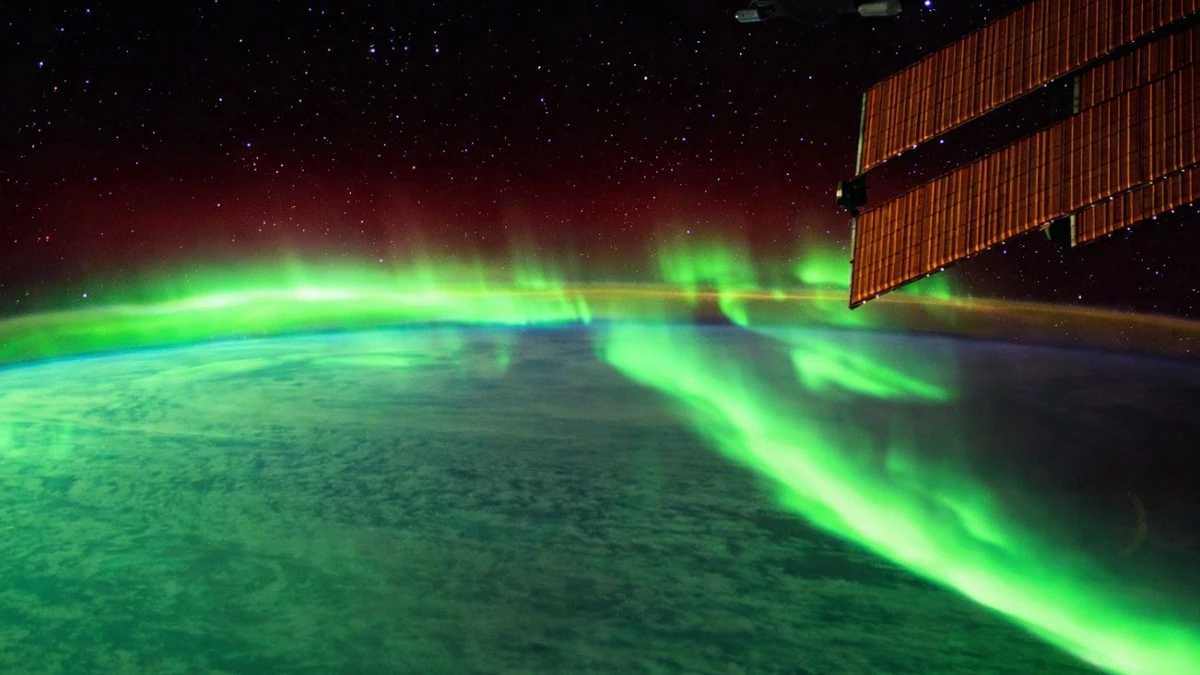
Aurora viewed from International Space Station as it crossed over the southern Indian Ocean on September 11, 2011. Credit: NASA
The forecast marks a shift from quiet to unsettled geomagnetic conditions on May 14 to expected storming on May 15 as the CIR linked to the negative polarity CH HSS reaches Earth.
The geomagnetic field might reach active conditions on May 14 if a sustained negative Bz period occurs, while G2 storming conditions are likely on May 15 due to the anticipated CIR impact. Active to G1 storm levels are expected to prevail on May 16 and into May 17 due to lingering CH HSS influence.
Possible high latitude impacts from the G2 storm include power grid fluctuations and voltage alarms in high latitude power systems. Spacecraft operations may experience satellite orientation irregularities, increased drag on low Earth orbit satellites is possible, while HF radio propagation may fade at higher latitudes during the storm period.
Aurora may be visible as far as New York, Wisconsin, and Washington state.
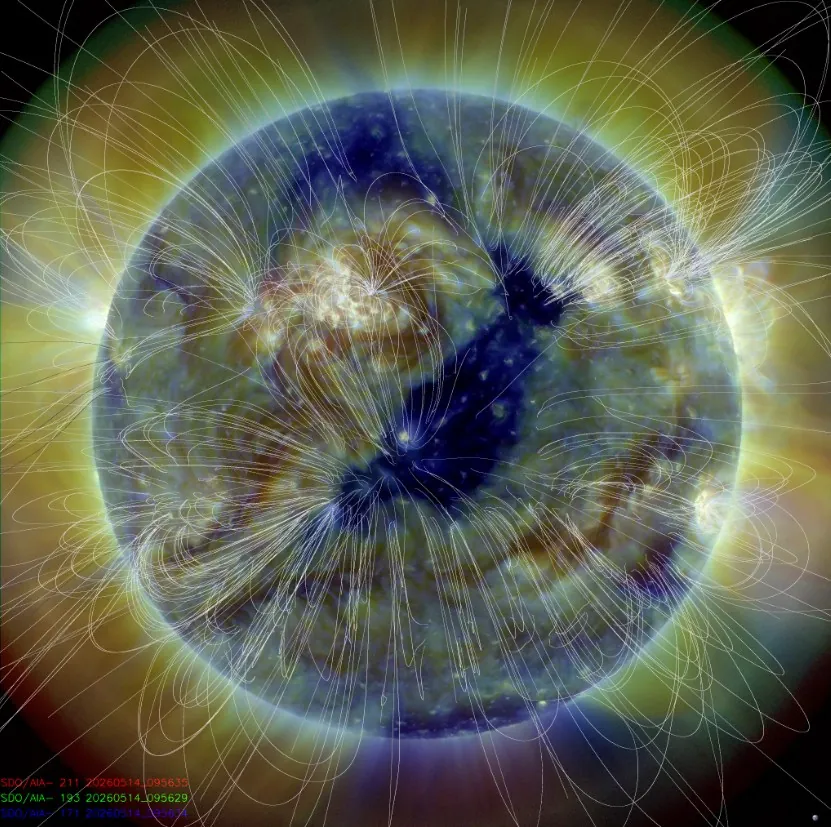

Solar wind parameters in 24 hours to 12:30 UTC on May 14 reflected the waning effects of a positive polarity CH HSS combined with a glancing blow from a coronal mass ejection (CME) that left the Sun on May 10. Total magnetic field strength decreased from 13 nT to 5 nT levels, while solar wind speed slowly dropped from about 500 km/s to 400 km/s levels by the end of the period.
Near Earth solar wind parameters are expected to continue reflecting waning positive polarity CH HSS influence through the end of the May 14. On May 15 and 16, a CIR associated with a negative polarity CH HSS is anticipated to impact Earth, producing more disturbed solar wind conditions.

Solar activity remained at low levels, with four active regions on the visible disk and only C-class activity. Region 4435 (beta) showed some growth and produced most of the C-class flares of May 14, including a C5.5 event that peaked at 06:42 UTC. Region 4436 (beta) produced three minor C-class flares between 16:30 and 18:30 UTC on May 13.
Solar activity is forecast to remain predominantly at low levels, with a chance for M-class flares through May 16. The greater than 2 MeV electron flux is expected to remain at moderate levels through May 16, while the greater than 10 MeV proton flux is expected to stay at background levels.
References:
1 Forecast Discussion – NOAA/SWPC – 12:30 UTC on May 14, 2026

I'm a dedicated researcher, journalist, and editor at The Watchers. With over 20 years of experience in the media industry, I specialize in hard science news, focusing on extreme weather, seismic and volcanic activity, space weather, and astronomy, including near-Earth objects and planetary defense strategies. You can reach me at teo /at/ watchers.news.

Commenting rules and guidelines
We value the thoughts and opinions of our readers and welcome healthy discussions on our website. In order to maintain a respectful and positive community, we ask that all commenters follow these rules.