
Black kites and brown falcons in northern Australia have been seen snatching smoldering sticks from wildfires, flying them into unburned grass and dropping them, starting new fires that send lizards, rodents and insects running straight toward the waiting birds
Black Kites, Whistling Kites and Brown Falcons in northern Australia have been reported picking up burning or smoldering sticks at active fires, carrying them beyond the fire front and dropping them into unburned vegetation, with several observers describing new grass fires and prey flushed from burning areas. A 2017 peer-reviewed study argues that some of this behavior is deliberate hunting, but its case rests on Indigenous Ecological Knowledge, historical records and eyewitness observations rather than a controlled behavioral experiment.
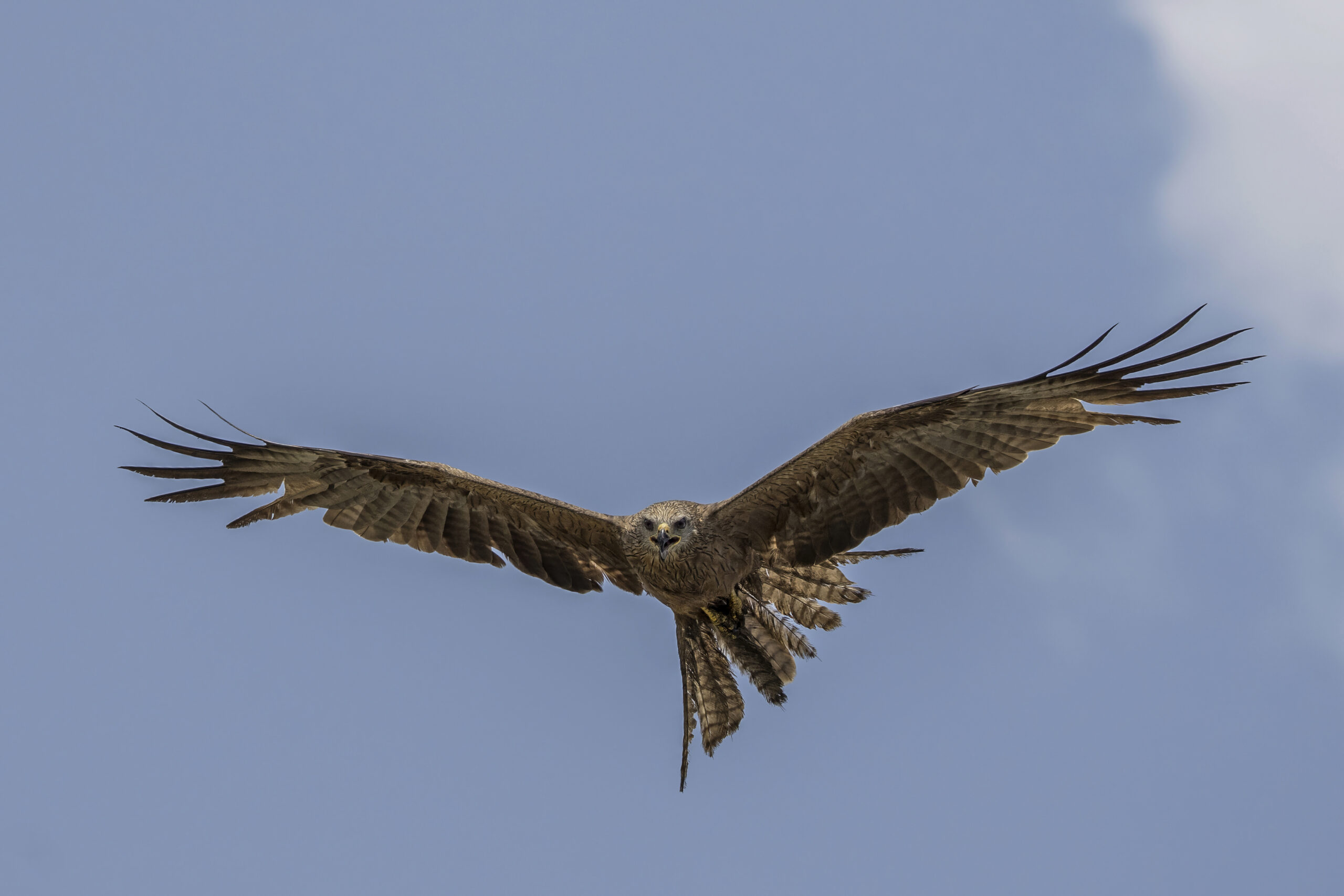
Black Kite (Milvus migrans affinis) in flight at Adelaide River, Northern Territory, Australia, on November 5, 2023. The image shows one of the principal raptor species associated with reported fire-spreading behavior. Credit: Charles J. Sharp / Wikimedia Commons (CC BY-SA 4.0)
Raptors gathering at active fires to hunt fleeing animals are well documented in tropical savannas. The behavior at the center of Bonta et al. (2017) is narrower: a bird picks up a burning or smoldering object, carries it away from the existing fire and releases it where unburned vegetation can ignite. The researchers called this fire-spreading and distinguished it from ordinary fire-foraging at a fire front.
The study combined published ethnographic and ornithological material with interviews and field research conducted between 2011 and 2017. Its mapped evidence includes knowledge and reports from seven non-Aboriginal informants and 12 Aboriginal groups across Western Australia, the Northern Territory and Queensland. The paper’s table contains 20 numbered records, but these are not 20 equivalent modern eyewitness observations; they include Indigenous Ecological Knowledge, historical accounts, direct observations and indirect reports.

Accounts of the behavior long predate the 2017 paper. One of the best known was recorded in Douglas Lockwood’s 1963 book I, The Aboriginal from Waipuldanya, an Alawa man also known as Philip Roberts. His account described a firehawk carrying a smoldering stick into dry grass and then waiting with other birds as rodents and reptiles escaped the new fire. Bonta and colleagues discussed the account as part of the evidence while cautioning that Lockwood’s retelling was less rigorous by modern ethnographic standards.
More recent direct observations were supplied by two of the study’s coauthors. While passing a smoky roadside fire on Cape York Peninsula in Queensland, Dick Eussen saw Black Kites working around the smoke and sparks. He reported that one bird lifted a smoking stick but dropped it on the road. Another carried a smoking stick across the road and released it into unburned grass, which soon flared.
Eussen described another encounter from the Ranger Uranium Mine near Kakadu in the Northern Territory, where he had worked as a firefighter. After a grass fire had burned itself out, he saw a Whistling Kite about 20 m (66 feet) ahead of him carrying a smoking stick in its talons. According to his account, the bird dropped it into dry grass, smoke began to rise and a spot fire formed. Eussen reported extinguishing seven fires during the episode and attributed all seven to the kites. Approximately 25 kites were foraging around the dying fire, but only two were described as adept at transporting smoking sticks.

Nathan Ferguson, then officer in charge of the Tennant Creek fire station, reported observing fire-spreading about a dozen times since 2001. Observations that stood out to him included events around 2000–2001 and in September 2016, when a small number of birds among much larger gatherings carried burning sticks more than 50 m (164 feet) and dropped them into unburned grass that ignited. His March 2017 observation instead involved unsuccessful attempts to transport burning material.
The reported geographic range is extensive. Bonta et al. described fire-spreading knowledge and observations across an approximately 2 400 km (1 490 miles) east-to-west and 1 000 km (620 miles) north-to-south swath of northern Australia. The authors did not conclude that the behavior was common among all birds. Ferguson encountered it repeatedly, while other experienced observers remembered seeing it only once during an entire career in the bush.
Species identification presents another difficulty. The paper centers on the Black Kite (Milvus migrans), Whistling Kite (Haliastur sphenurus) and Brown Falcon (Falco berigora), but the authors cautioned that smoke, distance and fast-moving activity around fires can make northern Australian raptors difficult to distinguish even for experienced observers. Some historical records use general names such as “firehawk” without establishing which species was involved.
Indigenous Ecological Knowledge forms part of the evidence base rather than background added after the observations. The researchers documented firehawk knowledge among multiple Aboriginal groups and connected some accounts with ceremonies including Lorrkon and Yabuduruwa. They excluded some unpublished first-hand Indigenous material from the paper while questions of cultural permission, protection of sacred knowledge and appropriate participation in the research were being addressed.
Mark Bonta later stressed that the scientific paper should not be framed as the discovery of something previously unknown to Aboriginal people. “This is not a new discovery,” he told Penn State in 2018. The study instead brought Indigenous knowledge together with historical literature and observations from firefighters, land managers and other witnesses for examination in the scientific literature.
The central scientific uncertainty concerns intent. Earlier observers proposed that a raptor diving at prey could accidentally grasp a hot stick and release it after discovering the mistake. Bonta and colleagues argued that deliberate fire-spreading would be more firmly established by showing that birds selectively pick up burning material and selectively deposit it where combustible vegetation can ignite.
The researchers solicited photographs and video from witnesses but reported receiving nothing viable. In their discussion they also said they knew of no published experimental tests of the fire-spreading hypothesis. Those limitations are important because observing a bird move burning material and seeing a new fire start does not, by itself, reveal the cognitive process behind the behavior.
The prey described in the source material also comes from several observations rather than one repeated sequence. Waipuldanya’s account described rodents and reptiles leaving newly burning vegetation, while the wider literature reviewed in the paper describes raptors hunting grasshoppers and other vertebrate and invertebrate prey around fire fronts. Fire clearly creates feeding opportunities for these birds, but the evidence does not show that every reported fire-spreading episode produced the same combination of prey.
The possible consequences extend beyond animal behavior. The paper states that Aboriginal rangers, firefighters and other land managers take the possibility of avian fire-spreading into account because transported burning material could cross roads, waterways or human-made firebreaks. The study did not quantify how often birds cause such spot fires or what proportion of escaped burns they account for.
That limitation matters when the behavior is connected to large Australian wildfires. Robert Gosford, a coauthor of the study, told AFP in 2021 that fires involving these birds could potentially become large, but that the research team had no evidence showing that firehawks had caused large-scale fires. The study therefore does not support attributing major Australian wildfire outbreaks to raptors.
The evidence instead describes individual birds or small subsets of larger raptor gatherings moving burning material, sometimes successfully and sometimes unsuccessfully. It does not establish that every member of the three species performs the behavior, that fire-spreading is frequent, or that raptors account for a substantial share of wildfire ignitions.
Bonta and colleagues proposed controlled burns with trained observers and recording equipment as a way to test the behavior more rigorously. Such work could establish what objects birds select, how often burning material is transported, where it is released, whether fresh vegetation ignites and what the birds do afterward. The unresolved scientific task is to distinguish the observed transport of fire and the extensive Indigenous and eyewitness record from the stronger claim that raptors deliberately manipulate fire as a hunting tool.
References:
1 Bonta, M., Gosford, R., Eussen, D., Ferguson, N., Loveless, E., & Witwer, M. (2017). Intentional fire-spreading by “firehawk” raptors in northern Australia. Journal of Ethnobiology, 37(4), 700–718. DOI: 10.2993/0278-0771-37.4.700
2 Firehawks: Do they intentionally spread fire to aid in food collection? – Penn State University – February 22, 2018
3 Posts falsely claim video shows fire-emitting bird that causes forest fires – AFP Fact Check – December 21, 2021

I’m a science journalist and researcher at The Watchers, contributing to the Epicenter edition, where I cover peer-reviewed scientific research and emerging discoveries across Earth and space sciences. With a background in astronomy and a passion for environmental science, I’ve worked in shark and coral conservation in Fiji, conducting reef and shark-behavior research, contributing to mangrove restoration, and earning PADI Open Water and Coral Reef Certifications. I bring a blend of scientific rigor and storytelling to illuminate the discoveries shaping our planet and beyond.
Published in the last 24 hours
- A levee protecting a highway north of San Francisco is pocked with animal burrows and only 3 feet wide in places, and a report warns this winter's El Niño could push water over the top Epicenter
- In January 2000, chunks of ice weighing up to 6 pounds fell out of clear blue skies over Spain for 10 days. One smashed through a car windshield, and scientists still can’t fully explain where they came from Epicenter
- The fastest wind gust ever measured on Earth, 253 mph, hit an oil island off Australia during Cyclone Olivia in 1996, and nobody noticed for more than a decade, until experts reading old data quietly took the record from New Hampshire's Mount Washington Epicenter
- The people who pay closest attention to the weather are the ones storms have already cost the most, a study of 946 students found, with one damaging storm making little difference to how much attention a student paid, but two or more making a clear one Epicenter
