
Polar vortex winds at 60°N drop from 22.13 to 5.44 m/s in eight days in rare November disruption; major SSW remains forecast
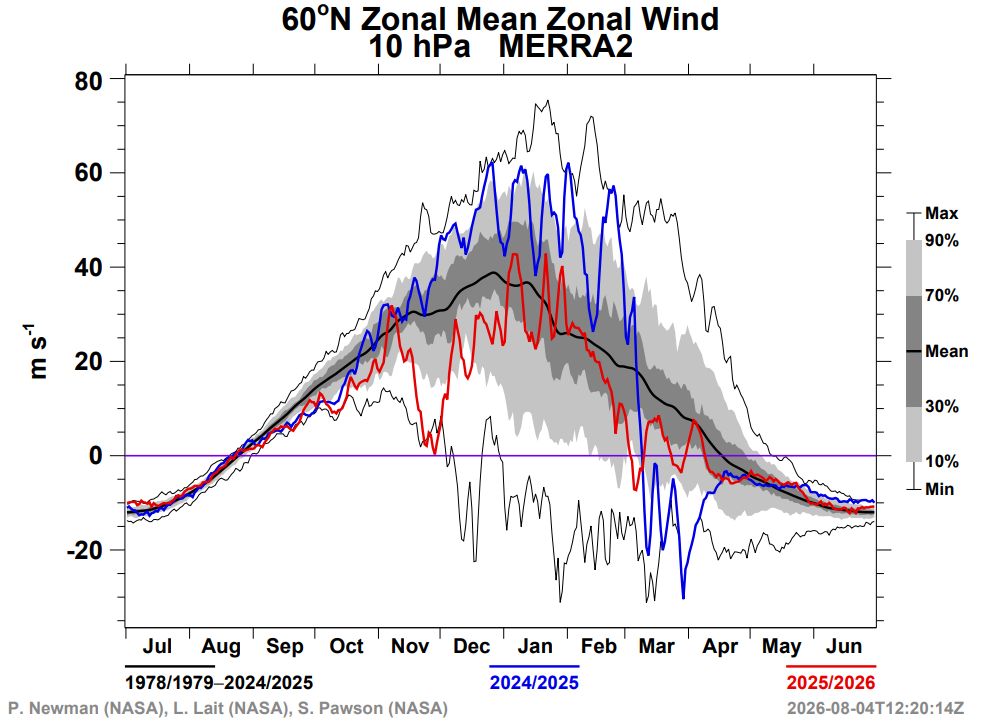
A rare November disruption of the Northern Hemisphere stratospheric polar vortex is underway, with the daily-mean wind at 60°N and 10 hPa weakening from 22.13 m/s (49.5 mph) on October 25 to 5.44 m/s (12.2 mph) on November 2, 2026. Forecast guidance continues to indicate a possible brief reversal during the second week of November, which would meet the defining wind-reversal threshold used to identify a major sudden stratospheric warming, while any surface-weather response remains uncertain
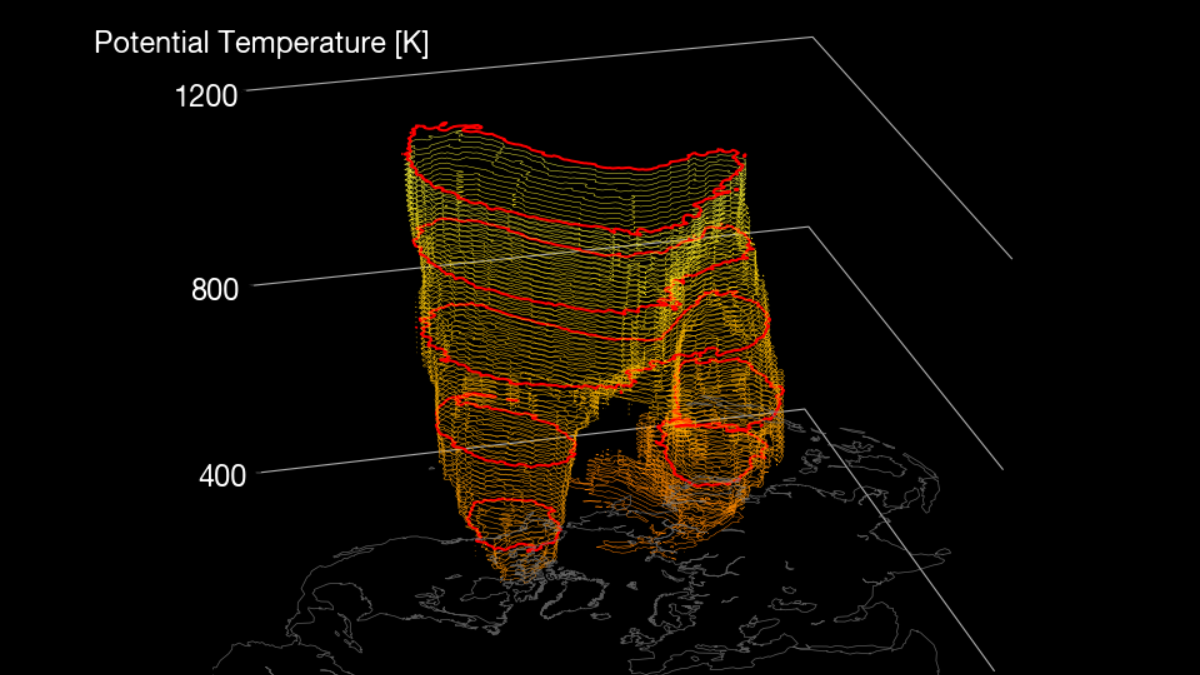
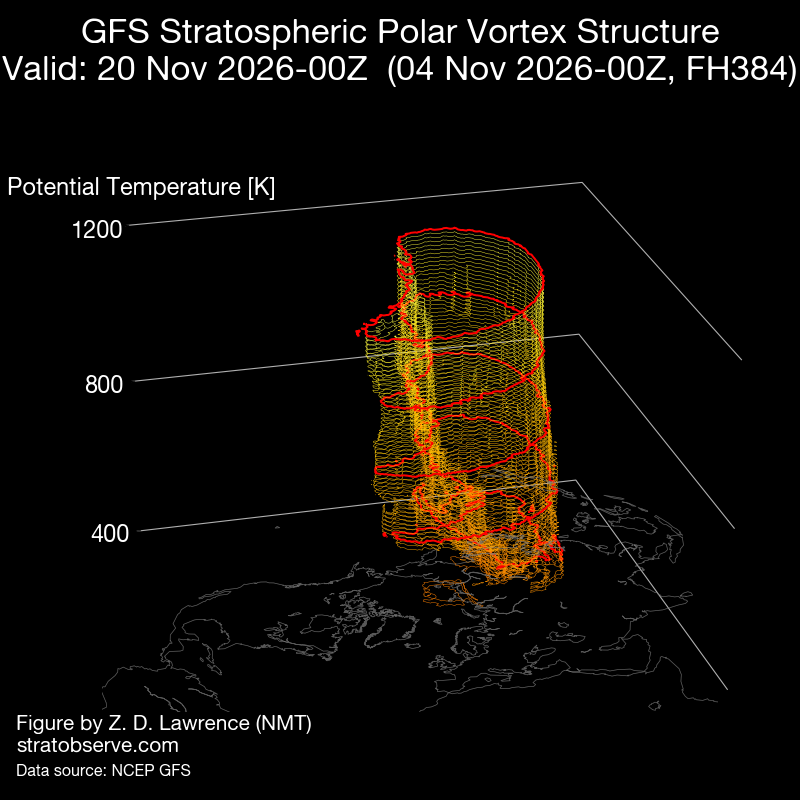
3D visualization of Stratospheric Polar Vortex for November 5 2026. Credit: StratObserve
NASA Ozone Watch’s GEOS-FP series placed the November 2 wind well below the 1978/79–2025/26 climatological mean of 25.62 m/s (57.3 mph) and the previous minimum of 13.68 m/s (30.6 mph) for that date. The same series forecast daily-mean winds below zero from November 9–11 before a return to westerly flow on November 12.
On November 4, the UK Met Office said the vortex was already unusually stretched and that strong wave-two activity was disturbing it from opposite directions. The disturbance was producing warming above the North Pole, while forecasts indicated the vortex would become increasingly displaced.
Many European Center for Medium-Range Weather Forecasts (ECMWF) ensemble members indicate that the stratospheric winds could briefly reverse during the following week. The Met Office described the expected reversal as relatively weak and short-lived and said uncertainty remained over whether a major SSW would occur.
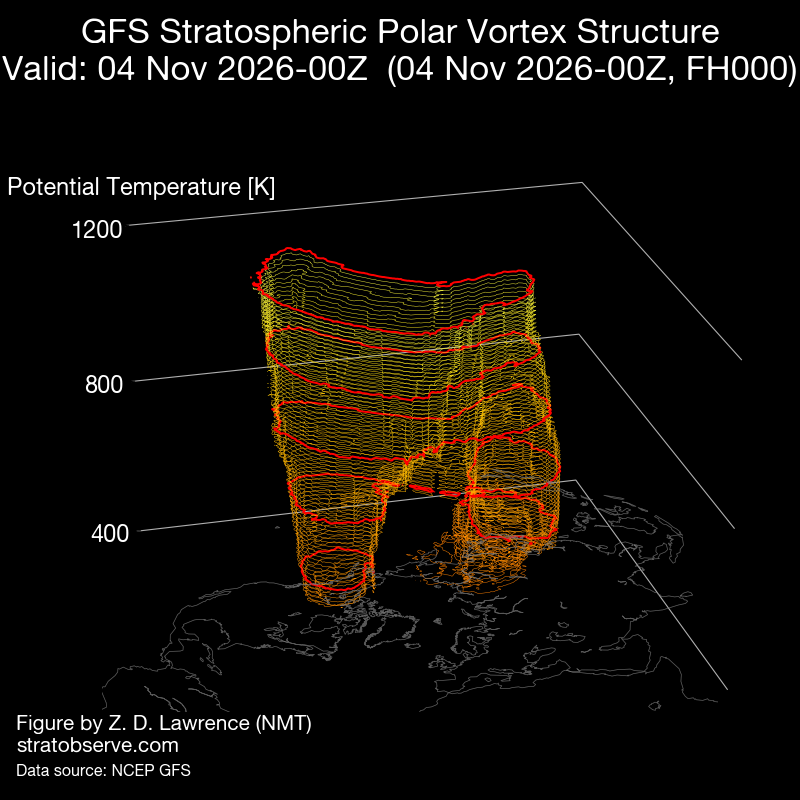
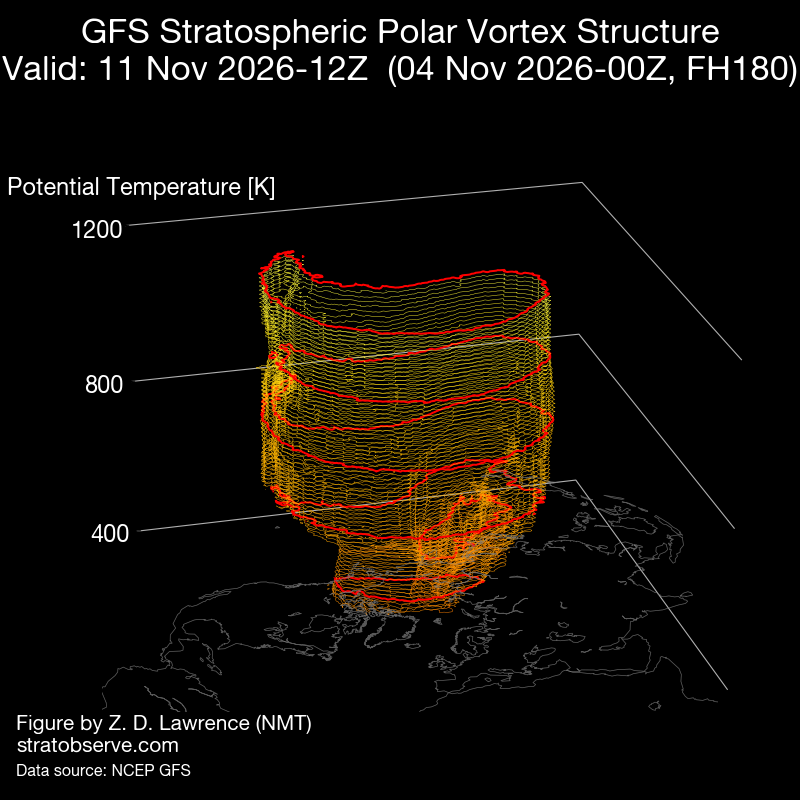
The U.S. Climate Prediction Center (CPC) described the pattern as a rare November stratospheric polar-vortex disruption in its Week 3–4 discussion issued at 19:00 UTC on October 30. Guidance at that time indicated a transition into a major SSW about one week later and projected a shift toward a negative Arctic Oscillation.
CPC’s November outlook, issued at 19:00 UTC on October 31, retained the more conditional assessment that a transition into an SSW was possible during the following week. It said SSW-related circulation effects can persist for up to two months, although their duration and regional expression vary between events.
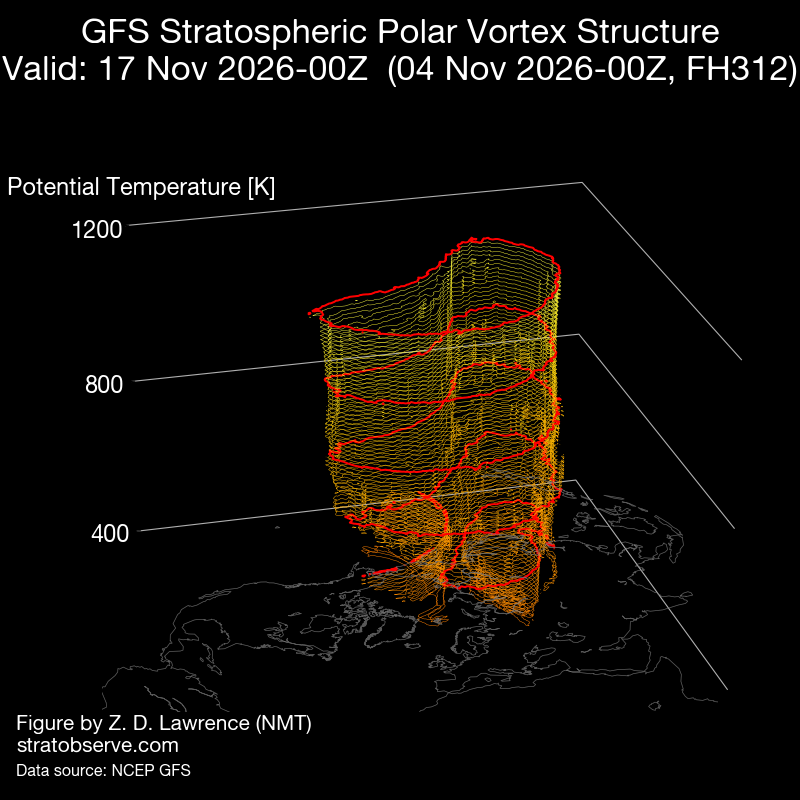
NOAA’s Sudden Stratospheric Warming Compendium identifies major midwinter SSWs through a reversal of the daily-mean zonal-mean zonal wind at 60°N and 10 hPa from westerly to easterly between November and March. Its event-separation criteria require winds to return to westerly for 20 consecutive days between events and for at least 10 days before April 30.
The compendium, which currently covers reanalysis data through 2023, lists a November 1958 event on November 30 in the NCEP-NCAR reanalysis. A November 1968 event is dated between November 27 and 29, depending on the reanalysis product.
A qualifying reversal during the second week of November 2026 would therefore occur more than two weeks earlier than the November events listed in the NOAA dataset. The comparison is specific to that compendium and should not be described more broadly as a complete current observational record.
The developing stratospheric signal is adding uncertainty to the U.S. early-winter outlook. CPC said the possible SSW and forecast negative Arctic Oscillation could compete with circulation patterns linked to El Niño, particularly over the eastern United States
The November outlook nevertheless continued to favor above-normal temperatures across substantial parts of the country. CPC did not present the possible SSW as evidence of an impending widespread cold outbreak.
In its October 8 ENSO discussion, CPC repoted that El Niño was continuing to strengthen, with a greater than 83% probability of a strong-to-very-strong event persisting through January–March 2027.
CPC’s November–January outlook, issued on October 15, favored above-normal mean temperatures across eastern Alaska, the northern tier and western third of the contiguous United States, South Florida, the Ohio Valley and the Mid-Atlantic.
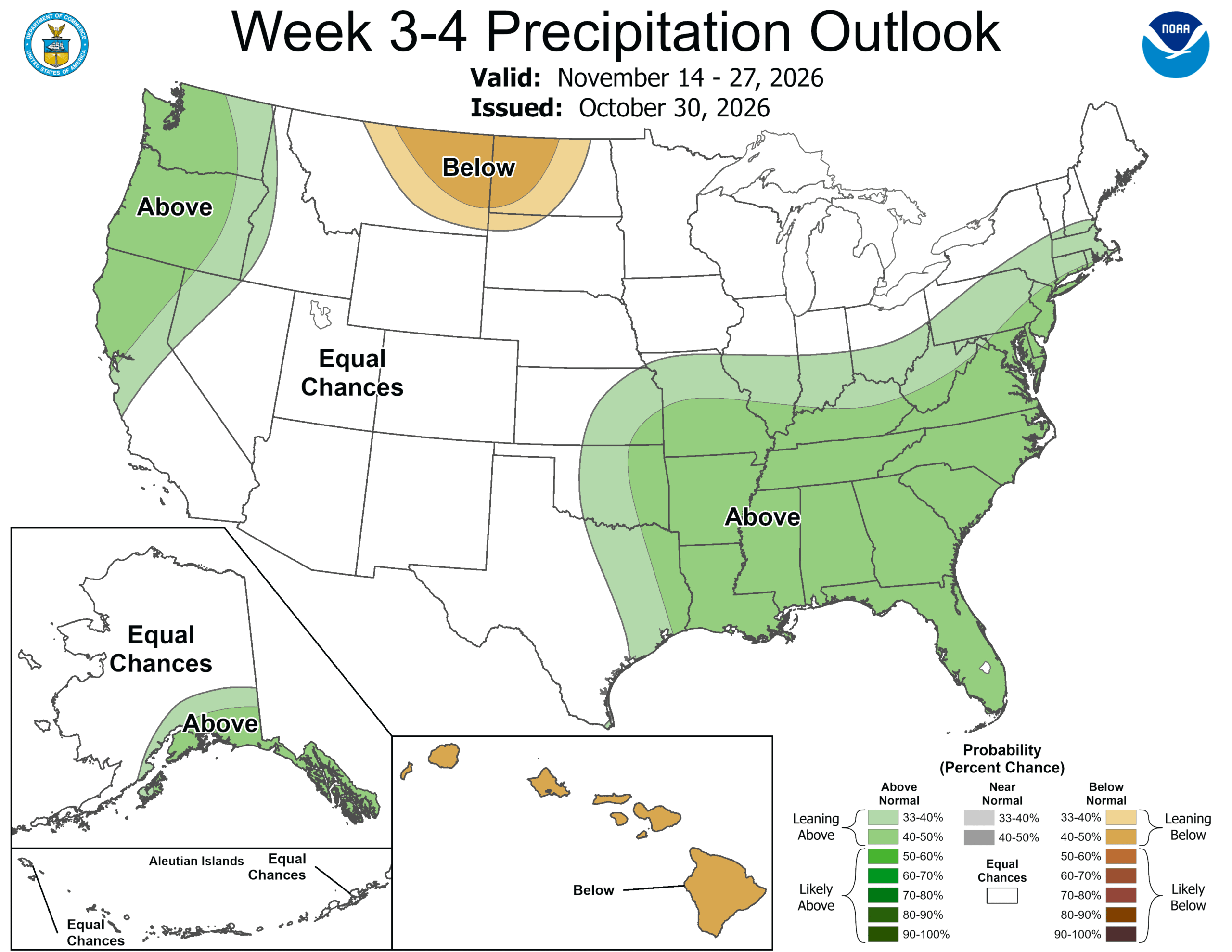
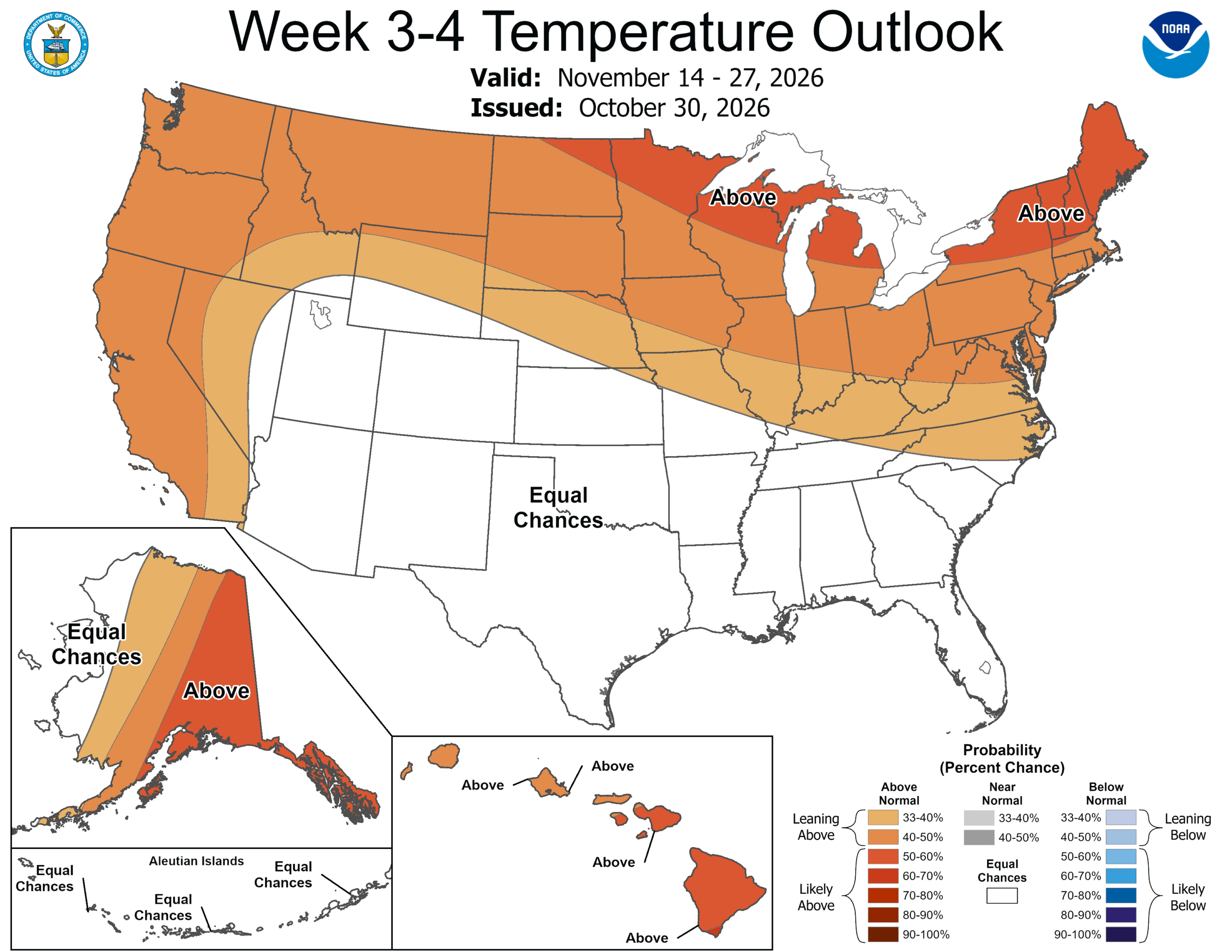
For November 14–27, CPC retained enhanced probabilities of above-normal temperatures along much of the western coastline and northern tier. The potential SSW was treated as one of several competing influences and a source of forecast uncertainty, rather than as a deterministic cold signal.
SSW events can influence surface weather when their circulation anomalies propagate into the troposphere. Environment and Climate Change Canada’s 2026 assessment states that post-SSW patterns often resemble the negative phase of the North Atlantic Oscillation and can favor warmer-than-normal conditions in eastern Canada.
For Europe, a major SSW would indicate the possibility of a later circulation change, not a deterministic forecast of cold or snowfall. Surface effects would depend on whether and when the disturbance propagates into the troposphere and on the atmospheric circulation present at that time.
The Met Office said any downward influence would generally develop over approximately two to six weeks and would not necessarily produce snow or severe cold. No authority source cited here forecasts a Europe-wide cold outbreak from the developing disturbance.
Until a negative analyzed daily-mean wind is confirmed at 60°N and 10 hPa, the vortex disruption is observed, a major SSW remains forecast, and downstream weather effects remain uncertain.
References:
1 2026/2027 Arctic 60°N, 10-hPa zonal-wind data — NASA Ozone Watch — accessed November 5, 2026
2 Deep dive: Could changes high above the Arctic influence the UK’s weather? — Met Office — November 4, 2026.
3 Week 3–4 Temperature and Precipitation Outlook — NOAA/CPC — October 30, 2026
4 ENSO Diagnostic Discussion — NOAA/CPC — October 8, 2026
5 Long-lead seasonal outlook discussion — NOAA/CPC — October 15, 2026
6 November 2026 Monthly Outlook Discussion — NOAA/CPC — October 31, 2026.

Rishav Kothari is Editor-in-Chief of The Watchers, where he runs the newsroom and covers earthquakes, volcanoes, severe weather and space weather.
