
Archival observations trace Rubin dwarf-planet candidate 2026 ED138 across 89 years
Archival observations have traced 2026 ED138, a newly discovered trans-Neptunian object beyond Neptune, across 89 years, from a marginal 1937 photographic plate to survey images collected in 2026. A preprint posted on November 2 estimates its diameter at 635–1 590 km (395–988 miles), depending on its unknown albedo, and improves its long-term ephemeris by a factor of five.
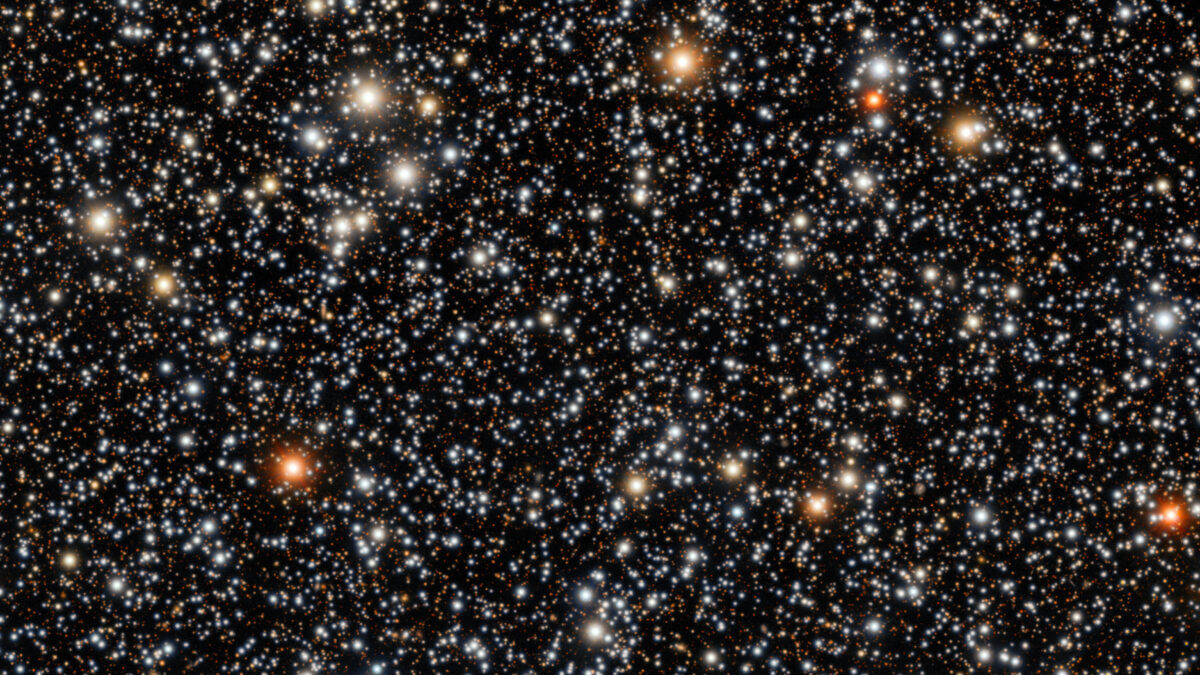
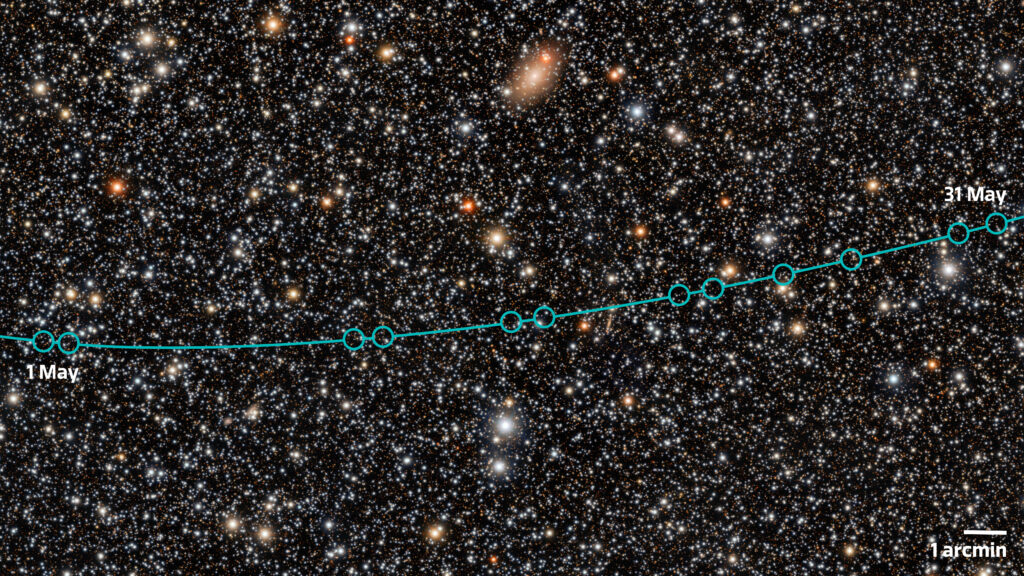
Composite Rubin Observatory observations showing part of 2026 ED138's orbital pathway between May 1 and May 31, 2026. The teal circles mark the candidate's measured positions against the background stellar field. Credit: NSF–DOE Vera C. Rubin Observatory/NOIRLab/SLAC/AURA; image processing: M. Jurić (UW), D. de Martin & M. Zamani (NSF NOIRLab)
The object was identified in early data from the NSF–DOE Vera C. Rubin Observatory and announced by the International Astronomical Union Minor Planet Center (MPC) on October 27. It is currently about 46 astronomical units (AU), or 6.88 billion km (4.28 billion miles), from the Sun.
Matthew Holman of the Center for Astrophysics at Harvard & Smithsonian identified 2026 ED138 on October 13 while running early Rubin observations through the pointdexter linking code developed with Kevin Napier. The software groups detections recorded on different nights that are consistent with the motion of one distant object.
Mario Jurić subsequently recovered 20 additional measurements from Rubin’s catalogs and images. The Simonyi Survey Telescope recorded 30 observations on 20 nights between March 4 and July 11, 2026.
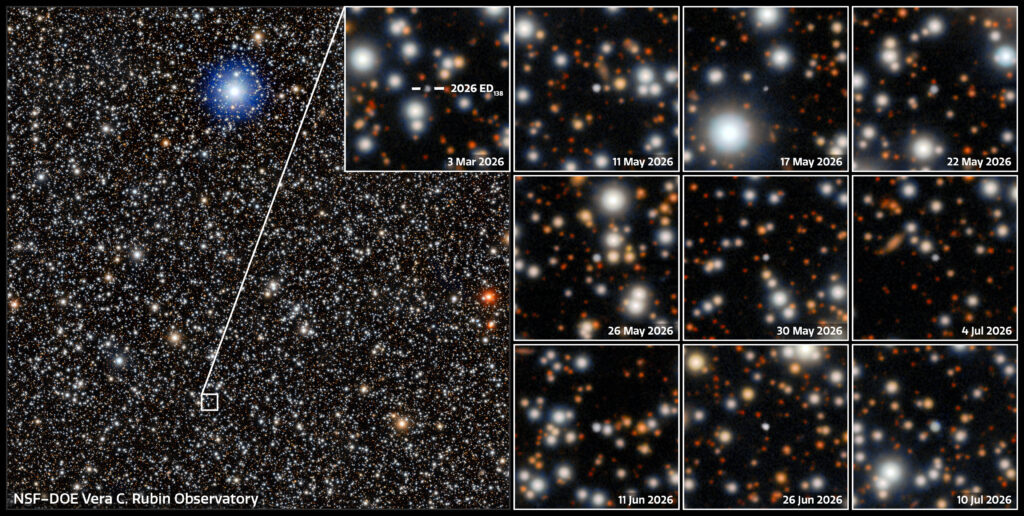
Observations spanning 89 years
The initial discovery paper recovered 44 usable Dark Energy Camera detections on 14 nights between 2016 and 2023. Combined with the Rubin measurements, these observations produced an initial orbital arc of 3 789 days.
A separate study recovered 2026 ED138 in five month-long observing sectors recorded by NASA’s Transiting Exoplanet Survey Satellite (TESS) between 2019 and 2026, four of them before the object’s discovery.
The object was too faint to identify in individual TESS images. Researchers removed stars cataloged by Gaia and stacked thousands of images along ED138’s predicted path, detecting it in all five observing sectors and at a combined significance of 34σ.
The TESS positions independently supported the calculated orbit. Its measured brightness was also consistent with the approximately 0.08-magnitude fading expected as its distance and viewing geometry changed.
A later archival search extended the record much farther backward. Murtagh et al. reported measurements from 12 photographic plates taken between 1954 and 2000, together with a marginal detection on a Harvard plate from 1937.
The researchers also identified the object in VISTA observations from 2010–2017, SkyMapper images from 2016–2020 and approximately 10 years of ATLAS photometry. Incorporating those measurements improved the predicted long-term position of the object by a factor of five.
Orbit near Neptune’s 12:7 resonance
2026 ED138 follows a barycentric orbit with a semimajor axis of 43.09 AU, an eccentricity of 0.139, and an inclination of 24.4°. Its perihelion distance is approximately 37.11 AU, keeping it beyond Neptune throughout its orbit.
Numerical integrations place the object near the edge of Neptune’s 12:7 mean-motion resonance, an orbital configuration also occupied by the dwarf planet Haumea. In the discovery study, 93 of 201 compatible orbital solutions remained resonant during integrations covering 10 million years.
That 46% fraction was insufficient to classify ED138 securely as a resonant object. Longer integrations reported by Murtagh et al. indicate that it can adhere to the resonance for tens of millions of years at a time but is rarely captured permanently.
Although its orbit resembles Haumea’s, its surface colors do not support membership in Haumea’s collisional family. The discovery paper measured a visible g – r color of 0.63, while the archival study placed it in the intermediate-red taxonomic class and found no evidence of the strong 1.5 μm water-ice absorption associated with Haumea-family objects.

Size and shape remain uncertain
The diameter of 2026 ED138 has not been measured directly. Murtagh et al. derived an absolute magnitude of Hv = 3.11 ± 0.05, corresponding to a diameter of 635–1 590 km (395–988 miles) for assumed geometric albedos between 0.25 and 0.04.
The earlier discovery paper derived an absolute magnitude of Hv = 3.19 and a diameter range of 612–1 530 km (380–951 miles). It is considered approximately 612–968 km (380–602 miles) more probable if the object’s reflectivity resembles that of other large trans-Neptunian objects.
The differences between the estimates reflect the photometry and assumed albedo rather than direct measurements of the object’s diameter. Thermal observations or stellar occultations are needed to determine its size and reflectivity more accurately.
The 89-year observing record also provides preliminary shape constraints. Earth’s viewing direction toward ED138 changed by approximately 87° between 1954 and the present, allowing researchers to compare its brightness from substantially different orientations.
The analysis excludes strongly flattened shapes with a polar-to-equatorial ratio of 0.6 or less for at least half of possible spin-axis orientations. Combined with a present-day light-curve amplitude below approximately 0.11–0.15 magnitude, it also excludes a Haumea-like elongated equilibrium shape for about 90% of the tested orientations.
These findings do not establish that ED138 is in hydrostatic equilibrium. The researchers identified a tentative rotation period of 10.4 hours, or approximately 20.7 hours if the light curve has two brightness peaks during each rotation.
Under the International Astronomical Union definition, a dwarf planet must orbit the Sun, not be a satellite, have not sufficiently cleared its orbital neighborhood, and have enough mass to assume a nearly round shape. The IAU currently recognizes Ceres, Pluto, Eris, Haumea and Makemake as dwarf planets.
2026 ED138 therefore remains a dwarf-planet candidate. Its absolute brightness places it among the ten intrinsically brightest known trans-Neptunian objects, but its diameter, albedo, and hydrostatic state remain unresolved.
Why earlier surveys missed it
2026 ED138 lies at a declination of approximately −43° and about 12° south of the Galactic mid-plane. Its far-southern position placed it outside the coverage of some earlier surveys, while its proximity to the Galactic plane placed it among dense fields of background stars.
Even the Rubin single-visit catalogs lacked an entry for ED138 in 24 of 38 visits whose images showed it. In many cases, the processing system combined nearby stars into regions too large for its normal deblending procedure and omitted the sources inside them.
Once the orbit was known, researchers recovered the object by fitting its point-spread function at the predicted locations while stars. The result shows that image-level searches, difference imaging, or processing configured for crowded fields may be required to find other large objects near the Galactic plane.
The early Rubin search that identified ED138 reported 2 440 previously unknown trans-Neptunian objects. ED138 had the lowest absolute magnitude, making it the intrinsically brightest object in that preliminary sample.
Based on the search’s recovery of previously known bright objects, the discovery team estimated that approximately three additional TNOs with Hv < 4 could remain undiscovered away from the Galactic plane. The researchers said they would more likely remain within 10° of the plane, where previous surveys have not reached comparable depth.
References:
1 NSF–DOE Vera C. Rubin Observatory Reveals Its First Dwarf Planet Candidate in Our Solar System – NSF–DOE Vera C. Rubin Observatory – October 27, 2026
2 New dwarf planet candidate discovered by NSF–DOE Rubin Observatory – U.S. National Science Foundation – October 27, 2026
3 Robinson, J. E., Schwamb, M. E., Jones, R. L., Jurić, M., Yoachim, P., Bolin, B. T., Chandler, C. O., Chesley, S. R., Fedorets, G., Fraser, W. C., Greenstreet, S., Hsieh, H. H., McGinley, L. J., Merritt, S. R., Opitom, C., & Parejko, J. K. (2025). Tuning the Legacy Survey of Space and Time Observing Strategy for Solar System Science: Incremental Templates in Year 1. The Astrophysical Journal Supplement Series, 279(1), Article 9. DOI: 10.3847/1538-4365/adc307

I’m a science journalist and researcher at The Watchers, contributing to the Epicenter edition, where I cover peer-reviewed scientific research and emerging discoveries across Earth and space sciences. With a background in astronomy and a passion for environmental science, I’ve worked in shark and coral conservation in Fiji, conducting reef and shark-behavior research, contributing to mangrove restoration, and earning PADI Open Water and Coral Reef Certifications. I bring a blend of scientific rigor and storytelling to illuminate the discoveries shaping our planet and beyond.
