
Flying glass cut a teacher in Russia but none of her 44 pupils, because when a meteor flashed across the sky in 2013, she told them to get under their desks
Forty-four fourth-graders at Lyceum No. 37 in Chelyabinsk escaped cuts when substitute teacher Yulia Karbysheva ordered them under their desks after a brilliant meteor flash on February 15, 2013. The shock wave arrived minutes later and shattered glass through the building; Karbysheva, who remained on her feet to open interior doors, was hospitalized with cuts to her left arm, including a tendon injury, and her left thigh, while none of the pupils suffered even a scratch.
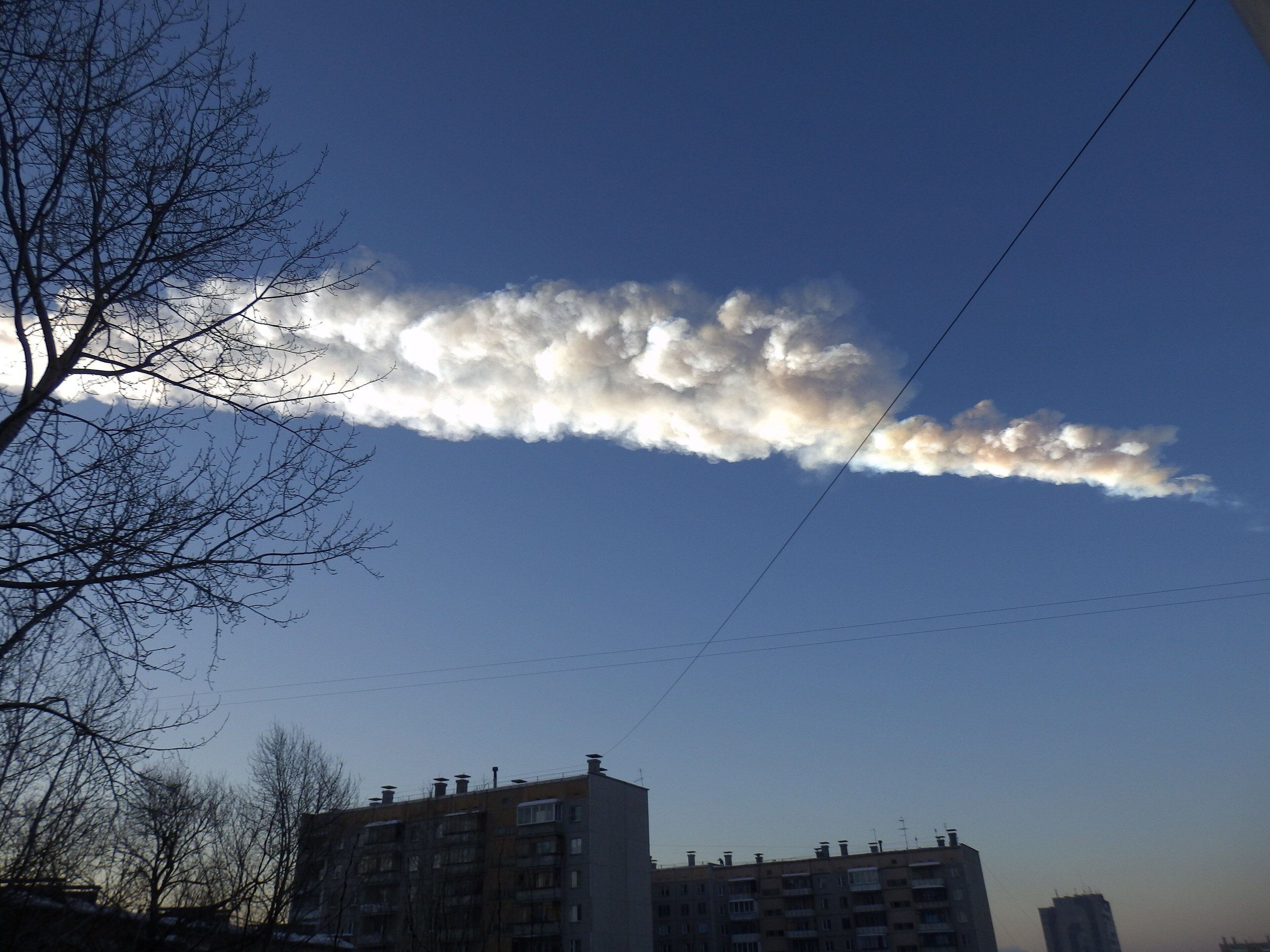
A trace of the meteorite in Chelyabinsk. Credit: Uragan. TT (CC BY-SA 3.0), via Wikimedia Commons.
The classroom episode unfolded during the Chelyabinsk airburst, the largest airburst on Earth since the 1908 Tunguska event. Popova et al. reconstructed an object 19.8 ± 4.6 m (65 ± 15 feet) across entering the atmosphere at 19.16 ± 0.15 km/s (11.91 ± 0.09 miles/s). Peak radiation occurred at 03:20:32.2 UTC at an altitude of 29.7 ± 0.7 km (18.5 ± 0.4 miles).

Key takeaways
- Interfax reported that Karbysheva ordered 44 fourth-graders under their desks after the flash; none received a scratch.
- Popova et al. measured about 140–151 seconds between maximum brightness and blast-wave arrival at most Chelyabinsk and Kopeysk video sites.
- Russian emergency-service hospital tallies supplied to the research team recorded 1 613 people seeking medical assistance, with most injuries involving cuts and bruises from broken glass.
- The evidence supports the protective value of moving the pupils away from windows, but it does not establish what injuries any particular child would otherwise have suffered.
The blast arrived after the flash
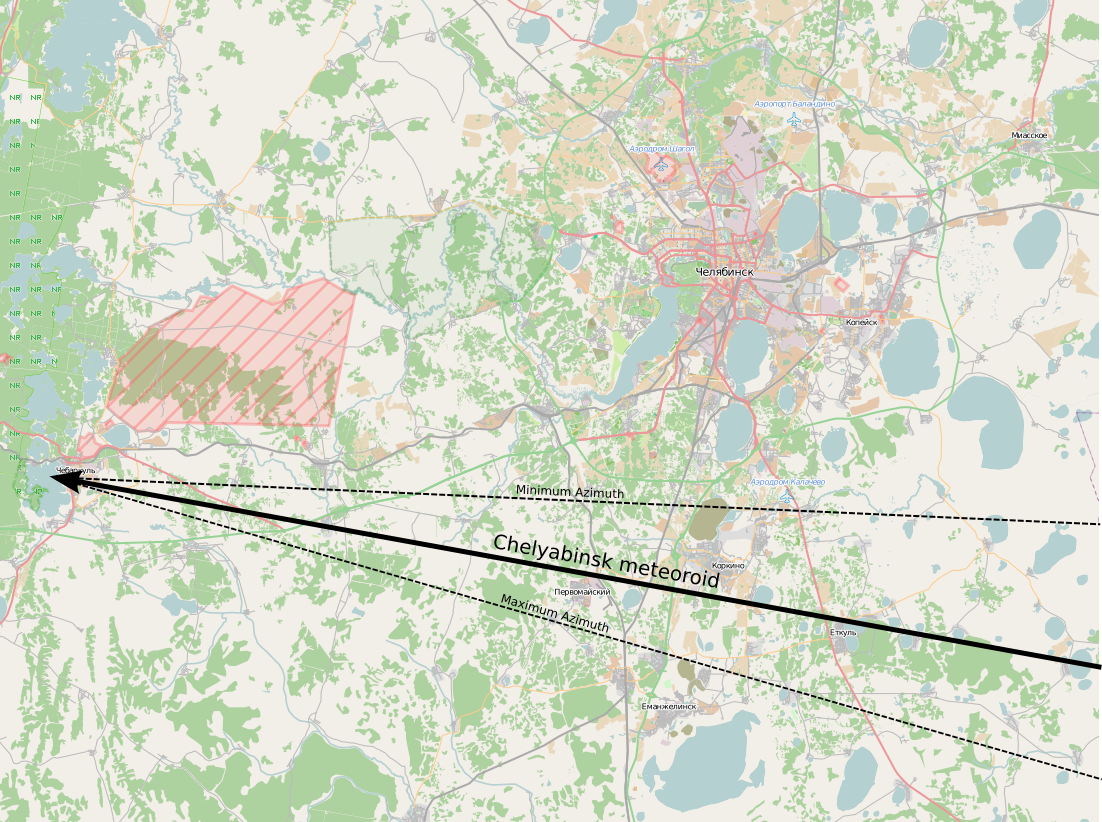
Light from the fireball reached the ground before the damaging pressure wave. Analysis of video records found a delay of about 140–151 seconds between maximum brightness and blast-wave arrival at most cameras in Chelyabinsk and nearby Kopeysk. Locations closer to the trajectory, including Pervomayskiy, Korkino and Yemanzhelinsk, recorded shorter delays of about 76–90 seconds.
The delay created an unusual hazard sequence. People could see the flash, move toward windows and remain there before the pressure wave reached the city. A 2021 U.S. interagency report on near-Earth-object emergency protocols later used Chelyabinsk as a practical example, noting that the bright airburst drew people to windows before an overpressure wave arrived about three minutes later and caused widespread glass breakage.

Karbysheva moved the pupils away from the windows
Interfax reported on February 16, 2013, that Karbysheva was substituting for two fourth-grade classes at Lyceum No. 37 when the powerful flash drew children toward a window. She ordered all 44 pupils under their desks and moved to open interior doors. The doors were made of glass because the school occupied a former kindergarten building.
Several minutes after the flash, the blast wave reached the school and shattered glass. Fragments struck Karbysheva. She then told the pupils to dress quickly and evacuated them from the building.

Oleg Denisov, chief doctor of Chelyabinsk City Hospital No. 9, told Interfax that none of the pupils received even a scratch. Karbysheva was hospitalized with cuts to her left arm, including a tendon injury, and her left thigh. Denisov said 112 people sought medical assistance at that hospital and 16 were admitted, including 11 children; most patients had cuts to the face and hands.
Broken glass caused most of the injuries
Hospital tallies communicated to the Chelyabinsk Airburst Consortium by the regional headquarters of the Russian Ministry of Emergencies recorded 1 613 people seeking medical assistance, 112 hospitalizations and two people in serious condition. No fatalities were recorded. Chelyabinsk city accounted for 1 210 of those seeking treatment.
Popova et al. reported that most people seeking medical attention had cuts and bruises from glass shattered by the shock wave. The researchers found no injuries directly attributable to structural damage or traffic accidents in the emergency-service dataset.

Damage extended far beyond the school. Regional administration and emergency-service data examined in the Science study listed 7 320 affected buildings across 11 municipal districts, including 740 schools and universities, 296 medical facilities, 110 cultural organizations, 48 sports facilities and 6 097 apartments and houses.
Within Chelyabinsk itself, 3 613 apartment buildings, about 44 percent of the total, had shattered or broken glass. Field surveys and emergency-service reports placed the broader glass-damage area at about 180 km (112 miles) north to south and 80 km (50 miles) east to west.
The object broke apart high in the atmosphere
The source of the damage was an atmospheric airburst rather than a large intact body striking Chelyabinsk. The incoming object fragmented as it passed through the atmosphere, depositing energy into the air and generating the shock wave that reached the ground. NASA’s Center for Near-Earth Object Studies estimated an effective diameter of about 18 m (59 feet) and an energy of about 440 kilotons of TNT equivalent; Popova et al. derived a diameter of 19.8 ± 4.6 m and several energy estimates in the roughly 500–600 kiloton range, with substantial uncertainty at these energies and altitudes.

Most of the incoming mass did not survive as meteorites. Popova et al. estimated that 76 percent evaporated and that most of the remaining mass became dust. The combined surviving meteorites amounted to about 4–6 metric tons, only 0.03–0.05 percent of the initial mass.

One of the largest surviving pieces reached Lake Chebarkul. Researchers documented a hole about 6–7 m (20–23 feet) across in ice roughly 70 cm (28 inches) thick. A mass of at least 570 kg (1 257 lb) was recovered from the lakebed in October 2013.

Chelyabinsk became a planetary-defense case study
Chelyabinsk was not detected before atmospheric entry. NASA’s Jet Propulsion Laboratory reported that the object’s approach remained within about 15° of the Sun’s direction, a part of the sky that ground-based asteroid surveys cannot observe effectively. The event became an important example of the risk posed by objects large enough to generate damaging airbursts but small enough to evade detection before impact.
The 2021 U.S. interagency emergency-protocol report uses Chelyabinsk to illustrate how public behavior can change exposure during a short-warning airburst. A bright flash can draw people toward windows before the pressure wave arrives, while the later blast can turn window glass into the main source of injury.
Karbysheva’s classroom provides a documented version of that sequence. The pupils were moved under desks before the shock wave reached the building and were reported unhurt, while Karbysheva remained exposed and was cut by glass. The available evidence does not establish what injuries any individual pupil would have suffered without her order, so the account supports the protective value of moving away from windows without establishing a specific counterfactual outcome.
References:
1 Челябинская учительница спасла при падении метеорита более 40 детей – Interfax – February 16, 2013
2 Popova, O. P., Jenniskens, P., Emel’yanenko, V., Kartashova, A., Biryukov, E., Khaibrakhmanov, S., Shuvalov, V., Rybnov, Y., Dudorov, A., Grokhovsky, V. I., Badyukov, D. D., Yin, Q.-Z., Gural, P. S., Albers, J., Granvik, M., Evers, L. G., Kuiper, J., Kharlamov, V., Solovyov, A., et al. (2013). Chelyabinsk airburst, damage assessment, meteorite recovery, and characterization. Science, 342(6162), 1069–1073. DOI: 10.1126/science.1242642
3 Additional Details on the Large Feb. 15 Fireball over Russia – NASA Jet Propulsion Laboratory – March 1, 2013
4 Report on Near-Earth Object Impact Threat Emergency Protocols – National Science and Technology Council – January 2021
5 Five Years after the Chelyabinsk Meteor: NASA Leads Efforts in Planetary Defense – NASA – February 15, 2018

I’m a science journalist and researcher at The Watchers, contributing to the Epicenter edition, where I cover peer-reviewed scientific research and emerging discoveries across Earth and space sciences. With a background in astronomy and a passion for environmental science, I’ve worked in shark and coral conservation in Fiji, conducting reef and shark-behavior research, contributing to mangrove restoration, and earning PADI Open Water and Coral Reef Certifications. I bring a blend of scientific rigor and storytelling to illuminate the discoveries shaping our planet and beyond.
Published in the last 24 hours
- In 1954, a grapefruit-sized meteorite crashed through a roof in Sylacauga, Alabama, and struck Ann Hodges as she napped on her couch Epicenter
- A meteorite blew a crater beside a village near Lake Titicaca in 2007, and dozens of villagers who went to see it got headaches and nausea, though tests found nothing the rock had added to the water Epicenter
- A South Dakota man put the widest and heaviest hailstone on US record in his freezer, and a power cut melted part of it before NOAA measured it at 8 inches across and nearly 2 pounds in 2010 Epicenter
- Black kites and brown falcons in northern Australia have been seen snatching smoldering sticks from wildfires, flying them into unburned grass and dropping them, starting new fires that send lizards, rodents and insects running straight toward the waiting birds Epicenter
