
Webb finds interstellar comet 3I/ATLAS carries water ice unlike most known comets
Water-ice grains released by interstellar comet 3I/ATLAS have spectral properties unlike those measured in most previously studied Solar System comets, while resembling ice signatures in some bodies beyond Neptune. James Webb Space Telescope data and spectral modeling favor tiny aggregates in which water ice is mixed with refractory material, placing the comet toward the refractory-rich end of a proposed range of icy grain properties that may extend across planet-forming disks around different stars.

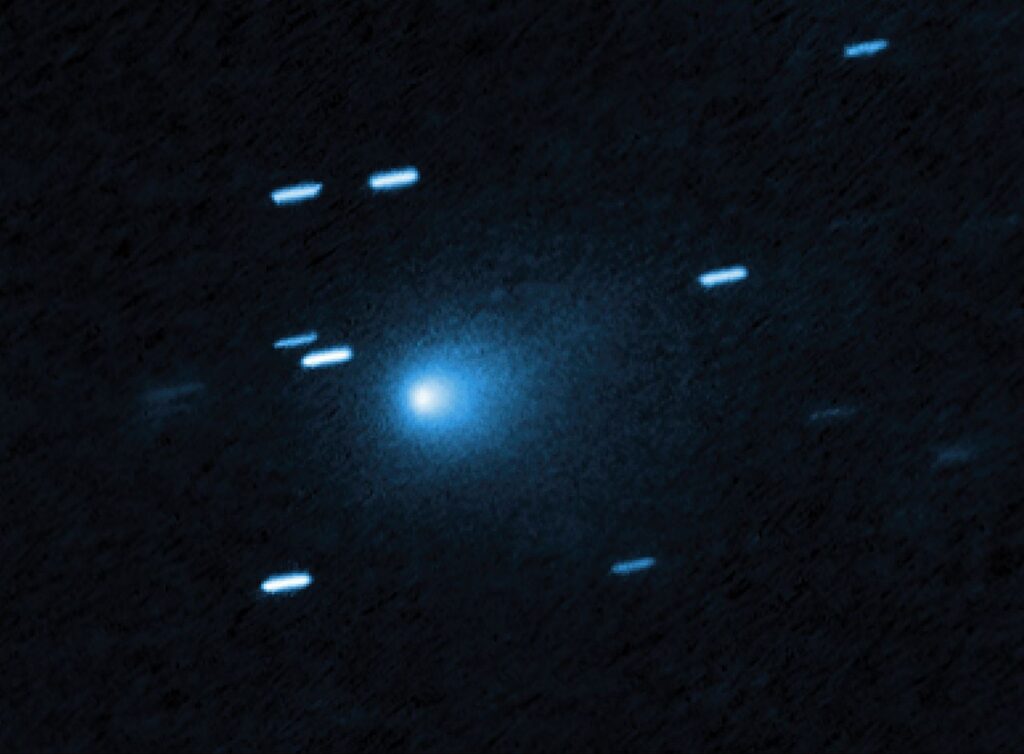
3I/ATLAS on November 16, 2025. Credit: Satoru Murata
A team led by Silvia Protopapa of the Southwest Research Institute analyzed three observations of 3I/ATLAS made with Webb’s Near-Infrared Spectrograph (NIRSpec) on August 6 and December 22, 2025, and April 1, 2026. The observations followed the comet for eight months around perihelion, when it was 3.3 AU, 2.4 AU, and 5.7 AU from the Sun, equivalent to about 494 million km (307 million miles), 359 million km (223 million miles), and 853 million km (530 million miles), respectively.
The measurements provide a rare comparison because 3I/ATLAS formed outside the Solar System and is only the third confirmed interstellar object identified passing through it.
Material released into its coma can therefore be examined with the same infrared techniques used to study comets and distant icy bodies formed around the Sun, giving researchers a direct way to compare some of the physical properties of planetesimal material assembled in different stellar systems.
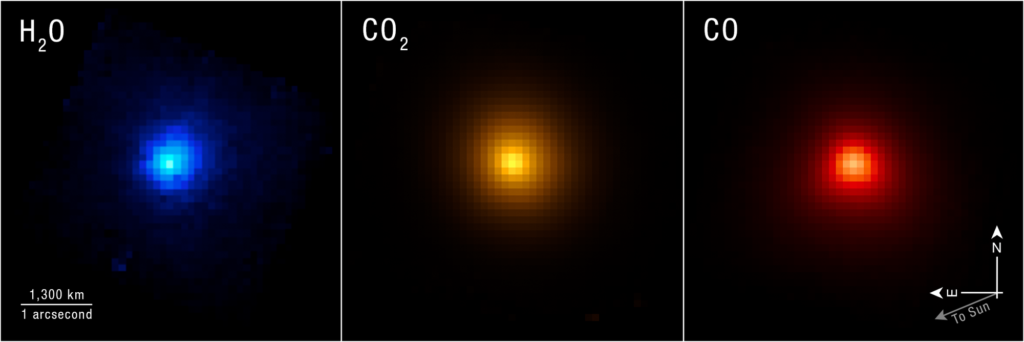
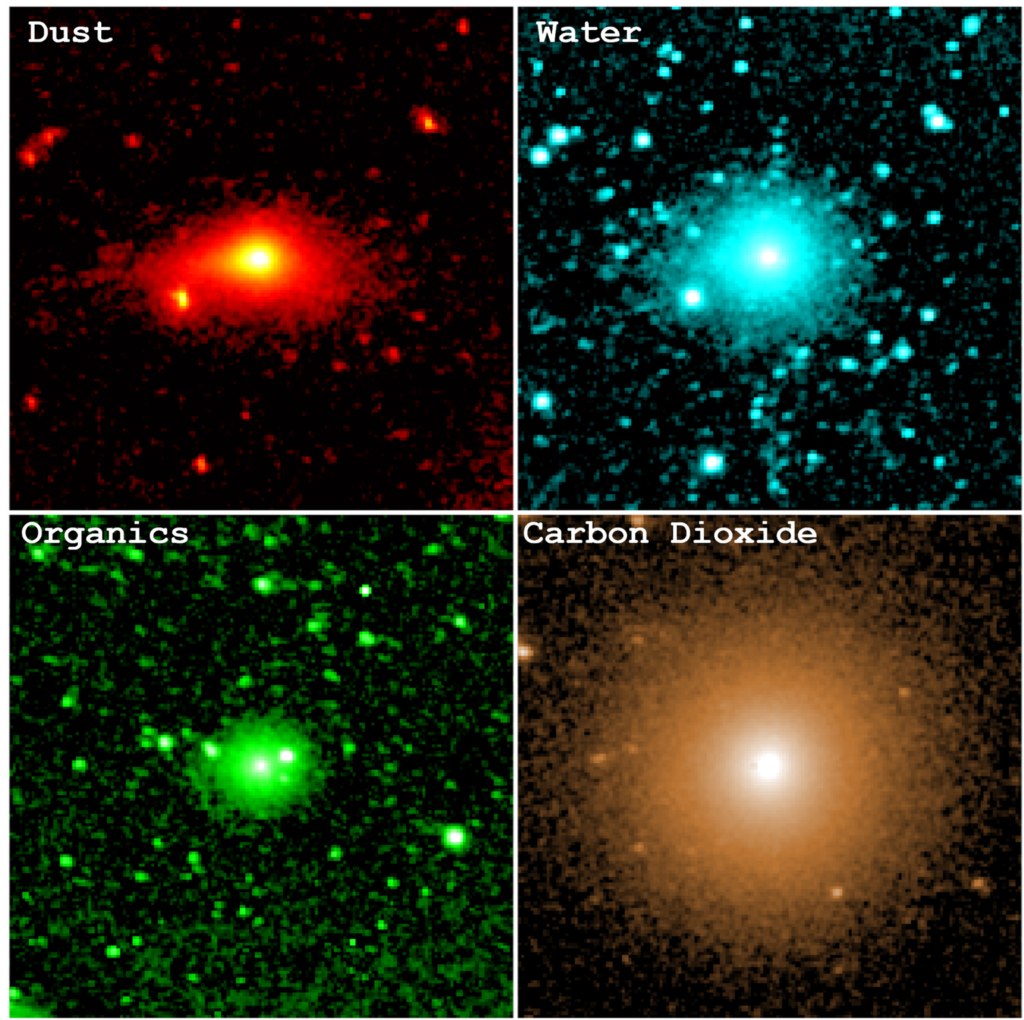
The spectra contained a broad water-ice absorption feature near 3 μm together with emission from H2O, CO2, and CO gas. Water ice normally also produces absorption bands near 1.5 and 2.0 μm, but those shorter-wavelength bands were weak or absent in 3I/ATLAS. Most previously studied water-ice-rich cometary comae show all three bands more clearly, making the combination in 3I/ATLAS physically different from the form of cometary ice usually inferred in the Solar System.
The difference matters because the strength of an absorption band depends not only on which substance is present but also on the physical form of the grains carrying it. The team modeled how infrared light scatters through grains of different sizes and compositions. Their best-fitting solutions favored submicron- to micron-sized aggregates containing water ice mixed with refractory material, the non-volatile solid component often described more loosely as dust.
In these small mixed grains, light travels through a relatively short path of ice before encountering other material. The models reproduce the weak 1.5 and 2.0 μm bands while retaining the much stronger feature near 3 μm. Grain size alone does not account for the difference: ice grains inferred in other comets can also be about a micron or smaller, but those grains have generally been interpreted as relatively pure ice or ice containing much less refractory material.
The observations also recorded changes as the comet passed through different parts of its orbit. By the April 2026 observation, when 3I/ATLAS was moving away from the Sun, the spectrum favored an additional population of somewhat larger, micron-scale, ice-rich aggregates. It also contained subtle structure near 3.1 μm consistent with crystalline water ice.
The cause of that evolution remains unresolved. The spectra can be reproduced with crystalline ice at the relevant observing epochs while changes in grain size and refractory mixing alter the spectral shape. Another viable interpretation involves an evolution from a more amorphous-like state toward crystalline ice. Michael S. P. Kelley of the University of Maryland, a co-author of the study, said the team also cannot yet distinguish changes caused by different solar-heating conditions from the exposure of fresh material as the comet eroded near the Sun.
The researchers then compared the 3I/ATLAS spectra with Webb observations of trans-Neptunian objects, icy bodies orbiting beyond Neptune. Several spectral groups show a similarly shaped water-ice absorption feature near 3 μm while also lacking strong 1.5 and 2.0 μm bands. The reported resemblance concerns the physical signature of the water ice and does not establish that 3I/ATLAS came from a region equivalent to the trans-Neptunian population of the Solar System.

The comparison instead places 3I/ATLAS toward the refractory-rich end of a proposed continuum extending from comparatively pure water-ice grains to aggregates containing progressively more refractory material. Protopapa et al. (2026) describe the comparison as consistent with the possibility that icy planetesimals formed in different protoplanetary disks can preserve overlapping grain properties at submicron-to-micron scales.
It is worth noting that only three interstellar objects have been confirmed, leaving too few direct samples to determine whether 3I/ATLAS is representative of the broader population. Its importance lies instead in providing material formed around another star that can be examined using methods already applied to icy bodies throughout the Solar System.
If later observations find the same range of water-ice properties in additional Solar System comets and interstellar visitors, the comparison would strengthen the case that some aspects of the physical state of water ice are established early in planet-forming disks and remain at least partly preserved as icy planetesimals assemble. The present study leaves that as a testable interpretation rather than a demonstrated universal formation process.

Future Webb observations will provide the critical test. Additional interstellar comets would show whether the refractory-rich ice inferred in 3I/ATLAS is common outside the Solar System, while observations of more Solar System comets would better define how widely the proposed grain-property continuum extends. Until those samples grow, 3I/ATLAS remains a rare comparison point between material assembled around the Sun and material formed in another planetary system.
Previous coverage of 3I/ATLAS
The Watchers began covering 3I/ATLAS shortly after its July 2025 discovery, examining its interstellar trajectory and possible ancient Galactic origin. Later reports covered its carbon-dioxide-rich coma, the detection of water, and observations by ESA’s Mars orbiters.
As the comet passed through the inner Solar System, coverage followed its October 2025 perihelion, NASA’s multi-mission observing campaign, and its closest approach to Earth. Post-perihelion SPHEREx observations then showed a marked increase in cometary activity.
More recent reports examined isotopic clues to its formation environment, nitrogen-rich chemistry consistent with very cold formation conditions, and estimates of how much surface material it lost.
References:
1 Protopapa, S., Kelley, M. S. P., Cordiner, M. A., Milam, S. N., Bodewits, D., Charnley, S. B., Drozdovskaya, M. N., Faggi, S., Farnocchia, D., Guilbert-Lepoutre, A., Micheli, M., Roth, N. X., Schwamb, M. E., Seligman, D. Z., & Villanueva, G. L. (2026). JWST reveals refractory-rich water ice in interstellar comet 3I/ATLAS: Evidence for a continuum of grain properties across protoplanetary disks. The Astrophysical Journal Letters, 1011(1), L11. DOI: 10.3847/2041-8213/aea60d
2 SwRI-led study uses Webb to compare interstellar comet 3I/ATLAS with icy bodies in our solar system – Southwest Research Institute – October 26, 2026

I’m a science journalist and researcher at The Watchers, contributing to the Epicenter edition, where I cover peer-reviewed scientific research and emerging discoveries across Earth and space sciences. With a background in astronomy and a passion for environmental science, I’ve worked in shark and coral conservation in Fiji, conducting reef and shark-behavior research, contributing to mangrove restoration, and earning PADI Open Water and Coral Reef Certifications. I bring a blend of scientific rigor and storytelling to illuminate the discoveries shaping our planet and beyond.
