
Discovery of water in 3I/ATLAS reveals chemistry shared across the galaxy
A team of Auburn University physicists using NASA’s Neil Gehrels Swift Observatory has detected water’s ultraviolet fingerprint in interstellar comet 3I/ATLAS. The discovery, published on September 30, 2025, in The Astrophysical Journal Letters, marks the first confirmed ultraviolet detection of water from a comet that originated beyond our solar system.

Image credit: ATLAS/University of Hawaii/NASA
For decades, scientists have wondered whether water is common throughout the galaxy. The discovery of 3I/ATLAS, a comet from another stellar system, finally offered a chance to test that idea. When researchers from Auburn University pointed the Swift Ultraviolet/Optical Telescope toward it, they detected the faint light of hydroxyl gas, a direct by-product of water vapor illuminated by sunlight.
This ultraviolet glow, invisible from the ground because Earth’s atmosphere blocks it, could only be captured from space. Swift’s position above the atmosphere gave scientists a clear view of the wavelengths where water’s molecular fingerprint appears. When the telescope recorded hydroxyl emissions at 308.5 nanometers, it proved that water was being released into space from the interstellar comet’s surface.
At the time, 3I/ATLAS was 2.9 astronomical units from the Sun, about 434 million km (270 million miles), roughly three times Earth’s distance from the Sun. At that distance, sunlight is far too weak to melt or sublimate water ice on most comets. Yet 3I/ATLAS was releasing water vapor at a rate of around 40 kg per second (88 pounds per second).
That amount of activity was remarkable, even for a typical solar-system comet, and it immediately signaled that something unusual was happening. The ultraviolet detection marked the first time astronomers had confirmed water from an interstellar comet using space-based observations, linking our solar system’s chemistry to another star system for the first time.
Water where it should not exist
The discovery raised an immediate puzzle: how could 3I/ATLAS release water so far from the Sun, where temperatures remain below the freezing point of most cometary ices? Researchers determined that if the comet’s water came solely from surface sublimation, an area of at least 7.8 km2 (3 mi2) would need to be active. That represents more than 8 percent of the comet’s surface, much higher than the 3 to 5 percent typically active on comets orbiting the Sun.
Such strong activity suggested that water was escaping not only from the surface but also from the surrounding cloud of dust and ice particles, known as the coma. Observations from other telescopes supported this view, showing that 3I/ATLAS’s coma contained numerous small icy grains that absorb sunlight more efficiently than the nucleus, heat up quickly, and release water vapor into space.o space.
This type of activity, driven by sublimating grains rather than direct surface heating, is rare but not unheard of. A few comets within our solar system, such as C/1980 E1 (Bowell) and C/2009 P1 (Garradd), have shown similar distant water production. However, 3I/ATLAS represents the first time this behavior has been documented in an interstellar object.
The detection implies that 3I/ATLAS’s nucleus may be porous or layered, allowing internal pockets of ice to vent through fractures. Such structural details record how the comet formed in the cold outer regions of its original star system, where even trace amounts of heat could preserve volatile materials for millions of years.
The ultraviolet view that changed comet science
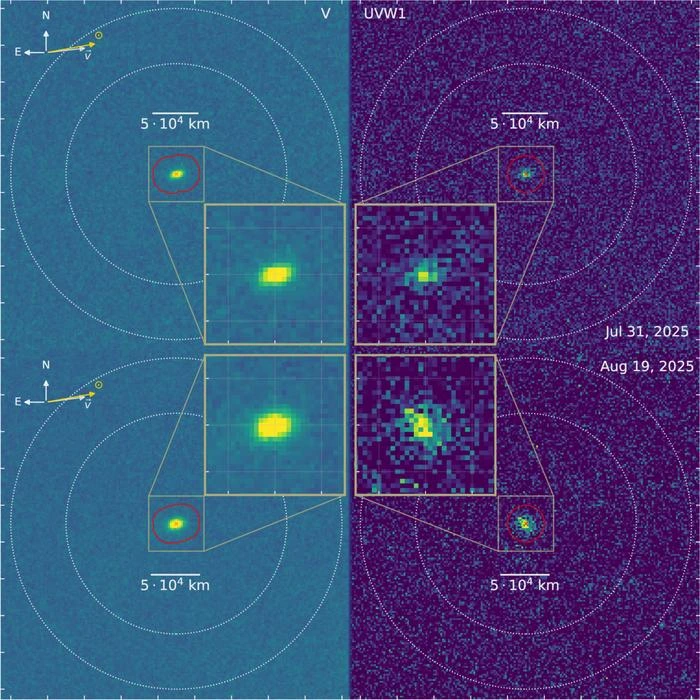
Detecting hydroxyl required exceptional precision and a telescope uniquely suited for the job. Swift’s Ultraviolet/Optical Telescope uses a 30-centimeter mirror, yet from orbit it achieves the ultraviolet sensitivity of a 4-meter ground-based observatory. The team employed the UVW1 filter, centered at 308 nanometers, alongside the visible-light V filter to separate the faint hydroxyl emission from reflected sunlight.
The first observing session, on July 31 and August 1, 2025, yielded only a marginal detection. A follow-up campaign on August 18 to 20 confirmed the emission with high statistical confidence. To counteract the comet’s motion, which could blur the images, scientists broke each exposure into 30-second slices, aligned them precisely, and stacked the data. The final dataset totaled about 42 minutes in visible light and 2.3 hours in ultraviolet.
This stacking technique produced clear, motion-corrected images that revealed how the comet’s ultraviolet profile was broader than its visible-light profile. That difference confirmed that the ultraviolet signal was coming from gas emission rather than sunlight reflected by dust. The ultraviolet emission map directly traced the region where water molecules were being destroyed by solar radiation, leaving hydroxyl behind.
The technique was so effective that it demonstrated Swift’s continued ability to study faint ultraviolet phenomena nearly two decades after launch. Originally designed to observe gamma-ray bursts, Swift’s ultraviolet telescope has now become one of the few instruments capable of detecting chemical activity in comets visiting from other star systems.
The observation was a technical triumph, showing how precision timing and orbital vantage can turn a small telescope into one of the most sensitive ultraviolet instruments in space.
What makes 3I/ATLAS different from other interstellar visitors
The story of interstellar comets began with 1I/‘Oumuamua in 2017. That object appeared dry, with no detectable gases or dust, suggesting it was rocky or covered in an insulating crust. The second, 2I/Borisov, discovered in 2019, was far more active and rich in carbon monoxide. Each object offered a different glimpse into how planetary systems form and evolve.
3I/ATLAS adds a new chapter by revealing a water-rich composition. This means that comets from other star systems can preserve the same ices that shape our solar system’s comets. The diversity among these interstellar objects shows that their parent systems formed under very different conditions—some colder and richer in volatiles, others warmer and depleted of ice.
By comparing these objects, astronomers can begin to map the range of environments that produce comets. In cooler regions, water and carbon dioxide freeze easily, forming icy planetesimals. In warmer, inner zones, materials may be more carbon-rich or rocky. The combination of these different chemistries shapes how planets and comets evolve in their native systems.
This discovery also reveals the shared chemical heritage of planetary systems across the Milky Way. The same ingredients, water, carbon compounds, and silicate minerals, appear to recur wherever planets form. 3I/ATLAS therefore serves as a physical link between our solar system and countless others, confirming that the building blocks of life are not confined to one star.
What we expect next
Although 3I/ATLAS has faded from view for now, it will become observable again after mid-November 2025. Astronomers plan to continue studying it with instruments such as the James Webb Space Telescope and the Hubble Space Telescope to track how its composition evolves as it approaches the Sun.
If the comet’s activity continues to be dominated by water, it would suggest that its nucleus still contains fresh ice layers. A shift toward gases like carbon dioxide or cyanogen, on the other hand, could indicate that deeper, more volatile materials are being exposed. Either outcome will provide valuable clues about how the comet’s ices are distributed and how they react to sunlight.
The data will also help refine models of how interstellar objects survive their journey through the galaxy. Understanding whether their ices remain intact or gradually erode can reveal how common it is for comets to move between star systems.
Regardless of what happens next, 3I/ATLAS has already changed the way astronomers view interstellar objects. It has proven that these cosmic visitors can carry and release water, the molecule most essential to life as we know it. Each new observation of this comet continues to send the same message across light-years: water is not unique to Earth or to our Sun’s family of planets. It is a universal thread connecting worlds across the stars.
References:
1 Physicists uncork a message in a bottle from another star – EurekAlert! – October 7, 2025
2 Water Production Rates of the Interstellar Object 3I/ATLAS – Zexi Xing et al. – The Astrophysical Research Letters – https://doi.org/10.3847/2041-8213/ae08ab –

I’m a science journalist and researcher at The Watchers, contributing to the Epicenter edition, where I cover peer-reviewed scientific research and emerging discoveries across Earth and space sciences. With a background in astronomy and a passion for environmental science, I’ve worked in shark and coral conservation in Fiji, conducting reef and shark-behavior research, contributing to mangrove restoration, and earning PADI Open Water and Coral Reef Certifications. I bring a blend of scientific rigor and storytelling to illuminate the discoveries shaping our planet and beyond.

Commenting rules and guidelines
We value the thoughts and opinions of our readers and welcome healthy discussions on our website. In order to maintain a respectful and positive community, we ask that all commenters follow these rules.