
Hubble and Webb uncover Omega Centauri’s first stellar-mass black hole after 23 years of observations
Instead of searching for X-rays or radio signals from material falling onto a black hole, astronomers measured the tiny motion of a star across the sky for more than two decades, revealing the first stellar-mass black hole ever detected in Omega Centauri. Their findings, published in The Astrophysical Journal Letters on July 13, 2026, demonstrate how precision astrometry from NASA’s Hubble Space Telescope and James Webb Space Telescope is uncovering hidden black holes that have escaped traditional searches.
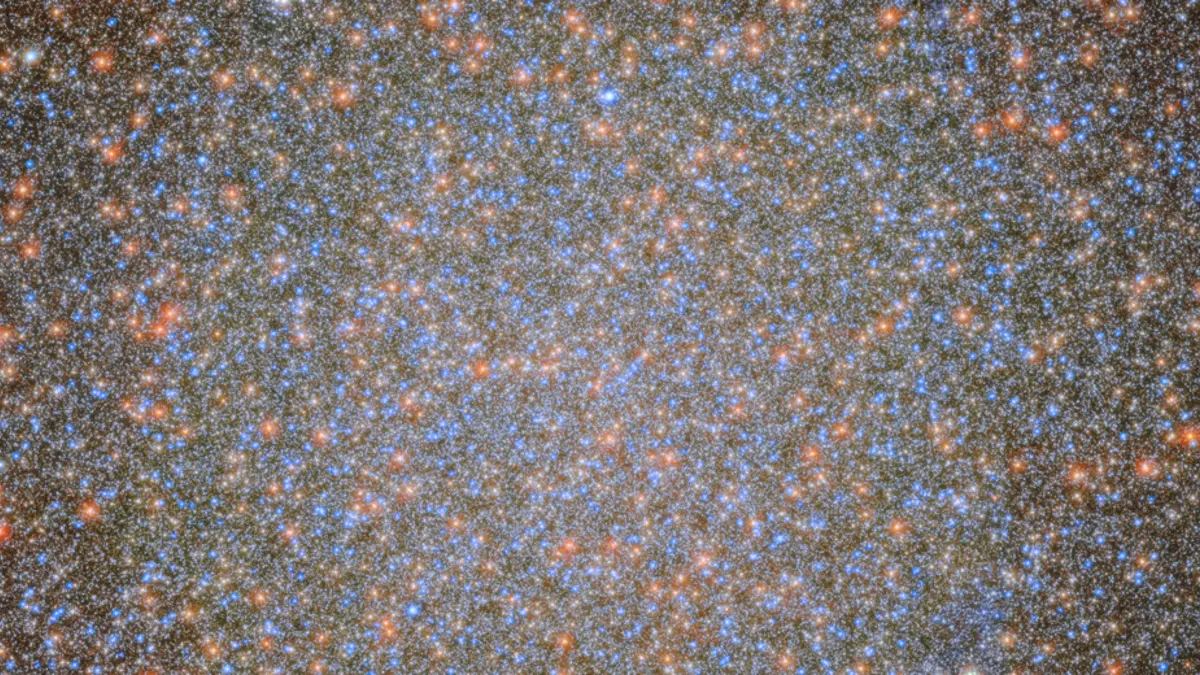
An image of the globular cluster Omega Centauri, a collection of myriad stars colored red, white, and blue on the black background of space. Credit: Science: Maximilian Häberle (MPIA)
For decades, Omega Centauri has presented astronomers with a paradox. The Milky Way’s largest globular cluster contains roughly 10 million stars, and theoretical models indicate it should host thousands of stellar-mass black holes left behind by massive stars that ended their lives as supernovae. Yet repeated observational searches found little evidence that this hidden population existed. Previous Hubble observations identified evidence for an intermediate-mass black hole near the cluster’s center, but the expected population of smaller black holes remained largely undetected.
Now, a team led by Matthew Whitaker of the University of Utah has identified the first confirmed stellar-mass black hole in Omega Centauri by combining archival observations from NASA’s Hubble Space Telescope with recent measurements from NASA’s James Webb Space Telescope. The findings, published in The Astrophysical Journal Letters, identify a black hole designated oMEGACat BH-2, providing the first direct evidence that the cluster’s long-predicted stellar-mass black hole population exists.
Unlike previous searches that relied on radial velocity measurements or looked for radio and X-ray emission from accreting material, the team searched for tiny changes in a star’s position across the sky. By combining Hubble observations spanning 2002 to 2023 with Webb’s infrared measurements, they tracked the orbit of a visible main-sequence star around an unseen companion using astrometry.
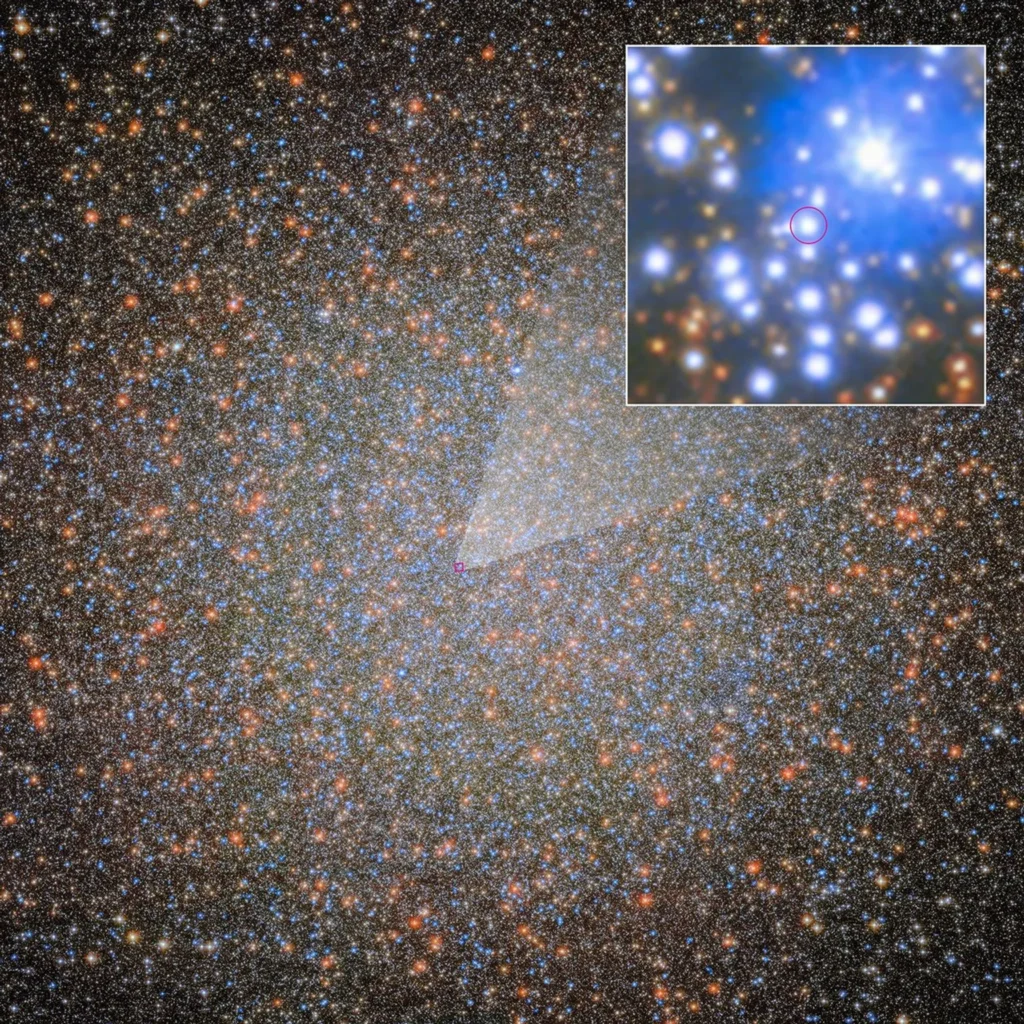
“With Hubble and Webb data, we were able to see the motion of the visible main sequence star that is part of this binary, which is about 18 000 light-years away in the dense environment of Omega Centauri,” Whitaker said. “The precision of these measurements is incredible, down to a fraction of a pixel on Hubble and Webb’s detectors. It would not have been possible to find this black hole without these two space telescopes.”
The 23-year observational baseline also resolved a long-standing question about the system. An earlier investigation had classified the unseen companion as a neutron star. By extending the Hubble record and incorporating Webb observations, the Utah-led team refined the companion’s mass and ruled out that interpretation. The binary completes one orbit every 94 years, making it the longest-period black hole binary system yet identified. Because the observations captured the system near periastron, where the visible star moves fastest, the researchers were able to determine the companion’s mass despite observing only part of the orbit.
The black hole’s actual mass surprised the researchers. Omega Centauri is a metal-poor stellar environment, a setting where theoretical models generally predict the formation of more massive stellar remnants.
“While we already knew that the star was 0.78 solar masses, we can now calculate the black hole’s mass, which is 4.46 solar masses and therefore too heavy to be a neutron star. However, its mass is much lower than would be expected in a metal-poor environment like Omega Centauri. This is surprising and exciting,” said Anil Seth, a co-author from the University of Utah. “We now know that a metal-poor star is able to form a black hole like this, and we need to figure out how that happens. This detection is providing some data to those who do that kind of modeling.”
The researchers conclude that oMEGACat BH-2 almost certainly formed through dynamical interactions inside the crowded cluster rather than evolving together with its visible companion. Their calculations indicate that encounters with neighboring stars will tear the system apart within about 800 million years, a relatively short lifetime compared with Omega Centauri’s estimated age of approximately 12 billion years.
Dense stellar systems such as Omega Centauri are considered among the primary environments where black hole binaries form through repeated gravitational interactions before eventually merging and producing the gravitational waves detected by observatories such as LIGO and Virgo.
Finding the first member of Omega Centauri’s hidden black hole population provides an important observational test for models of globular cluster evolution and black hole formation. The team expects additional discoveries as Hubble and Webb continue surveying the cluster, while NASA’s planned Nancy Grace Roman Space Telescope is expected to accelerate the search by repeatedly imaging the crowded stellar fields of the Galactic bulge with Hubble-like resolution across a much wider field of view.
References:
1 Whitaker, M., Kerr, E., Seth, A., Häberle, M., Strader, J., Anderson, J., Bellini, A., Clontz, C., Freeman, Z., Griggio, M., et al. (2026). A long period stellar-mass black hole binary in ω Centauri. The Astrophysical Journal Letters, 1006(1), L1. https://doi.org/10.3847/2041-8213/ae7a5c
2 NASA’s Hubble Discovers First of Star Cluster’s Missing Black Holes – NASA – July 13, 2026

I’m a science journalist and researcher at The Watchers, contributing to the Epicenter edition, where I cover peer-reviewed scientific research and emerging discoveries across Earth and space sciences. With a background in astronomy and a passion for environmental science, I’ve worked in shark and coral conservation in Fiji, conducting reef and shark-behavior research, contributing to mangrove restoration, and earning PADI Open Water and Coral Reef Certifications. I bring a blend of scientific rigor and storytelling to illuminate the discoveries shaping our planet and beyond.

Commenting rules and guidelines
We value the thoughts and opinions of our readers and welcome healthy discussions on our website. In order to maintain a respectful and positive community, we ask that all commenters follow these rules.