
The interstellar comet 3I/ATLAS is thought to be about twice as old as Earth, and the James Webb Space Telescope has now found that its ice looks less like any comet from our own solar system than like the frozen worlds beyond Neptune, a sign it formed somewhere its star’s light could barely reach
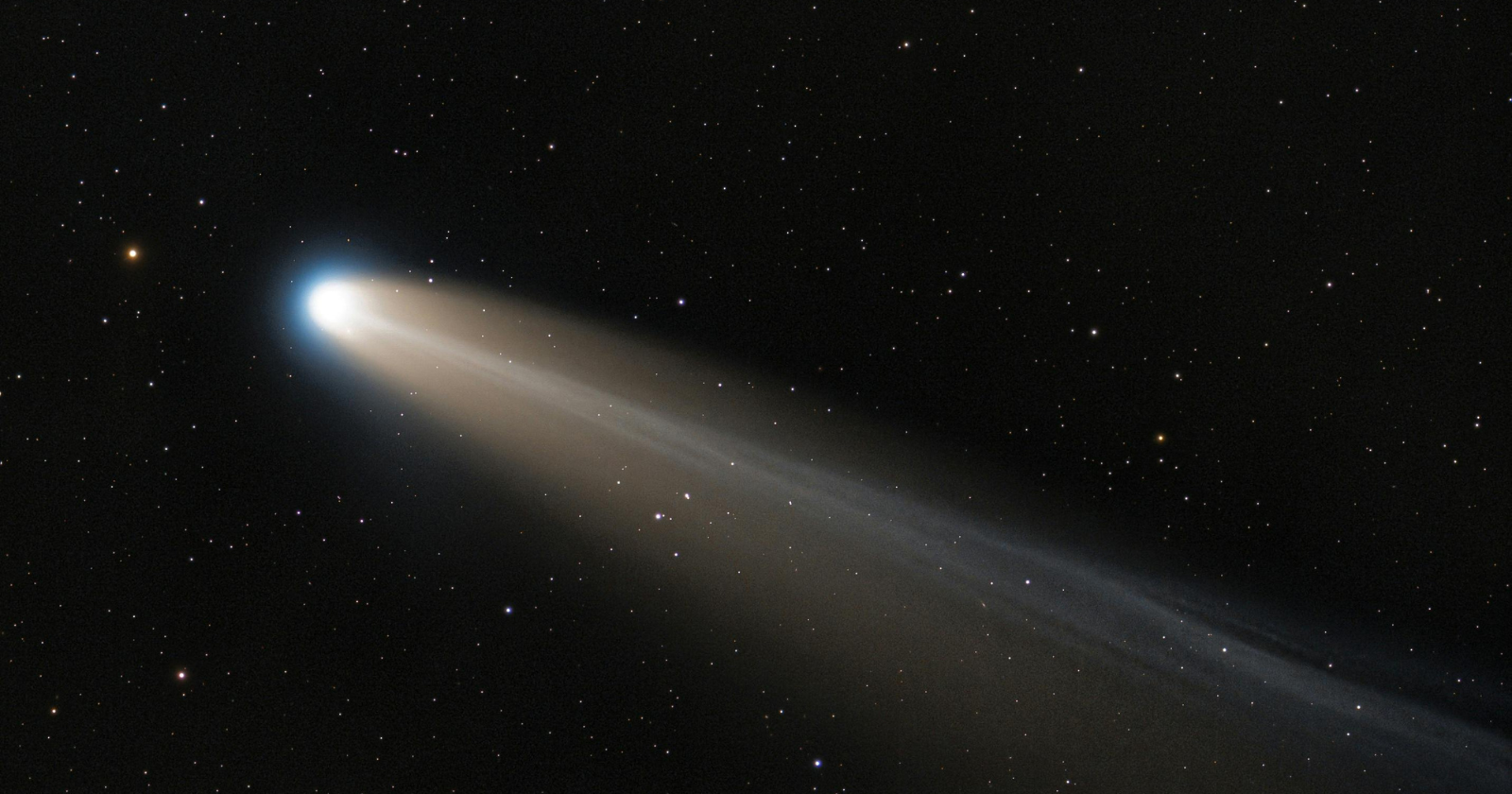
On July 1, 2025, a telescope in Chile spotted a faint object moving far too fast to belong to the Sun. It was only the third visitor from another star system ever found, and it was named 3I/ATLAS.
Over the following months, it swept through our solar system and headed back into interstellar space. Now a study using NASA’s James Webb Space Telescope has found that its ice resembles some of the coldest, most distant objects in our own solar system, rather than most of the comets we know.
A visitor from another star
3I/ATLAS travels on a hyperbolic orbit, meaning it isn’t bound to the Sun and will never return. It came from somewhere among the billions of stars in the Milky Way and will continue drifting between the stars after leaving us.
Only two such objects had been found before: ‘Oumuamua in 2017 and comet 2I/Borisov in 2019. Each one gives astronomers a rare chance to study material formed around another star without leaving our solar system.
Possibly older than the solar system
Researchers at the University of Oxford traced the comet’s steep path through the galaxy. They concluded that it probably came from the Milky Way’s “thick disk,” a region of older stars above and below the main disk where the Sun lives.
Based on that, they estimated it is likely more than 7 billion years old, with a range of roughly 7.6 to 14 billion years. Earth and the Sun formed about 4.6 billion years ago. The team said there was a two-thirds chance the comet is older than our solar system. Other astronomers point out that trajectory alone can’t pin down an age, but its colour and chemistry also suggest it’s very old.
What Webb found in its ice
Scientists at the Southwest Research Institute used Webb’s near-infrared instrument to observe 3I/ATLAS three times between August 2025 and April 2026, before and after its closest approach to the Sun. They studied ice grains streaming off the comet into its glowing cloud, or coma.
They found tiny grains of water ice, about a micron across or smaller, mixed with dust. The grains are similar in size to those in comets from our solar system. But the way they absorb light is different from most comets we’ve studied.
A match beyond Neptune
The team then compared the comet with Webb observations of trans-Neptunian objects, icy bodies that orbit beyond Neptune and are thought to preserve material from the early solar system. Several groups of these objects showed a very similar pattern in their water ice.
The match was strongest for objects whose light also shows signs of carbon dioxide ice and organic compounds. The study, published in The Astrophysical Journal Letters, suggests that the icy building blocks of planets may share similar properties around many different stars.
Clues to where it was born
Trans-Neptunian objects formed in the cold outer reaches of the young solar system, far from the Sun’s warmth. The resemblance raises the possibility that 3I/ATLAS formed in a similarly cold region around its own star, though the study itself doesn’t pinpoint where.
Other observations support the idea that it formed somewhere cold. Earlier Webb measurements found its coma was unusually rich in carbon dioxide compared with water. The comet also contains high levels of deuterium, a heavy form of hydrogen, which can point to very cold, early conditions.
Why it matters
Interstellar comets act like samples from other star systems, delivered for free. Studying them helps scientists test whether the processes that built our planets are common across the galaxy.
The Webb results suggest that, despite forming around another star and possibly billions of years earlier, 3I/ATLAS was made from similar ingredients to the icy bodies at the edge of our own solar system. Future surveys, such as the Vera C. Rubin Observatory, are expected to discover many more interstellar visitors, giving scientists more chances to compare.

The Watchers Staff covers earthquakes, volcanoes, severe weather, space weather and other natural events. Published since 2011, The Watchers reports on a changing planet and the science behind it.
Published in the last 24 hours
- Mount Everest is the highest point above sea level, but because the Earth bulges at the equator, the summit of a volcano in Ecuador sits farther from the centre of the planet, making it the closest piece of land on Earth to outer space Epicenter
- Winds high above the Arctic broke a 68-year record by collapsing in early November, and while the eastern US has already had a taste of the cold it shook loose, forecasters say a second wave could arrive around Thanksgiving weekend
- Weather radar tracked meteorites falling into Cape Cod Bay after a 1.1-kiloton fireball over Massachusetts on 30 May 2026; researchers have now traced its orbit almost out to Jupiter. Epicenter
- 10 named storms, one hurricane for the first time since 1925: Why has the Atlantic been so quiet in 2026 Epicenter
