
Mount Everest is the highest point above sea level, but because the Earth bulges at the equator, the summit of a volcano in Ecuador sits farther from the centre of the planet, making it the closest piece of land on Earth to outer space
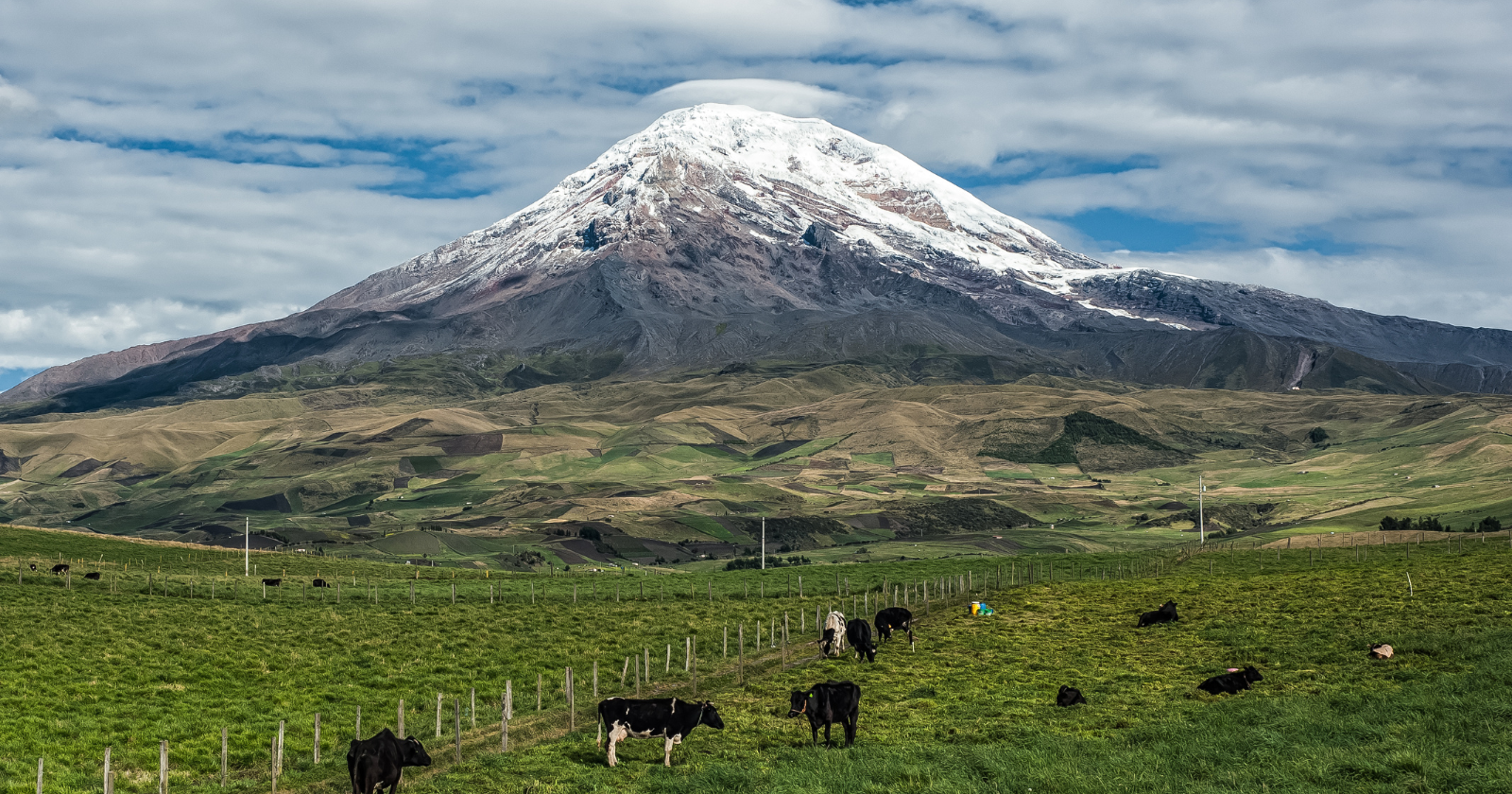
High in the Ecuadorian Andes, about 150 kilometres south of Quito, a snow-capped volcano rises above the clouds. Chimborazo is only about 6,263 metres tall, nearly 2.6 kilometres shorter than Mount Everest.
Yet stand on its summit and you’re farther from the centre of the Earth than anyone standing on Everest. The reason has nothing to do with the mountain itself. It’s about the shape of the planet.
The Earth isn’t a perfect sphere
We often picture the Earth as a perfect ball, but it isn’t. As the planet spins, it bulges slightly at the equator and flattens at the poles, a bit like a ball of dough spun on a finger.
The difference is about 21 kilometres. The distance from the Earth’s centre to the equator is around 6,378 kilometres, while the distance to the poles is about 6,357 kilometres. That means anything near the equator starts with a head start of several kilometres.
Why Chimborazo comes out on top
Chimborazo sits just over 1 degree south of the equator, almost on top of the bulge. Everest, by contrast, lies about 28 degrees north, where the Earth’s surface is closer to the centre.
So although Everest rises much higher above sea level, Chimborazo stands on much “higher” ground to begin with. Its summit is about 6,384.4 kilometres from the Earth’s centre, roughly 2 kilometres farther out than Everest’s.
Measuring the mountain
In 2016, a team of French and Ecuadorian scientists carried precise GPS equipment to the top of Chimborazo. They measured its height at 6,263.47 metres above sea level and confirmed its distance from the Earth’s centre.
Their results settled a long-standing question. Among all points on the Earth’s solid surface, the summit of Chimborazo is the farthest from the planet’s centre. The second-farthest is another Andean peak near the equator, Huascarán in Peru. Everest doesn’t come close.
What “highest” really means
This doesn’t make Everest any less impressive. It remains the highest mountain above sea level, which is how mountain heights are usually measured.
Measuring from sea level makes sense for most purposes, because it reflects how high a mountain rises above the surrounding land and how thin the air is at the top. Climbers on Everest face far less oxygen than those on Chimborazo. But measured from the centre of the planet, Chimborazo reaches farther out than any other point on land.
A mountain with a remarkable history
Chimborazo has fascinated scientists for centuries. In the early 1800s, it was thought to be the highest mountain in the world. In 1802, the German explorer Alexander von Humboldt climbed to about 5,800 metres on its slopes, higher than any European was known to have climbed at the time.
The summit was first reached in 1880 by the English climber Edward Whymper and his Italian guides, Jean-Antoine and Louis Carrel. Today the volcano is considered dormant. Its last eruption is thought to have been around 1,500 years ago.
A shrinking ice cap
Chimborazo’s glaciers have long been important to local communities, providing water for farming and drinking. For generations, local ice merchants known as hieleros climbed the mountain to cut blocks of ice and carry them to market.
Like many tropical glaciers, Chimborazo’s ice has been shrinking as the climate warms and as volcanic ash darkens its surface. Scientists are watching closely, since the loss of this ice could affect water supplies for people living below.
What it means for the rest of us
Chimborazo’s record is a reminder that the Earth’s shape affects more than maps. Because of the equatorial bulge, people living near the equator are slightly farther from the planet’s centre than people near the poles, and gravity is slightly weaker there too.
It also shows how a simple question, such as “what’s the highest point on Earth?”, can have more than one correct answer. It depends on where you start measuring.

The Watchers Staff covers earthquakes, volcanoes, severe weather, space weather and other natural events. Published since 2011, The Watchers reports on a changing planet and the science behind it.
Published in the last 24 hours
- The interstellar comet 3I/ATLAS is thought to be about twice as old as Earth, and the James Webb Space Telescope has now found that its ice looks less like any comet from our own solar system than like the frozen worlds beyond Neptune, a sign it formed somewhere its star’s light could barely reach Epicenter
- Winds high above the Arctic broke a 68-year record by collapsing in early November, and while the eastern US has already had a taste of the cold it shook loose, forecasters say a second wave could arrive around Thanksgiving weekend
- Weather radar tracked meteorites falling into Cape Cod Bay after a 1.1-kiloton fireball over Massachusetts on 30 May 2026; researchers have now traced its orbit almost out to Jupiter. Epicenter
- 10 named storms, one hurricane for the first time since 1925: Why has the Atlantic been so quiet in 2026 Epicenter
