
Weather radar tracked meteorites falling into Cape Cod Bay after a 1.1-kiloton fireball over Massachusetts on 30 May 2026; researchers have now traced its orbit almost out to Jupiter.
Weather radars picked up meteorites falling toward Cape Cod Bay after a bright fireball crossed Massachusetts on May 30, 2026. Researchers have now combined those echoes with meteor-radar and pressure recordings to reconstruct the object’s path through the atmosphere and its earlier orbit around the Sun. Their study is still under review.
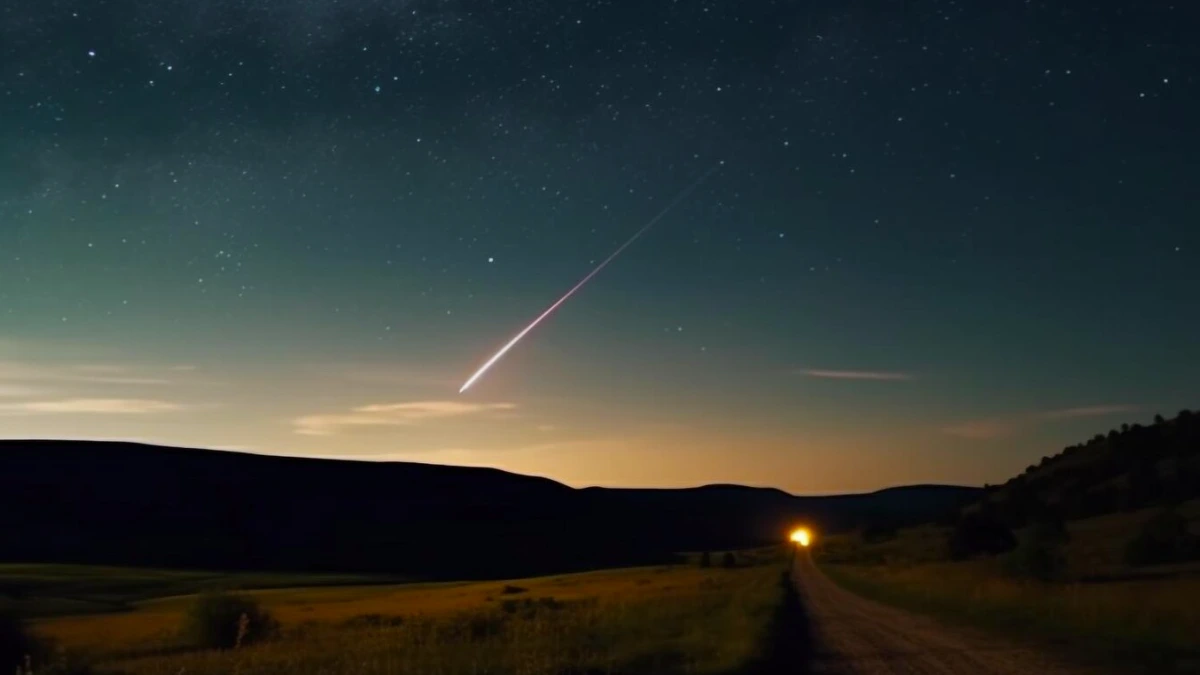
Representative image for a fireball. Image credit: FreePik
The fireball was seen in daylight, and its sonic boom was heard across parts of New England. Clouds obscured parts of the view, but cameras, satellites and instruments on the ground each recorded a different part of what happened.
The reconstruction was led by Juha Vierinen of UiT The Arctic University of Norway and posted as a preprint on October 17. MIT Haystack Observatory said on November 9 that the paper was under review for The Astronomical Journal.
From a bright fireball to falling fragments
The event reached peak brightness at 18:06:23 UTC on May 30, or 14:06:23 EDT in Massachusetts. U.S. Government sensor data released through NASA’s Center for Near-Earth Object Studies (CNEOS) placed that flash about 32 km (20 miles) above the coast.
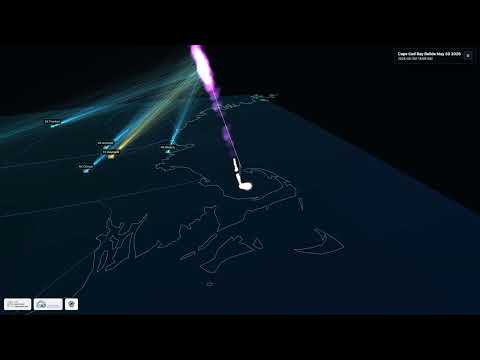
High above the coast, the first radar signals came from electrically charged gas, or plasma, surrounding the incoming rock and trailing behind it. These echoes were recorded by SIMONe, the meteor-radar network based at MIT Haystack Observatory.
The signal from plasma moving with the object was detected between about 90 and 71 km (56 and 44 miles) altitude. Echoes from its wake continued much lower, to about 33.6 km (21 miles), helping the team reconstruct a steep path toward Cape Cod Bay.

Lower down, weather radars picked up solid fragments. The paper identifies detections from the Boston and Albany weather radars and Boston’s airport radar, with a possible additional detection from the Long Island radar. The airport instrument is a separate radar system, rather than part of the NEXRAD network.
The fragment echoes were above the clouds in the area, helping distinguish them from ordinary weather. Their positions, combined with wind measurements and a falling-fragment model, narrowed the likely landing area within the bay.
This slower descent is known as dark flight: the fragments have stopped producing the brilliant meteor light but continue falling, with winds shifting where they land.
What the boom revealed
The sound supplied another set of clues. Pressure sensors recorded infrasound, the low-frequency pressure waves generated as the object raced through the atmosphere and broke apart.
Six citizen-operated Raspberry Shake/Boom sensors helped establish the direction from which the signal arrived. Their individual signals were too weak to qualify as significant detections on their own, but combining the records revealed a clear shared signal.
CNEOS lists an estimated total impact energy of 1.1 kilotons of TNT equivalent, calculated from the light released. The paper’s acoustic analysis gives roughly 0.5 kilotons, with the sound most strongly associated with the terminal breakup region.
These estimates use different observations. The authors say their difference falls within the known scatter of the acoustic method. They should not be treated as two separate, precisely measured portions of the event’s energy.
An unusual orbit, with no known parent
Working backward from the measured trajectory, the team reconstructed the object’s orbit before its encounter with Earth. It followed a long ellipse around the Sun, reaching an estimated 4.27 ± 0.20 astronomical units at its farthest point. One astronomical unit is approximately Earth’s average distance from the Sun.
That takes the nominal orbit beyond the main asteroid belt while remaining inside Jupiter’s orbit. It does not establish that the object came from Jupiter or from beyond it.
The orbit sits close to the boundary used to distinguish comet-like and asteroid-like paths, and different classification tests gave conflicting answers. The team found no convincing match to a cataloged parent body or established meteor shower.
“We cannot determine its exact history,” Vierinen told Space.com. The authors compare it with other durable meteoroids on comet-like orbits that may have begun as fragments in the main asteroid belt.
Why the fragments may be iron-rich
The preprint cites an initial NASA estimate of about 1.6 m (5.2 feet) across. Its radar behavior, survival under strong atmospheric loading, and relatively large surviving fragments all point toward a mechanically strong body, although estimates of its size depend on the assumed energy and composition.
Six radar-constrained fall calculations gave fragment masses from about 3.2 g to 1.425 kg (0.11 ounces to 3.14 pounds). These are modeled masses, not recovered and weighed stones, and they do not define the full range of fragments that may have fallen.
An iron-rich composition could help explain that strength, but the authors retain it as a possibility. Confirming the material would require a recovered sample or other independent evidence of composition.

The search moved to the seafloor
A marine search has already taken place. In a newsletter published on October 19, the U.S. Geological Survey reported that its scientists and colleagues from Woods Hole Oceanographic Institution surveyed the predicted fall zone in September.
The team used multibeam sonar and compared new seafloor measurements with earlier surveys, looking for changes that might indicate fragments. That report does not announce a recovered meteorite.
The radar study benefited from an unusual concentration of instruments. Ryan Volz of MIT Haystack told Space.com: “We got pretty lucky to observe this one.” He said an event would need to occur within roughly 100 km (62 miles) of a comparable meteor-radar system for the head echoes seen here to be detectable.
The observations connect an incoming orbit with a likely fall area, even after the visible fireball has disappeared. Recovering a fragment would allow laboratory tests of the proposed iron-rich composition and give researchers a sample to compare with the reconstructed orbit.
References
1 Vierinen, J., et al. 2026. Radar and Infrasound Observations of the 2026 May 30 Cape Cod Bay Superbolide. arXiv:2610.24566v1, posted October 17, 2026; submitted to The Astronomical Journal. Preprint DOI. Findings remain subject to peer review.
2 NASA/JPL Center for Near-Earth Object Studies. Fireball and Bolide Data. Event at May 30, 2026, 18:06:23 UTC; machine-readable event record. Accessed November 16, 2026. Data are provided from U.S. Government sensors and may be revised.
3 MIT Haystack Observatory. 2026. Geospace scientists investigating fireball meteor above Cape Cod Bay. November 9, 2026.
4 U.S. Geological Survey, Woods Hole Coastal and Marine Science Center. 2026. Woods Hole Coastal and Marine Science Center Newsletter: Summer 2026. Published October 19, 2026. See “Search for a Fallen Meteorite” and “Multibeam Sonar Surveys.”
5 Cooper, K. 2026. Cape Cod Bay meteor investigation and researcher interviews. Space.com, November 9, 2026. Source of the attributed Vierinen and Volz interview quotations.

Rishav Kothari is Editor-in-Chief of The Watchers, where he runs the newsroom and covers earthquakes, volcanoes, severe weather and space weather.
Published in the last 24 hours
- 10 named storms, one hurricane for the first time since 1925: Why has the Atlantic been so quiet in 2026 Epicenter
- In 2005, a driver near Russia's Chulyshman River picked up a stone to wedge under his car wheel and kept it for 20 years; the Meteoritical Bulletin has now approved it as the Altai Republic's first meteorite. Epicenter
- Amazon fire hotspots rise 82.6% in October 2026 as El Niño intensifies Epicenter
- The Leonid meteor shower peaks on the night of November 17, exactly 60 years after the 1966 storm, when some observers reported meteors falling at up to 40 a second, though this year’s show should be closer to 15 an hour
