
A 19-year-old Nebraska teacher reportedly tied her pupils together with twine and led them to safety through a blizzard in January 1888
On January 12, 1888, a violent blizzard tore the roof from a rural Nebraska schoolhouse, forcing 19-year-old teacher Minnie Freeman to lead her pupils through blinding snow to a nearby farmhouse. Contemporary reports describe her linking the children with twine and carrying the youngest. Everyone reached shelter, but historical accounts disagree on how many children she rescued and how far they walked.

The storm became known as the Schoolchildren’s Blizzard because it struck while pupils were attending isolated rural schools across Nebraska, Dakota Territory, and neighboring states. Many had left home during unusually mild conditions, without clothing sufficient for the extreme cold that followed. In some places, the transition from relatively comfortable weather to dangerous blowing snow took only a few hours.
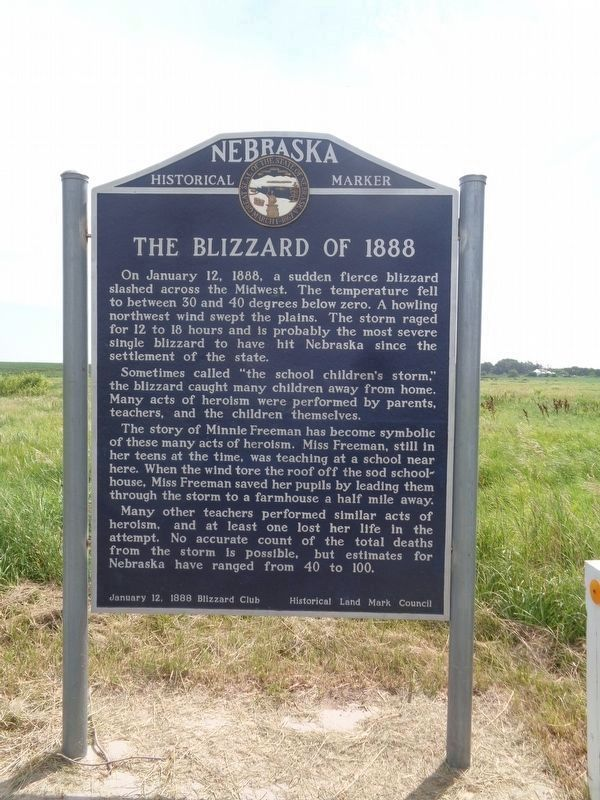
Freeman’s rescue near Ord became one of the most widely celebrated episodes of the disaster. It was documented by newspapers in 1888, remembered in later histories and commemorated by Nebraska’s official historical marker. The central outcome is consistent: Freeman brought the children under her care to shelter alive. The exact details of their escape, however, changed between accounts.
A warm winter morning ended in a deadly blizzard
January 12 began with relatively mild weather across much of the affected region. Nebraska State Historical Society accounts describe schoolchildren playing outside during their midday recess and some adults working outdoors without heavy winter clothing. The conditions offered little indication to those on the ground of the severe weather that would develop that afternoon.
A powerful surge of Arctic air moved into the region, accompanied by a sharp shift to northerly winds. Snow was lifted and driven across the prairie, sharply reducing visibility. The greatest danger came from the combination of wind, blowing snow, and rapidly falling temperatures rather than snow accumulation alone.
A Nebraska State Historical Society retrospective describes winds reaching approximately 90 km/h (56 mph) and temperatures falling to around -38°C (-36°F) during the storm. Conditions varied by location, and these figures should not be interpreted as measurements recorded at every schoolhouse. The storm’s most severe conditions lasted roughly 12 to 18 hours in much of Nebraska.
In the open countryside, familiar landmarks disappeared behind blowing snow. A farmhouse could be close enough to reach in ordinary weather but almost impossible to locate during a whiteout. Children stranded at school faced a difficult choice: remain in buildings with limited food, fuel, or structural protection, or attempt to reach shelter across exposed ground.
History Nebraska estimates that 40 to 100 people died in the state. The wider storm caused fatalities across several states and territories, but historical records do not establish an exact overall total. The uncertainty reflects incomplete reporting from isolated settlements and the difficulties of compiling losses after the disaster.
The schoolhouse lost its roof, forcing a dangerous evacuation
Minnie Mae Freeman was teaching in Mira Valley, south of Ord in Valley County, when the storm reached her schoolhouse. Contemporary accounts place her age at 19. The building was constructed of sod, an important building material for settlers on the Great Plains, where timber was often scarce.
An account reproduced in the March 1888 issue of The Arrow, a Pi Beta Phi publication, describes the storm tearing the schoolhouse door from its hinges before lifting the roof. With the building no longer providing adequate protection, Freeman gathered the pupils for a walk to the nearest farmhouse.
Reports published shortly after the storm describe her finding a length of twine and fastening the children together. Historian Tom Isern, drawing on an account supplied to the Omaha Bee by J. H. Ager of Ord, describes four groups of three children connected by tethers, while Freeman carried the youngest pupil. The precise arrangement differs in later retellings.
The children then made their way toward a farmhouse through the blowing snow. The March 1888 account describes them stumbling over drifts and being knocked down by the wind. Freeman kept the group moving until they reached the home of a nearby school patron, where they were sheltered.
A contemporary newspaper account reprinted in the Buchanan Record on February 23, 1888 also describes Freeman using strong twine, carrying the youngest child and leading the others to a farm residence. It places the journey at three-quarters of a mile, rather than the half-mile distance recorded on Nebraska’s historical marker.
Twine, distance, and pupil numbers differ between historical accounts
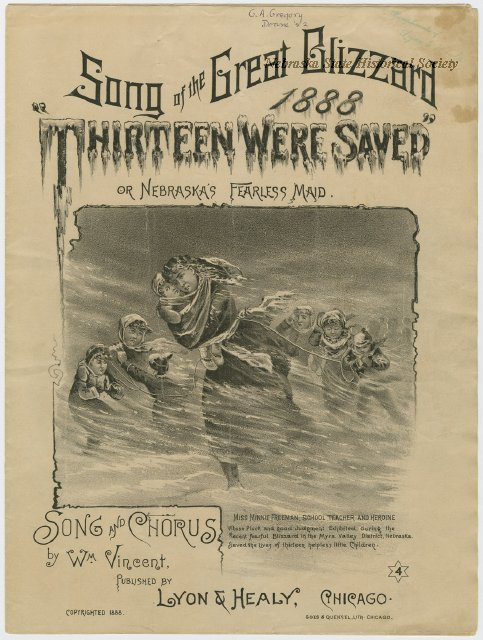
The familiar version of Freeman’s rescue describes 13 children tied together with twine and led approximately 0.8 km (half a mile) to safety. Each element has some support in the historical record, but the surviving accounts do not establish one completely consistent version.
The use of twine is supported by early newspaper reports and by statements later attributed to Freeman herself. In a published recollection reproduced by the Nebraska Department of Education, she described taking a ball of stout twine from her desk, tying the children together and securing one end to her arm.
However, reports differ on whether the children were arranged in single file, in pairs or in small connected groups. A later newspaper letter disputed the tying altogether and described children holding hands. The disagreement makes the general claim that Freeman kept the group together better supported than any precise reconstruction of the formation.
The distance is similarly uncertain. Nebraska’s official marker states that Freeman led her pupils to a farmhouse approximately 0.8 km (half a mile) away. Other contemporary accounts place the destination at about 1.2 km (three-quarters of a mile), while some later versions give approximately 1.6 km (one mile). No surviving measurement establishes an exact route.
The number of children presents an even more important discrepancy. Early reports and the Nebraska State Historical Society’s 1947 account identify 13 pupils. That number became central to Freeman’s fame through an 1888 commemorative song titled Thirteen Were Saved, or Nebraska’s Fearless Maid.
Yet a chapter titled The Blizzard of 1888, published under the name Minnie Freeman Penney in the 1916 Collection of Nebraska Pioneer Reminiscences, gives her class as 17 pupils. It also places the farmhouse almost a mile from the schoolhouse. The account describes all the children reaching shelter and receiving a warm meal and beds.
The 1916 chapter is important because it appeared under Freeman’s own name, although it recounts her experiences in the third person. Its larger pupil count is not reconciled with the earlier accounts. Nebraska educational material also acknowledges reports of 13, 16, and 17 children, demonstrating that the discrepancy has long been recognized.
These disagreements do not overturn the essential outcome of the rescue. They do, however, prevent the exact number of children, the binding arrangement, and the distance from being presented as independently settled facts.
Other Nebraska teachers faced devastating outcomes
Freeman’s successful evacuation was not representative of every schoolhouse caught in the storm. Other teachers attempted similar journeys under conditions in which becoming disoriented could be fatal, even when shelter was nearby.
Lois Royce, a teacher near Plainview, attempted to lead three young children to a nearby farmhouse after conditions at her school became untenable. They lost their way in the storm. All three children died, and Royce survived with injuries that required amputation of her lower limbs.
Emma Shattuck, another teacher in Holt County, became lost after leaving her school. She found partial shelter in a haystack and remained there from Thursday until Sunday. She suffered severe frostbite, underwent amputations, and subsequently died.
Other groups survived by remaining indoors rather than attempting to travel. An account of teacher Arthur Heywood, preserved in Nebraska educational records, describes him keeping children inside their schoolhouse overnight, with older pupils helping care for the younger ones until parents arrived after the storm.
These accounts show why no single response could guarantee survival. The condition of the building, available fuel, distance to shelter, visibility and the direction of travel all affected the options available to teachers. Freeman’s success depended on the group reaching its destination despite a storm that made even much shorter journeys deadly.
A failed warning system and the making of a Nebraska legend
The Schoolchildren’s Blizzard occurred when federal weather forecasting was administered by the U.S. Army Signal Service. Weather observations and warnings depended heavily on telegraph communications, and a warning could be delayed or prevented from reaching a community if the lines failed.
The National Weather Service’s historical account of the storm in the Black Hills records a particularly clear example. A cold-wave warning issued from St. Paul, Minnesota, failed to reach Rapid City, Dakota Territory, before the storm because Western Union telegraph lines had gone down. The local warning signal was therefore raised too late. This was a documented communications failure rather than evidence that no forecast existed anywhere in the affected region.
After the winter storms of 1888, the limitations of the federal forecasting service attracted substantial criticism. In 1890, Congress transferred national weather responsibilities from the War Department to a civilian Weather Bureau within the Department of Agriculture. The institutional change had broader origins, but the disasters of 1888 became important examples in the history of weather-warning reform.
Modern forecasts can communicate expected snowfall, wind gusts, timing, and visibility before conditions deteriorate. For example, Blizzard Warnings issued across the northeastern United States in February 2026 described anticipated whiteout conditions, while warnings for the northern Great Plains in December 2025 identified the combination of dangerous winds and blowing snow. Such information was not available to rural families in 1888 through comparable rapid public-alert systems.
Freeman’s rescue also became part of the cultural response to the catastrophe. Composer William Vincent produced the commemorative song Song of the Great Blizzard: Thirteen Were Saved, or Nebraska’s Fearless Maid. Freeman received public honors, including a gold medal, and accounts of her actions circulated nationally.
In later years, survivors established the January 12, 1888 Blizzard Club and collected accounts of the disaster. Its 1947 publication, In All Its Fury, preserved memories of children, teachers, farmers and families whose experiences might otherwise have been lost.
Freeman’s story endured because it supplied a rare successful outcome to a disaster remembered for widespread losses. The surviving records establish that she brought her pupils to safety after their schoolhouse was damaged. What remains unresolved is the exact composition of the group and the route they followed, details that reveal how quickly a documented rescue can acquire conflicting versions while its central achievement remains unchanged.
References:
1 James C. Olson, Looking Back on the Blizzard of 1888 – Nebraska State Historical Society – January 1947, reproduced online.
2 Blizzards – Nebraska State Historical Society – February 1999
3 Marker Monday: The Blizzard of 1888 – Nebraska State Historical Society – Publication date not specified on the accessed page
4 Blizzards – Nebraska State Historical Society – February 1999
5 Fran Becque, Minnie Freeman and the Schoolhouse Blizzard of 1888 – Fraternity History & More – February 18, 2015; reproducing material published in The Arrow, March 1888
6 Tom Isern, The Legend of Minnie Freeman – Prairie Public, Plains Folk – March 9, 2024
7 Contemporary report on Minnie Freeman and the 1888 blizzard – Buchanan Record, Buchanan, Michigan – February 23, 1888
8 Peg Sheldrick and Cindy Johnson, The Blizzard of 1888, Virtual Capitol Lessons – Nebraska Department of Education – Publication date not specified; includes excerpts from the Omaha World-Herald, January 12, 2013
9 The 19-Year-Old Teacher Near Ord, Nebraska, Who Led Her Pupils to Safety in a Blizzard – KNOWOL – Historical newspaper analysis linking the Omaha Daily Bee and New-York Tribune reports of January and February 1888
10 Minnie Freeman Penny, The Blizzard of 1888, in Collection of Nebraska Pioneer Reminiscences – Nebraska Society of the Daughters of the American Revolution – 1916, pages 203–204; digitized by Project Gutenberg
11 The Children’s Blizzard in the Black Hills Country – National Weather Service, Rapid City – Publication date not specified
12 Jason G. Gauthier, History and the Census: The 1888 Schoolchildren’s Blizzard – U.S. Census Bureau – January 1, 2026
13 Blizzard of January 12, 1888 – Nebraska State Historical Society – Online historical account of the Blizzard Club and its 1947 publication

Rishav Kothari is Editor-in-Chief of The Watchers, where he runs the newsroom and covers earthquakes, volcanoes, severe weather and space weather.
Published in the last 24 hours
- In the winter of 1811–12, earthquakes near New Madrid, Missouri, shook so hard that witnesses saw the Mississippi River flow backward, and the shaking left a brand-new lake in Tennessee Epicenter
- On 28 August 1859 a solar storm shocked telegraph operators and threw sparks on other lines, and on 2 September Boston to Portland clerks unhooked their batteries and kept sending for more than two hours on the aurora's current alone. Epicenter
- In 2019, the Ronald Reagan Presidential Library hired hundreds of goats to eat 13 acres of brush around it; months later the Easy Fire surrounded the library, and the fire break the goats left behind slowed the flames before they reached the building Epicenter
- NASA built the Opportunity rover to last 90 days on Mars, and Martian winds helped keep it alive for nearly 15 years by blowing dust off its solar panels, until a planet-wide dust storm in 2018 blocked sunlight and silenced the rover Epicenter
