• Noctilucent cloud season begins: How glowing night clouds form near the edge of space

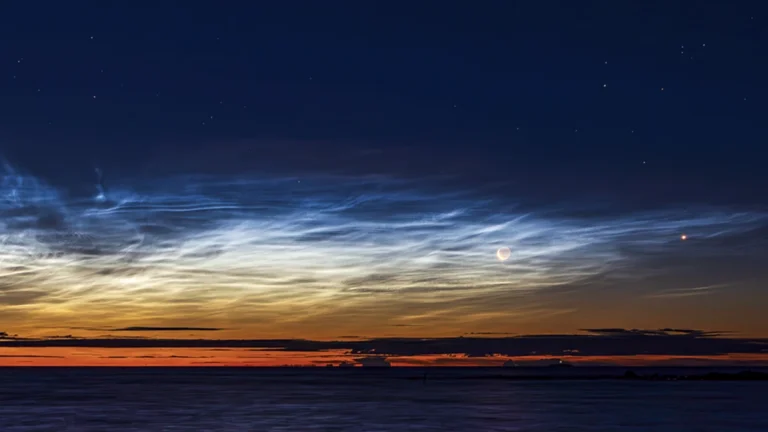
    Noctilucent cloud season is underway across the Northern Hemisphere, bringing one of Earth’s most unusual atmospheric phenomena back to twilight skies. Composed of microscopic ice crystals suspended near the edge of space, these clouds shine with a distinctive silver-blue glow when conditions in the upper atmosphere become cold enough for them to form.

  • New analysis sheds light on unexpected reversal in Earth’s molten outer core beneath the Pacific

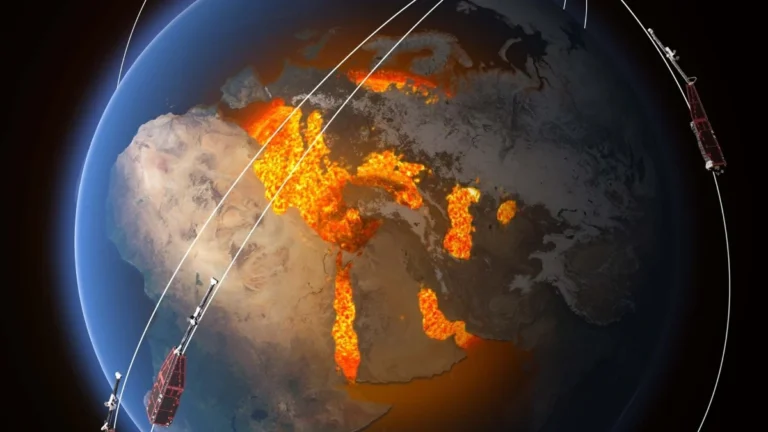
    A new analysis of geomagnetic observations from 1997 to 2025 shows that the unexpected reversal in Earth’s outer-core flow beneath the equatorial Pacific around 2010 has weakened since 2020, refining scientists’ understanding of one of the most unusual deep-Earth changes detected in recent decades.

  • ESA and JAXA sign planetary defence agreement for Ramses mission to Apophis

    The European Space Agency and the Japan Aerospace Exploration Agency signed a Memorandum of Cooperation on planetary defence and a dedicated Ramses mission agreement in Berlin, Germany, on May 7, 2026. Ramses is planned to rendezvous with asteroid (99942) Apophis before its safe close flyby of Earth on April 13, 2029.

  • Biggest solar storms can occur years after solar maximum

    Solar Cycle 25 remains in an active phase after reaching its peak sunspot number in late 2024, but major solar storms remain possible as the cycle declines, NOAA Space Weather Prediction Center (SWPC) research scientist Mark Miesch said in a video update posted on May 1, 2026. Solar activity is forecast to gradually decrease in the coming years, but the declining phase can still produce strong flares, CMEs, and geomagnetic storms.

  • New York and New Orleans among most flood-prone U.S. cities, new study shows

    Flood risk along the U.S. Gulf and Atlantic coasts affects a disproportionate share of the population, with 16.7% living in very high-risk zones that cover just 1.1% of land, according to a new study. New York City and New Orleans rank among the most exposed urban areas, with up to 4.75 million residents at risk in New York and nearly 99% of New Orleans’ population located in flood-prone zones. High-risk areas account for another 3.5% of land but include 16.21% of residents.

  • High radiation levels measured at sunken Soviet submarine K-278 Komsomolets site

    Sunken Soviet submarine K-278 Komsomolets in the Norwegian Sea continues to release radioactive material more than three decades after sinking on April 7, 1989, according to a 2026 study. Measurements show extremely high concentrations of radionuclides near the wreck, while rapid dilution in surrounding seawater limits broader environmental impact.

  • Eight bright fireballs reported over U.S. in March as spring fireball season returns

    Eight bright fireballs were reported over the U.S. between March 3 and 24, 2026, drawing renewed attention to a seasonal increase in fireball activity often seen around the March equinox. NASA has long said sporadic fireball rates can rise by about 10% to 30% during this period, a pattern recognized for more than four decades, even though its cause remains unresolved.

  • How disruption in the Strait of Hormuz threatens fertilizer supply and global food prices

    Shipping through the Strait of Hormuz sharply declined in early March after escalating conflict in the Gulf disrupted commercial navigation through the narrow corridor between Iran and Oman. While the strait is widely known as one of the world’s most important oil routes, it also connects natural gas exports from Gulf producers to global fertilizer production and agricultural supply chains. Disruptions affecting this corridor can therefore propagate beyond energy markets and influence fertilizer availability, agricultural input costs, and ultimately food prices worldwide.

  • Earth’s magnetic power is shifting from Canada to Siberia

    Satellite measurements from 2014 to 2025 show that the northern hemisphere’s strongest magnetic field region is shifting from Canada toward Siberia as the Canadian lobe weakens and the Siberian lobe intensifies. The redistribution is directly linked to the continued eastward drift of the north magnetic pole, now moving at about 36 km/h (22 mph), and requires updates to global navigation models. Over the same 11-year interval, the southern hemisphere’s strong-field region between Australia and Antarctica remained largely stable.

  • SOLAR-1 reaches Lagrange point 1, beginning NOAA’s new operational era in space-weather observation

    A new operational space-weather satellite, named SOLAR-1, took position between Earth and the Sun on January 23, 2026, about 1.6 million km (1 million miles) from Earth. The observatory begins the transition of U.S. space-weather monitoring from research missions to continuous hazard surveillance, enabling earlier detection of solar storms that can affect satellites, communications, and power systems.