
Euclid uncovers 31 ancient quasars, including the most distant ever observed
A study published in Astronomy & Astrophysics on July 6, 2026, reports that the European Space Agency’s (ESA) Euclid space telescope has discovered 31 quasars dating to the Universe’s first billion years. The discoveries include the two most distant quasars ever observed and provide astronomers with their first large sample of these rare objects from the epoch of reionisation, offering new insight into how the earliest supermassive black holes and galaxies formed.
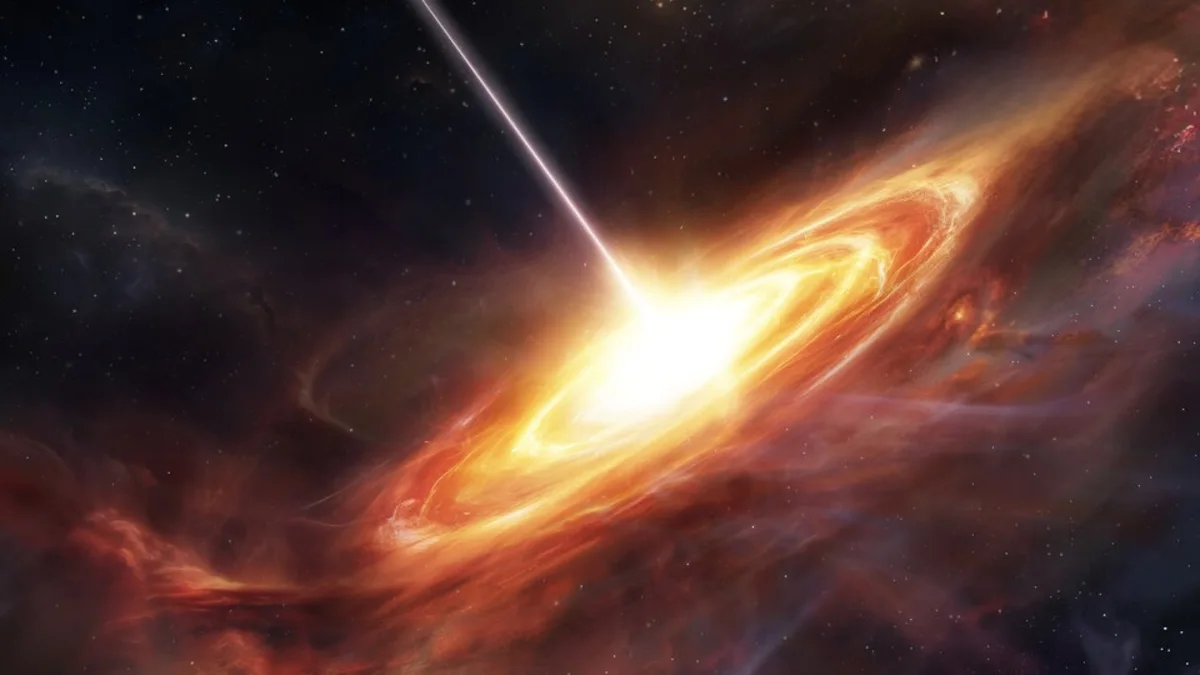
Artist’s concept of an ancient quasar. Credit: ESA
The European Space Agency’s (ESA) Euclid space telescope has discovered 31 quasars dating to the Universe’s first billion years, including the two most distant ever observed. Identified during the mission’s first 1.5 years of science operations, the discoveries provide astronomers with their largest sample yet of quasars from the epoch of reionisation, when the first stars and galaxies transformed the young Universe from an opaque, neutral state into the transparent cosmos seen today.
The discoveries are described in a study published on July 6, in Astronomy & Astrophysics.
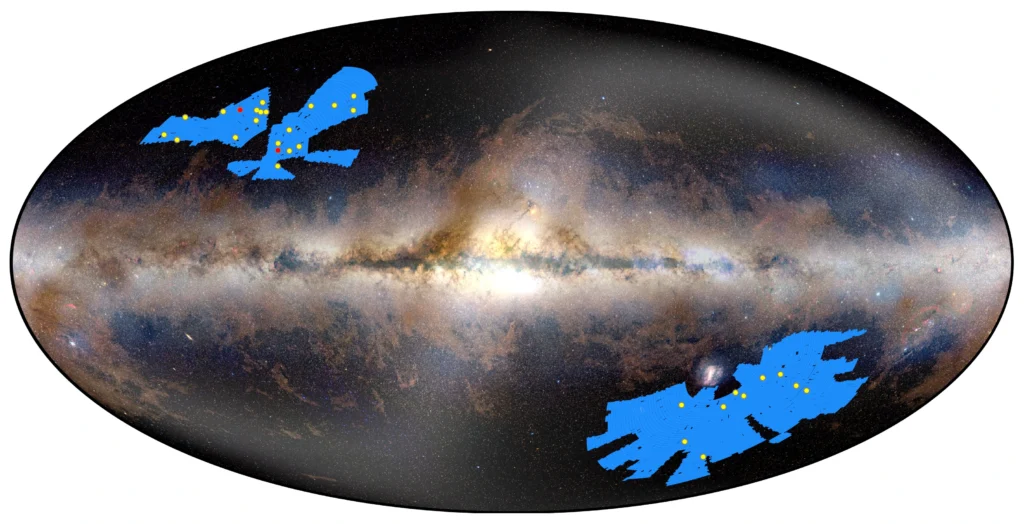
An international team from the Euclid Consortium identified the quasars using observations collected during the first 1.5 years of the Euclid Wide Survey, which has so far mapped about 3 000 deg2 of the sky. Researchers combined multiple machine-learning and probabilistic techniques to identify promising candidates before confirming them through spectroscopic observations with ground-based telescopes.
Quasars are the intensely luminous cores of galaxies powered by supermassive black holes accreting surrounding gas. As material spirals toward these black holes, enormous amounts of energy are released, allowing quasars to outshine the combined light of the billions of stars in their host galaxies.
Finding quasars from this early period of cosmic history has proved exceptionally difficult because they are both rare and faint, and their ancient infrared light can easily be mistaken for that of much closer stars. Previous surveys detected only the brightest examples, providing an incomplete view of the earliest quasar population.
Euclid’s combination of wide-area coverage, deep imaging and space-based infrared observations is allowing astronomers to detect much fainter quasars across vast regions of the sky. Rather than revealing only the brightest outliers, the mission is beginning to uncover what researchers describe as the broader population of ancient quasars, providing the first opportunity to study these objects as a group.
The survey identified quasars spanning redshifts between 6.6 and 7.8. Twelve lie at redshifts of 7 or higher, more than doubling the number of known quasars from this early stage of cosmic history.
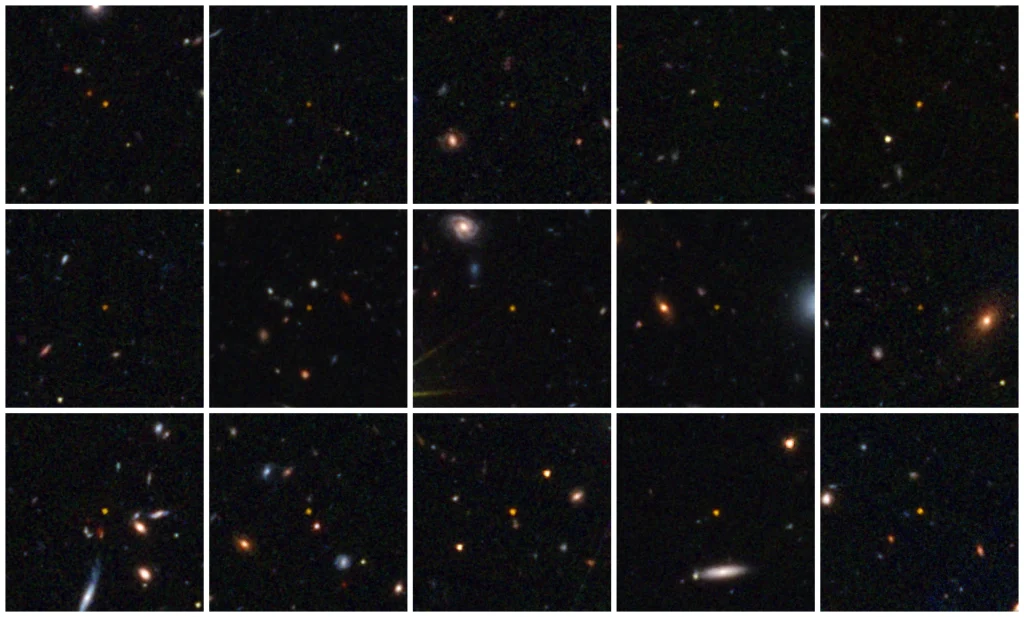
The most distant object, designated EUCL J172902.75+641018.1, has a redshift of 7.77, while the second most distant, EUCL J125308.55+705432.3, has a redshift of 7.69. Both emitted their light about 670 million years after the Big Bang, when the Universe was only about 5% of its current age. The previous record-holder, discovered in 2021, had a redshift of 7.64.
Many of the newly identified quasars are significantly less luminous than those discovered in earlier surveys, extending observations into a population that was previously beyond reach. Because these objects are thought to be more representative of the early quasar population than the exceptionally bright quasars discovered in the past, they are expected to improve understanding of how the first supermassive black holes formed, grew and evolved alongside their host galaxies.
The survey also identified two quasars with radio counterparts in the LOFAR Two-metre Sky Survey (LoTSS). According to the researchers, their powerful radio emission is more consistent with jets produced by actively accreting supermassive black holes than with star formation in their host galaxies, providing evidence that powerful quasar jets were already present less than a billion years after the Big Bang.
Follow-up observations of one of the newly discovered quasars indicate that it resides in a dusty, gas-rich galaxy undergoing intense star formation, offering a glimpse of the environments in which some of the earliest supermassive black holes evolved.
The discoveries come from only a fraction of Euclid’s planned six-year survey, which will eventually map more than one-third of the sky while observing billions of galaxies. Based on current discoveries and mission forecasts, researchers expect Euclid to uncover many more distant quasars and potentially identify the first known quasars beyond a redshift of 8, opening an even earlier window into cosmic history.
The researchers caution that spectroscopic follow-up observations remain essential to characterise many of the newly discovered quasars, particularly the faintest objects, and to better understand how the earliest supermassive black holes, galaxies and the intergalactic medium evolved during the epoch of reionisation.
References:
1 Euclid: Discovery of 31 new quasars at 6.6 < z < 7.8 – D. Yang, J. F. Hennawi, F. Guarneri, J. Wolf, S. Belladitta et al. – Astronomy & Astrophysics – July 6, 2026 – DOI: https://doi.org/10.1051/0004-6361/202658883 – OPEN ACCESS
2 Euclid discovers the most ancient quasars in the Universe – European Space Agency (ESA) – July 6, 2026

I’m a science journalist and researcher at The Watchers, contributing to the Epicenter edition, where I cover peer-reviewed scientific research and emerging discoveries across Earth and space sciences. With a background in astronomy and a passion for environmental science, I’ve worked in shark and coral conservation in Fiji, conducting reef and shark-behavior research, contributing to mangrove restoration, and earning PADI Open Water and Coral Reef Certifications. I bring a blend of scientific rigor and storytelling to illuminate the discoveries shaping our planet and beyond.

Commenting rules and guidelines
We value the thoughts and opinions of our readers and welcome healthy discussions on our website. In order to maintain a respectful and positive community, we ask that all commenters follow these rules.