
Over 300 000 evacuated in France and Spain as authorities prepare for renewed heatwave
Massive wildfires continued to burn across southwestern Europe on Monday, July 27, 2026 as French and Spanish authorities prepared for another period of extreme heat expected later this week. More than 300 000 people have been displaced, while thousands of firefighters, aircraft and international emergency crews continue battling some of Europe’s largest wildfires. Officials warned that rising temperatures and critically dry vegetation could make containment efforts significantly more difficult.
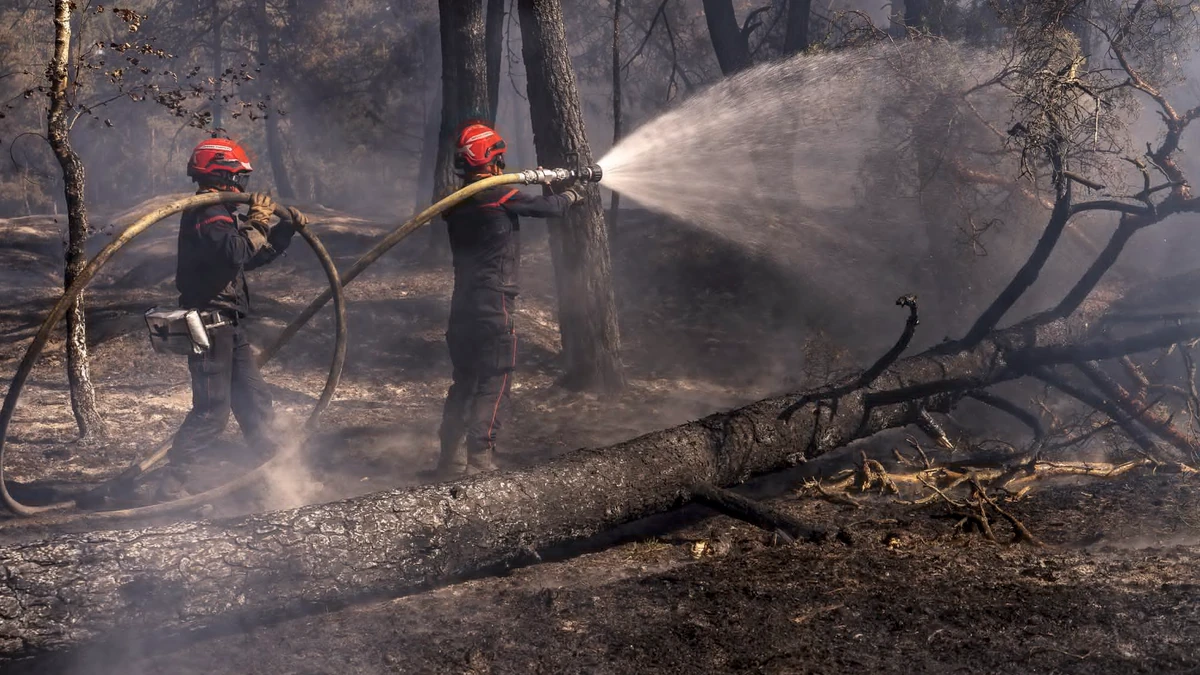
Firefighters battling wildfires in France on July 25, 2026. Credit: President Emmanuel Macron
Massive wildfires continued to burn across southwestern Europe on Monday, July 27. France and Spain continue attempts to contain some of the continent’s most destructive fires before another heatwave intensifies later this week.
More than 300 000 people have been displaced across the two countries, while thousands of firefighters, aircraft and international emergency crews remain engaged in suppression operations.
The most critical situation remains in France’s Gironde department, where the wildfire advanced to within about 15 km (9 miles) of Bordeaux before cooler temperatures and lighter winds slowed its progress overnight on July 26.
The fire had been stabilized but was not yet under control, stressing that firefighters remain on high alert as hotter, drier weather is forecast later this week, accoridng to French Interior Minister Laurent Nuñez. Around 220 000 people have been evacuated or displaced since the fire began.
The Gironde wildfire has burned about 42 000 ha (104 000 acres), an area roughly four times the size of Paris, making it one of the largest wildfires in modern French history.
About 2 500 firefighters, supported by water-bombing aircraft, helicopters, military personnel and international crews deployed through the European Union Civil Protection Mechanism, continue working to prevent renewed fire growth around Bordeaux and the surrounding wine-producing region.
President Emmanuel Macron chaired a crisis meeting on Monday to coordinate the national response to the Gironde wildfire and other active fires across France as authorities prepared for another period of dangerous fire weather later this week.
France has recorded more than 13 500 wildfires in 2026, with over 100 000 ha (247 000 acres) being reportedly burned nationwide, making this the country’s most severe wildfire season on record.
Firefighters battling the Gironde blaze also observed the formation of pyrocumulonimbus clouds, towering thunderstorms generated by the fire itself.
Laurent Nuñez described the phenomenon as a first for France’s wildfire response. These fire-generated storms produce powerful updrafts, erratic winds and lightning that can rapidly increase fire intensity and spread, making suppression efforts significantly more difficult.
Spain is simultaneously battling multiple major wildfires across the central and eastern parts of the country, including the record-breaking blaze in Ávila, fires west of Madrid and an active wildfire in Castellón Province.
The Ávila wildfire has burned more than 50 000 ha (123 500 acres), making it Spain’s largest recorded wildfire, while more than 150 000 ha (370 700 acres) have burned nationwide during the 2026 wildfire season. More than 100 000 people have been evacuated across affected regions.
One of the most challenging operations continues in Castellón Province, where firefighters are working around areas contaminated by unexploded Spanish Civil War ordnance.
The unexploded munitions restrict access to parts of the fire zone and complicate suppression efforts. Spanish authorities have also classified several of the ongoing fires as sixth-generation wildfires, describing them as extremely intense fires capable of generating their own weather systems, behaving unpredictably and overwhelming conventional firefighting strategies.
The European Union has activated its Civil Protection Mechanism to reinforce firefighting operations in both France and Spain. Aircraft, helicopters and ground crews from several participating countries have been deployed to support suppression efforts, while the Copernicus Emergency Management Service continues providing rapid satellite mapping to assist emergency responders.
Meteorological agencies warned that the recent improvement in firefighting conditions may be temporary. Another period of extreme heat is forecast later this week, with temperatures expected to exceed 35°C (95°F) across parts of France and 40°C (104°F) in parts of Spain.
Authorities warn that critically dry vegetation combined with renewed hot weather could quickly increase wildfire activity and make containment efforts more difficult.
Earlier, Spain’s Interior Minister Fernando Grande-Marlaska Gómez has declared a national emergency covering the Madrid region and the neighboring province of Ávila after fast-moving wildfires threatened populated areas and prompted the activation of Level 3, the country’s highest civil protection emergency reserved for incidents of national interest. The order was signed on July 23 and published in the Official State Gazette (BOE) on July 24.
References:
1 Europe wildfire in pictures: Gigantic fire cloud engulfing France, Spain regions – CNBC – July 27, 2026
2 Wildfire has ‘life of its own’, says French minister, with blaze nine miles from Bordeaux outskirts – BBC – July 27, 2026

I am an Assistant Editor and Severe Weather & Science Journalist at The Watchers, specializing in real-time severe weather coverage, geophysical event reporting, and research-driven scientific analysis. You can reach me at rishav(at)watchers(.)news.

Commenting rules and guidelines
We value the thoughts and opinions of our readers and welcome healthy discussions on our website. In order to maintain a respectful and positive community, we ask that all commenters follow these rules.