
Wildfire near Ferial Reservoir in Spain’s Bardenas Reales brought under control in about 2 hours after burning 4-5 ha of Aleppo pine
A wildfire near Embalse del Ferial in the Bardenas Reales area of Navarra, Spain, was brought under control at approximately 22:30 LT on June 19, 2026, after a coordinated response involving helicopters, helitransported forest firefighters and ground crews. Authorities reported no injuries and no damage to property.
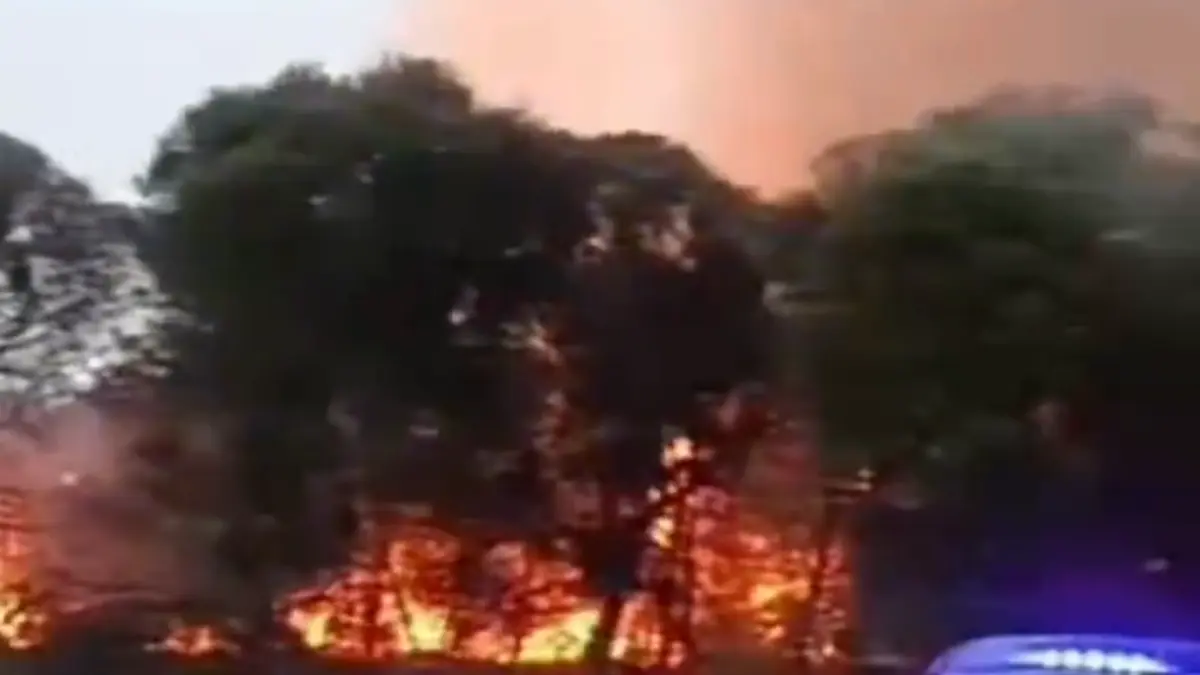
Image credit: Guardia Civil Navarra
The fire was detected at approximately 20:25 LT on June 19 by a patrol from SEPRONA, the environmental protection unit of the Guardia Civil based in Castejón. Officers observed a column of smoke and located a fire in a pine woodland area situated within an agricultural landscape near the reservoir.
The initial affected area was estimated at about 0.5 ha (1.2 acres). The fire later expanded to between 4–5 ha (10– 12.4 acres) before crews stopped its advance. Authorities reported that the affected area consisted mainly of Aleppo pine (Pinus halepensis) woodland.
Resources mobilized to the scene included two helicopters, three light firefighting brigades from Peralta, Tafalla, and Tudela, a helitransported forest fire brigade (BHIF), Forest Guards from the regional environmental department, Policía Foral officers, and additional Guardia Civil personnel.
Emergency services reported the fire under control at approximately 22:30 LT on June 19. Extinguishment operations continued afterward, and firefighters from the Peralta station remained inside the perimeter on the morning of June 20, carrying out cooling and surveillance work.
The Guardia Civil continued monitoring the area while authorities prepared a technical inspection to determine the cause of the fire. No official cause had been reported as of June 20.
The incident occurred during a period of very high to extreme wildfire danger across parts of Navarra, according to forecasts issued by AEMET, Spain’s State Meteorological Agency.
Guardia Civil and emergency services reminded the public to avoid using agricultural machinery during the hottest hours of the day, refrain from abandoning waste in natural areas, particularly glass, and comply with fire-use restrictions.

I’m a science journalist and researcher at The Watchers, contributing to the Epicenter edition, where I cover peer-reviewed scientific research and emerging discoveries across Earth and space sciences. With a background in astronomy and a passion for environmental science, I’ve worked in shark and coral conservation in Fiji, conducting reef and shark-behavior research, contributing to mangrove restoration, and earning PADI Open Water and Coral Reef Certifications. I bring a blend of scientific rigor and storytelling to illuminate the discoveries shaping our planet and beyond.
Published in the last 24 hours
- Airline pilots reported red flashes shooting upward from thunderstorms for decades, until a camera being tested in Minnesota in 1989 caught one by accident above a distant storm Epicenter
- Luxor sits inside the 258 km wide path of the total solar eclipse of 2 August 2027, and totality will last up to 6 minutes 23 seconds near the city, with the Sun 82 degrees overhead at greatest eclipse. Epicenter
- On 13 April 2029 the 340 m asteroid Apophis will pass about 32,000 km above Earth's surface, inside the ring of geosynchronous satellites, and NASA says observers across the Eastern Hemisphere will see it without a telescope or binoculars. Epicenter
- Dust shed by Halley's Comet gives Earth the Eta Aquarids every May and the Orionids every October, and the comet itself, which passed 4.94 million km away on 10 April 837 at about magnitude -3.5, is due to reach perihelion on 28 July 2061. Epicenter
