
More than 6 000 evacuated as Bug and Fred Mountain fires threaten communities north of Reno, Nevada
More than 6 000 people were evacuated from residential neighborhoods in Washoe County and the Reno-Sparks Indian Colony–Hungry Valley as the Bug and Fred Mountain fires threatened communities north of Reno, Nevada. By the evening of August 11, the combined Bug-Fred incident was listed at 23 458 ha (57 966 acres) with 0% containment, while the separate Stallion Fire was listed at 12 767 ha (31 548 acres) with 0% containment. Nevada’s state of emergency remains in effect through August 17 unless terminated sooner.
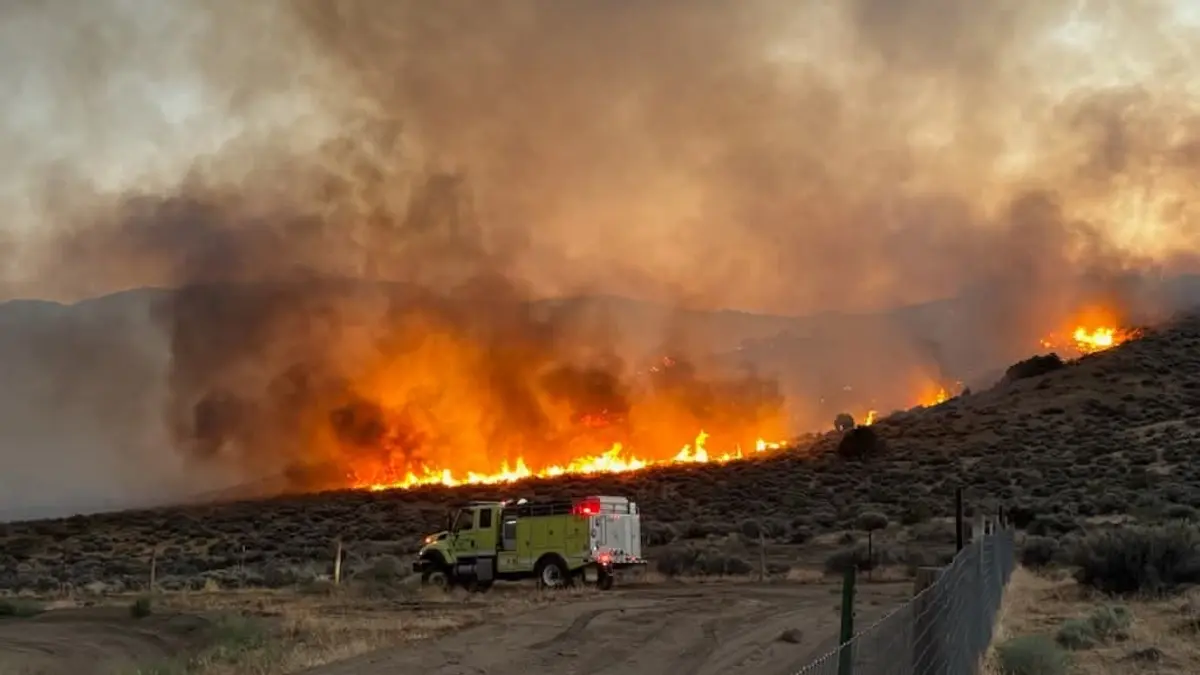
Flames spread across brushland as crews respond to the Bug, Fred Mountain and Stallion fires in northern Nevada. Credit: Bug, Fred Mountain & Stallion Fire Information
CAL Fire reported the Bug Fire starting at 16:08 LT on August 8, east of U.S. Route 395 and south of Bringman Road in Lassen County, California. The fire expanded into Nevada and later burned together with the Fred Mountain Fire. By the evening of August 11, incident figures listed the combined Bug-Fred footprint at 23 458 ha (57 966 acres) with 0% containment.
An earlier CAL FIRE mapping update placed 17 306 ha (42 763 acres) in Nevada and 624 ha (1 541 acres) in California. CAL FIRE said active fire was no longer present in the California portion at that time. Evacuation orders and warnings remained in effect in Washoe County.
The nearby Stallion Fire was listed at 12 767 ha (31 548 acres) with 0% containment in Washoe County’s evening August 11 figures. The same update said 285 personnel was assigned to Bug/Fred and 102 personnel assigned to Stallion. Those staffing figures refer to the evening of August 11.
https://youtu.be/OD9kBD5CgC0?si=EnHORJvdLyW-Ifmy
Nevada declared a state of emergency on August 10 for affected areas of Washoe County and the Reno-Sparks Indian Colony-Hungry Valley.
The declaration states that more than 6 000 people had been evacuated, with thousands of additional residents in evacuation-warning zones. The Bug and Fred Mountain fires threatened thousands of homes in Cold Springs, Red Rock, Antelope Valley and Reno-Sparks Indian Colony-Hungry Valley. The state emergency remains in effect through August 17 unless terminated sooner.
The declaration states that the Bug and Fred Mountain fires were affecting schools, electrical transmission and distribution lines, natural-gas lines, a water-treatment facility, telecommunications sites and a local airport. It does not state that all of those facilities were destroyed or physically damaged.
State agencies were directed to work through the Nevada Emergency Operations Center to supplement local response. The Office of Emergency Management and Homeland Security was directed to work with the Nevada Division of Forestry and the Federal Emergency Management Agency. Washoe County and the Reno-Sparks Indian Colony opened evacuation centers, while Washoe County established a large-animal evacuation facility.
https://www.youtube.com/live/he_oVxccyyY?si=XFW0j3LqV3VINS6y
Authorities have issued different cause classifications for the Bug Fire. CAL FIRE said the cause is under investigation, while Bureau of Land Management Nevada reporting classified it as human-caused. The reviewed authority material does not resolve that difference.
The Freds Mountain Fire is also the subject of a criminal investigation. The Washoe County Sheriff’s Office announced on August 11 that Christine Mitchell, 47, was arrested in connection with the fire after investigators developed probable cause for charges including third-degree arson. The Sheriff’s Office alleges that she intentionally started multiple fires in the area. The investigation remains open, and the arrest does not constitute a finding of guilt.
Fire-weather conditions changed on August 12. In an Area Forecast Discussion issued at 02:25 LT (09:25 UTC), the National Weather Service in Reno forecast thunderstorms moving northward toward the Reno area and closer to the Bug and Stallion fires. The forecast included isolated lightning outside rain cores and outflow gusts near 64 km/h (40 mph). A Fire Weather Watch was in effect from late Wednesday night through Thursday evening for northern Washoe County and adjacent areas.
https://www.facebook.com/share/v/14kqXzS6aPg/
Smoke from the Bug and Stallion fires was forecast to reduce visibility near the fire sites, including possible effects at Reno-Stead Airport. NWS Reno placed the chance of a stronger thunderstorm outflow pushing a larger smoke area south toward the Reno area at 5-10%.
August is within the climatological peak period for wildfire activity across boreal and temperate regions of the Northern Hemisphere. The evacuation scale, infrastructure impacts and emergency response define the operational significance of the fires.
References:
1 Bug Fire – CAL FIRE / Bureau of Land Management – August 11, 2026
2 Declaration of Emergency – The Bug and Fred Mountain Fires – State of Nevada – August 10, 2026
3 Washoe County Sheriff’s Office arrests woman in connection with Freds Mountain Fire – Washoe County Sheriff’s Office – August 11, 2026
4 Area Forecast Discussion – National Weather Service Reno – August 12, 2026
5 Bug, Fred Mountain and Stallion fires operational update – Washoe County – August 11, 2026

I’m a science journalist and researcher at The Watchers, contributing to the Epicenter edition, where I cover peer-reviewed scientific research and emerging discoveries across Earth and space sciences. With a background in astronomy and a passion for environmental science, I’ve worked in shark and coral conservation in Fiji, conducting reef and shark-behavior research, contributing to mangrove restoration, and earning PADI Open Water and Coral Reef Certifications. I bring a blend of scientific rigor and storytelling to illuminate the discoveries shaping our planet and beyond.
