
Spanish government assumes command of wildfire response after declaring national emergency in Madrid region and Ávila
Spain’s Interior Minister Fernando Grande-Marlaska Gómez has declared a national emergency covering the Madrid region and the neighboring province of Ávila after fast-moving wildfires threatened populated areas and prompted the activation of Level 3, the country’s highest civil protection emergency reserved for incidents of national interest. The order was signed on July 23 and published in the Official State Gazette (BOE) on July 24.
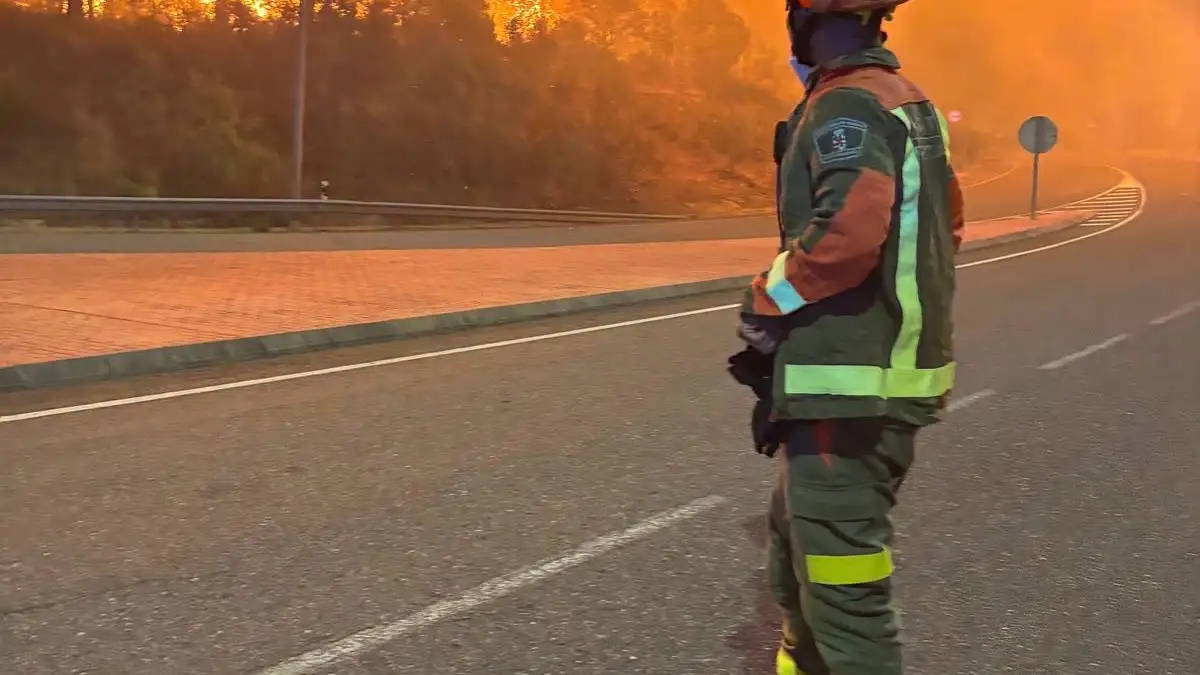
Wildfire crews battle fast-moving fires in the Madrid region and neighboring Ávila, Spain. Credit: Agencia de Seguridad y Emergencias Madrid 112
Fast-moving wildfires are burning through Villa del Prado and San Martín de Valdeiglesias in the Madrid region and Burgohondo in neighboring Ávila.
The Interior Ministry described the multi-front fires as “a particularly serious situation” because of their rapid spread, their impact on inhabited areas and the growing threat to people, infrastructure and the natural environment. Adverse weather conditions, preventive evacuations and the deployment of emergency crews from multiple agencies have further complicated firefighting operations.
Madrid’s regional government requested that the emergency be placed under national command. Interior Minister Fernando Grande-Marlaska Gómez then extended the declaration to neighboring Ávila, placing both territories under a single command because the wildfire emergency had expanded beyond one region.
The declaration activates Level 3, Spain’s highest civil protection emergency, which is reserved for incidents of national interest requiring central government leadership because of their scale, complexity or cross-regional impact.
Grande-Marlaska now has overall responsibility for directing the emergency and coordinating state, regional and local resources across the affected areas. Operational command has been assigned to Spain’s Military Emergency Unit (UME), the country’s specialized military disaster response force.
Additional personnel and resources can also be mobilized from elsewhere in Spain if conditions worsen, even if those regions are not directly affected by the fires.
The national emergency took effect immediately upon being signed on July 23 and will remain in force until the Ministry of the Interior declares that normal conditions have been restored. The order was published in the Official State Gazette (BOE No. 179) on July 24 for general public information.
References:
1 Order INT/748/2026, of July 23, declaring a national emergency in the territory of the Community of Madrid and in the province of Ávila as a result of forest fires – AEBOE – July 24, 2026

I’m a science journalist and researcher at The Watchers, contributing to the Epicenter edition, where I cover peer-reviewed scientific research and emerging discoveries across Earth and space sciences. With a background in astronomy and a passion for environmental science, I’ve worked in shark and coral conservation in Fiji, conducting reef and shark-behavior research, contributing to mangrove restoration, and earning PADI Open Water and Coral Reef Certifications. I bring a blend of scientific rigor and storytelling to illuminate the discoveries shaping our planet and beyond.

Commenting rules and guidelines
We value the thoughts and opinions of our readers and welcome healthy discussions on our website. In order to maintain a respectful and positive community, we ask that all commenters follow these rules.