
Hera begins close survey to explain why DART deflected Dimorphos so strongly
ESA’s Hera spacecraft is now examining the Didymos-Dimorphos binary asteroid system from 28.5 km (17.7 miles), combining visible-light, 25-band multispectral and thermal-infrared observations as it begins the close-range investigation of NASA’s 2022 DART impact. DART shortened Dimorphos’ orbit by about 33 minutes, but explaining the size of that deflection requires measurements that could not be obtained from Earth, including the moonlet’s mass, internal structure and the extent to which escaping impact debris amplified the momentum transferred by the spacecraft.
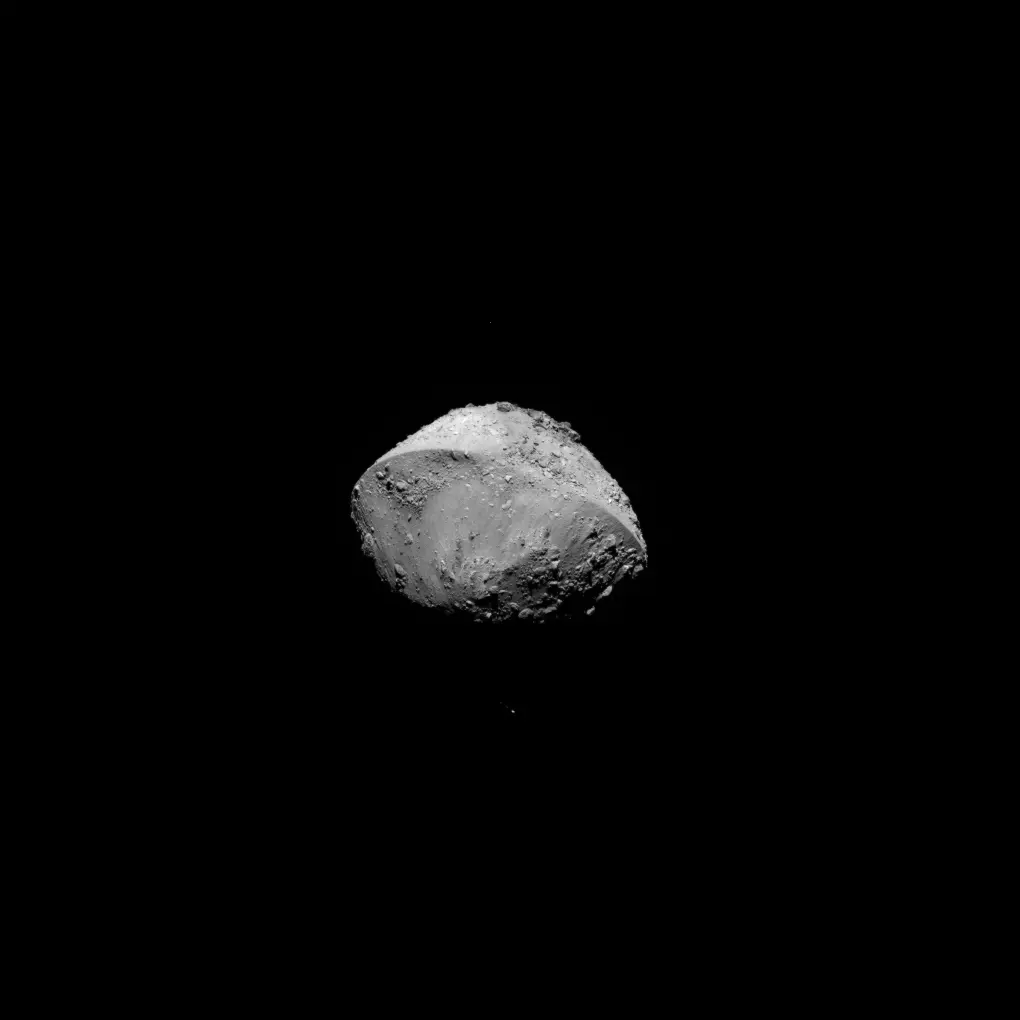
Didymos seen by Hera's Asteroid Framing Camera from 28.5 km (17.7 miles). The image has a spatial resolution of approximately 2.7 m (8.9 feet) per pixel; Dimorphos is almost entirely in shadow in the visible-light observations. Credit: ESA
Hera’s newest observations provide three different physical views of the binary asteroid system. ESA reported on November 17, 2026, that the spacecraft had imaged the 780 m (2 560 feet) Didymos from 28.5 km (17.7 miles) using its Asteroid Framing Camera, HyperScout H imaging spectrometer and Thermal Infrared Imager. The monochrome Asteroid Framing Camera image reaches a spatial resolution of approximately 2.7 m (8.9 feet) per pixel.
The visible-light view resolves the larger asteroid’s pronounced equatorial ridge together with boulder-rich and comparatively clearer areas of its surface. Didymos completes one rotation in about 2.2 hours. ESA is examining whether that rapid rotation helps move loose material toward the equator and contributes to formation of the ridge, an interpretation that remains to be tested against Hera’s continuing observations.
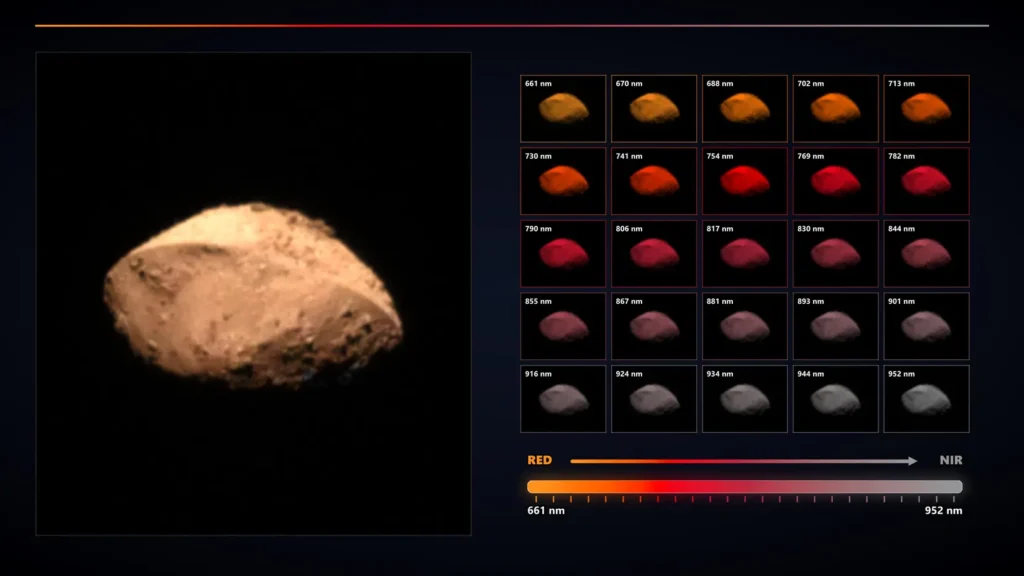
HyperScout H adds compositional information that a monochrome camera cannot provide. The instrument records the asteroid in 25 spectral bands extending from visible red into the near-infrared. Minerals and other surface materials reflect different fractions of incoming sunlight at different wavelengths, so the resulting spectral pattern can be compared with laboratory measurements of meteorites and mineral samples to constrain what the asteroid’s surface is made of.
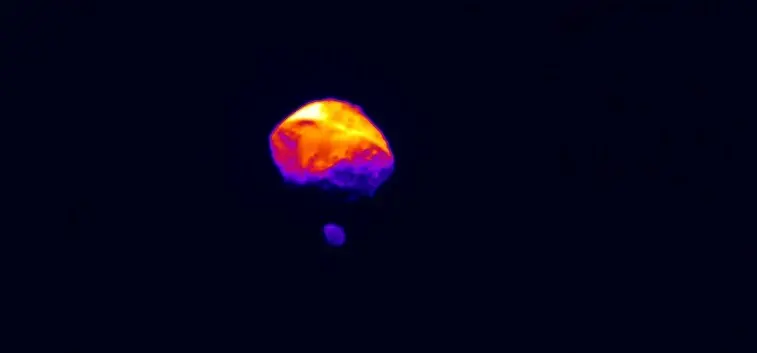
The Thermal Infrared Imager (TIRI), supplied and operated by the Japan Aerospace Exploration Agency (JAXA), measures a different property: heat emitted from the surface. Tracking how temperatures vary across the asteroids and change with time helps distinguish solid rock from porous or fractured material and loose particles ranging down to dust. Dimorphos is almost entirely in shadow in the corresponding visible and multispectral views, while its full body is detectable thermally.
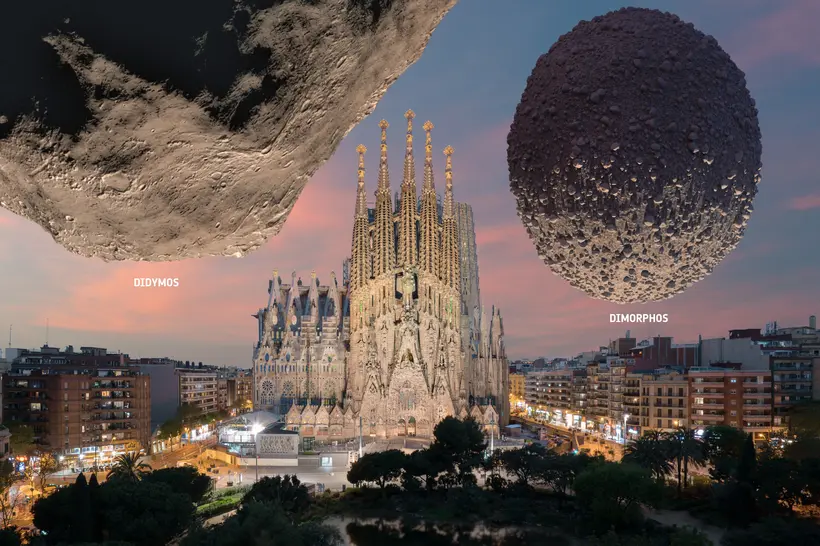
The physical scale and gravity of the two bodies make this type of investigation unusually delicate. Didymos is approximately 780 m (2 560 feet) across and Dimorphos about 151 m (495 feet). ESA estimates the surface gravity of Didymos at roughly 40 000 times weaker than Earth’s and that of Dimorphos at about 200 000 times weaker. Hera therefore moves through the system at a typical relative velocity of only about 12 cm/s (4.7 inches/s), using controlled arcs around the binary system rather than a conventional tight circular orbit.
The scientific reason for measuring those properties began with NASA’s Double Asteroid Redirection Test (DART). On September 26, 2022, the 580 kg (1 279 lb) DART spacecraft struck Dimorphos at approximately 6.1 km/s (3.8 miles/s). ESA reports that the collision produced a debris plume extending across about 10 000 km (6 214 miles) of space and shortened the moonlet’s orbit around Didymos by around 33 minutes.
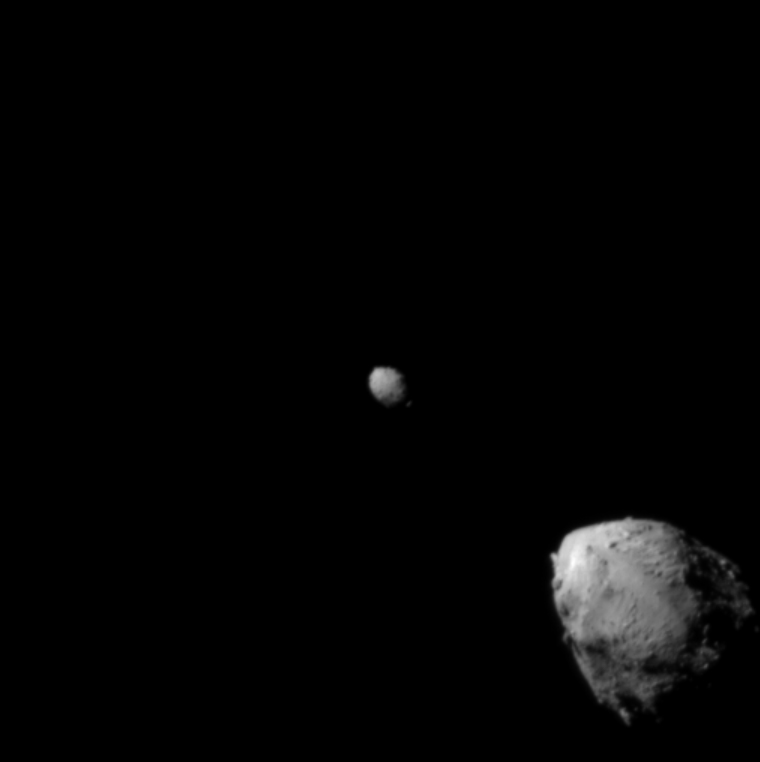
DART’s final approach supplied the first close views of Dimorphos itself. The moonlet’s surface was covered by blocks and smaller material rather than presenting a simple smooth target, information that immediately made its physical response to the impact more complicated than the change in orbital period alone could reveal.
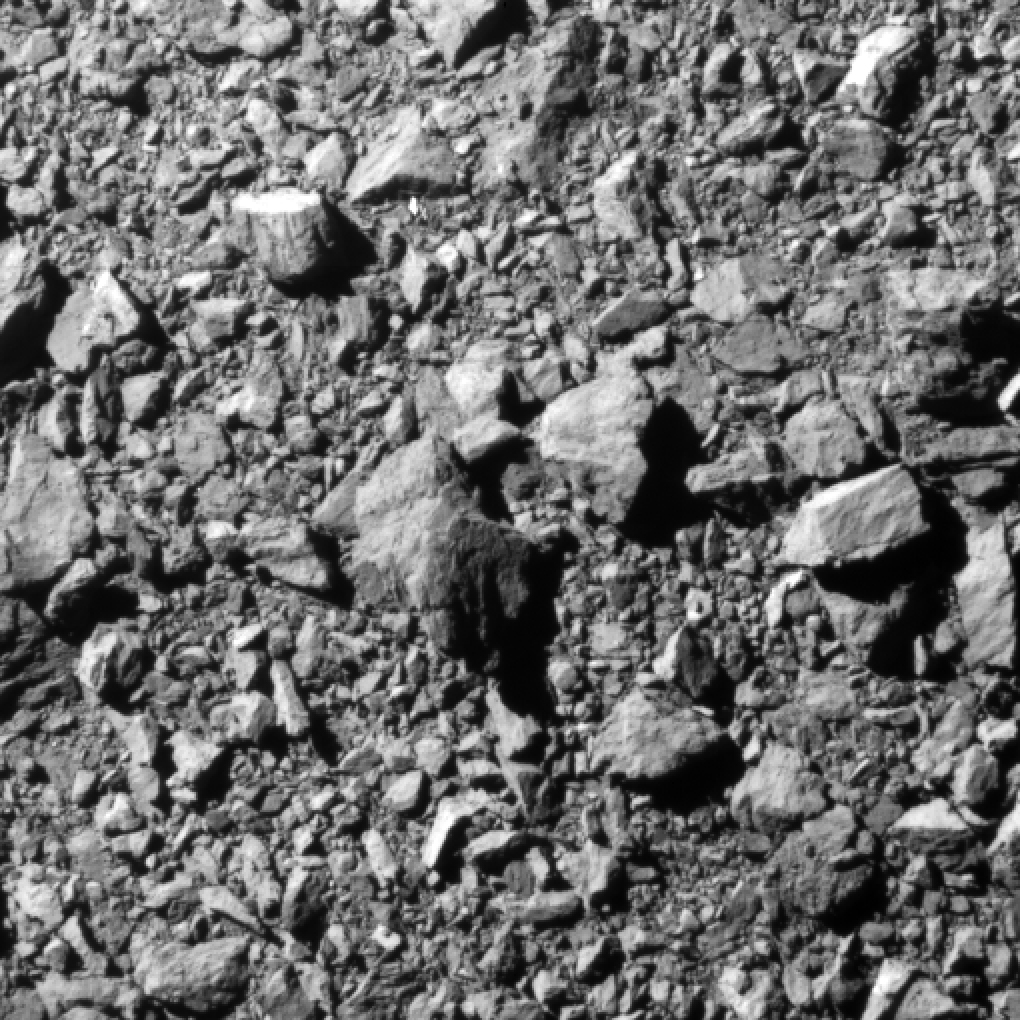
The orbital change establishes that the kinetic impact worked, but it does not by itself specify how efficiently momentum was transferred. Cheng et al. (2023) calculated that the impact produced an instantaneous reduction of 2.70 ± 0.10 mm/s in Dimorphos’ along-track orbital velocity. Material excavated from the asteroid and ejected into space carried momentum in the opposite direction, adding recoil to the direct push supplied by DART itself.
The strength of that enhancement is expressed by the momentum-enhancement factor β. A value of one would represent momentum transfer from the spacecraft without additional enhancement from escaping ejecta; values above one mean the ejecta added recoil. For a plausible Dimorphos bulk-density range of 1 500–3 300 kg/m3, Cheng et al. derived β values from 2.2 to 4.9. Under the specific assumption that Dimorphos had the same bulk density as Didymos, 2 400 kg/m3, the result was β = 3.61 with a +0.19/−0.25 uncertainty at 1σ.
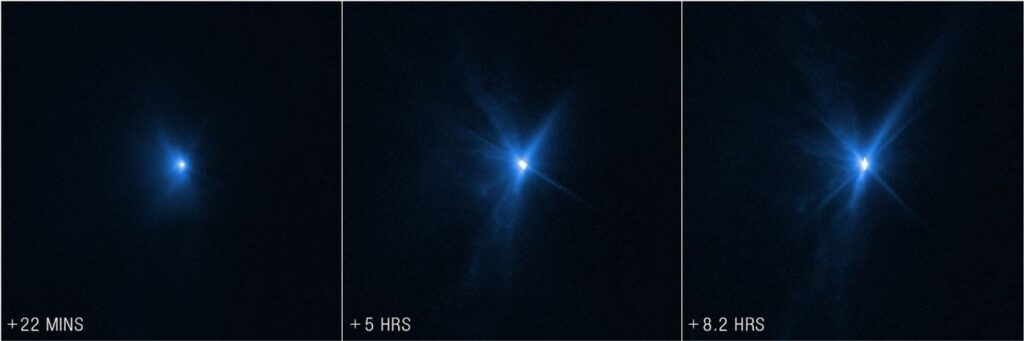
The broad β range is not simply a measurement error. It reflects how strongly the calculation depends on properties of Dimorphos that were not directly known after DART, especially its mass and density. The amount, velocity and direction of excavated material also depend on how the asteroid is assembled internally, how porous it is and how its surface and subsurface respond to a hypervelocity collision.
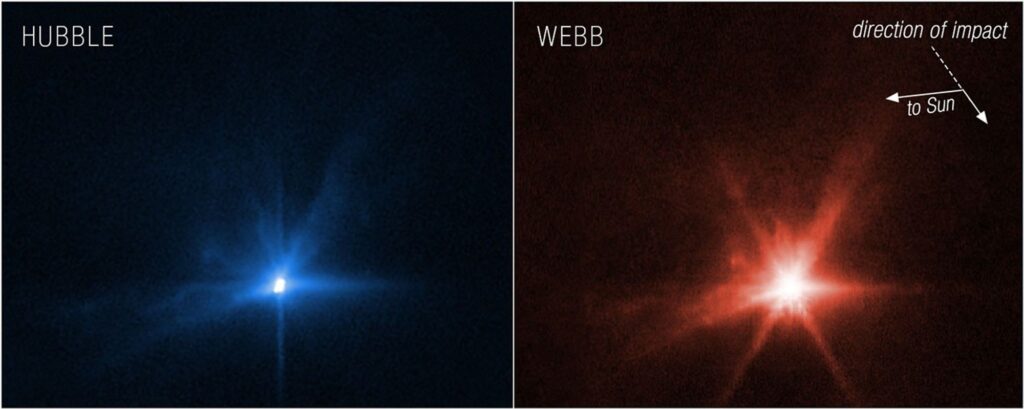
That is the gap Hera is intended to close. ESA lists the precise mass, internal structure and composition of Dimorphos among the mission’s principal targets. Another fundamental question is morphological: whether DART excavated a recognizable impact crater or whether the collision reorganized or reshaped a much larger fraction of the 151 m (495 feet) body. Those different outcomes imply different mechanical responses to the same type of kinetic impact.

Hera’s main spacecraft approaches the problem with several complementary instruments rather than one measurement. Its two Asteroid Framing Cameras provide visible-light imaging for navigation and science; HyperScout H measures 25 visible and near-infrared spectral bands; TIRI maps thermal behavior; a laser rangefinder measures distance to the surface; and radio tracking, including links with the CubeSats, will help determine the gravity fields of Didymos and Dimorphos.
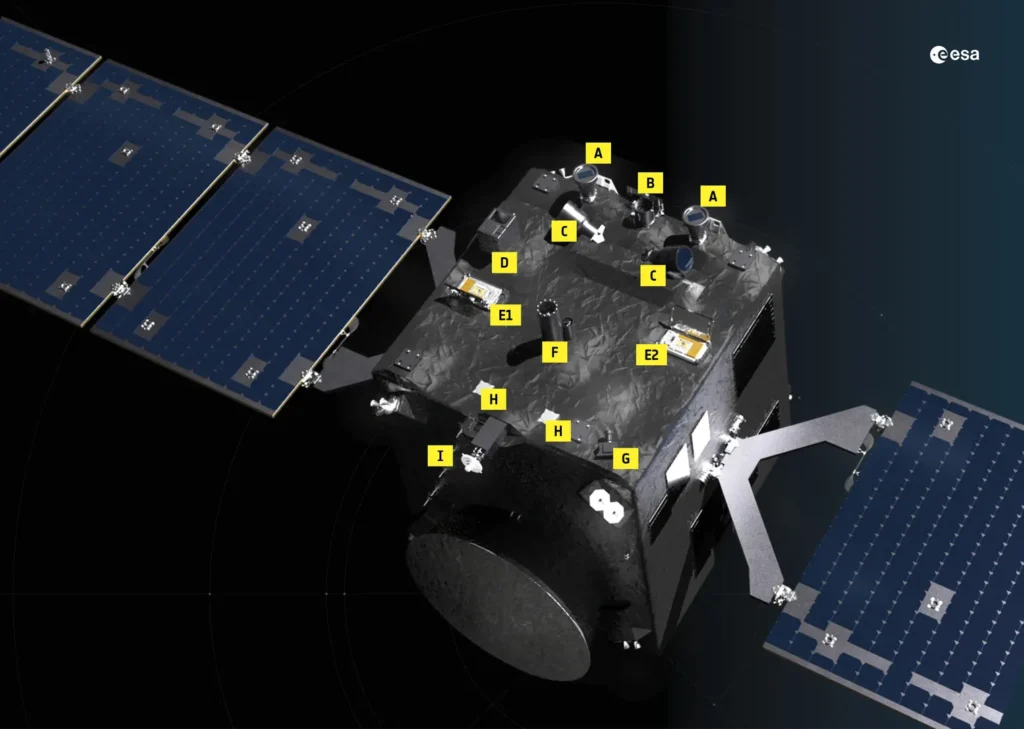
The laser rangefinder operates with 1 550 nm pulses and has a stated distance accuracy better than 1 m (3.3 feet) across a working range from 10 m (33 feet) to 20 km (12.4 miles). These range measurements, together with imaging and radio science, help reconstruct the geometry and gravitational environment of the system rather than relying only on two-dimensional photographs.
Juventas is designed to extend the investigation inside Dimorphos. Its JURA radar will unfold four antennas, each 1.5 m (4.9 feet) long, and is designed to probe as deep as 100 m (328 feet) into the moonlet with a stated resolution of 15 m (49 feet). ESA describes it as the first radar sounding of an asteroid’s interior. After landing, the CubeSat’s GRASS gravimeter is intended to make the first direct gravity measurements from an asteroid surface.
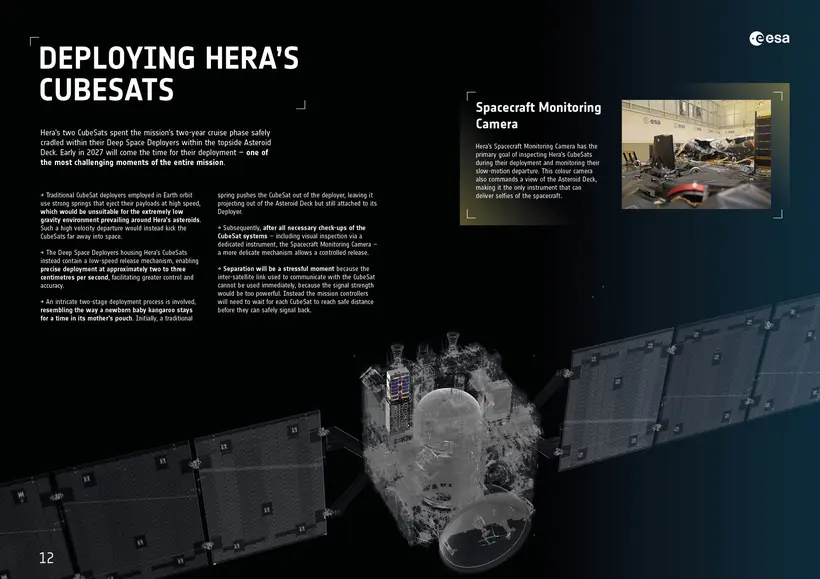
Milani will examine a different set of properties. Its ASPECT instrument will obtain visible, near-infrared and shortwave-infrared spectra to investigate the mineralogy of the surface and individual boulders, while VISTA is designed to detect small dust particles and examine volatile material. ESA plans for Milani to operate at distances decreasing from about 10 km (6.2 miles) to 2 km (1.2 miles), providing observations much closer to Dimorphos than the main spacecraft during its initial characterization.

The present observations still mark an early stage of the investigation. Hera has begun resolving Didymos in visible, spectral and thermal data, while Dimorphos remains largely shadowed in the newly released visible-light views. ESA says more detailed images of both asteroids are scheduled to be unveiled on November 25, 2026. The mission has not yet published the measurements needed to fix Dimorphos’ mass, reconstruct its full internal architecture or determine definitively whether DART left a conventional crater or produced broader reshaping.
Neither Didymos nor Dimorphos posed an Earth-impact threat before DART, and the experiment did not create one. The planetary-defence question is therefore not whether the present system is dangerous, but whether the response of a real asteroid to a kinetic impact can be predicted from measurable physical properties. DART established the change in motion; Hera is designed to determine enough about the target to explain how that change was produced and to reduce one of the major uncertainties in applying the same technique to a future hazardous object.23
References:
1 Hera surveying asteroids with superhuman vision – European Space Agency – November 17, 2026
2 Hera Frequently Asked Questions – European Space Agency – April 12, 2024
3 Cheng, A. F., Agrusa, H. F., Barbee, B. W., Meyer, A. J., Farnham, T. L., Raducan, S. D., Richardson, D. C., Dotto, E., Zinzi, A., Della Corte, V., Statler, T. S., Chesley, S., Naidu, S. P., Hirabayashi, M., Li, J.-Y., Eggl, S., Barnouin, O. S., Chabot, N. L., Chocron, S., Collins, G. S., Daly, R. T., Davison, T. M., DeCoster, M. E., Ernst, C. M., Ferrari, F., Graninger, D. M., Jacobson, S. A., Jutzi, M., Kumamoto, K. M., Luther, R., Lyzhoft, J. R., Michel, P., Murdoch, N., Nakano, R., Palmer, E., Rivkin, A. S., Scheeres, D. J., Stickle, A. M., Sunshine, J. M., Trigo-Rodriguez, J. M., Vincent, J.-B., Walker, J. D., Wünnemann, K., Zhang, Y., Amoroso, M., Bertini, I., Brucato, J. R., Capannolo, A., Cremonese, G., Dall’Ora, M., Deshapriya, P. J. D., Gai, I., Hasselmann, P. H., Ieva, S., Impresario, G., Ivanovski, S. L., Lavagna, M., Lucchetti, A., Epifani, E. M., Modenini, D., Pajola, M., Palumbo, P., Perna, D., Pirrotta, S., Poggiali, G., Rossi, A., Tortora, P., Zannoni, M., & Zanotti, G. (2023). Momentum transfer from the DART mission kinetic impact on asteroid Dimorphos. Nature, 616(7957), 457–460. DOI: 10.1038/s41586-023-05878-z

I’m a science journalist and researcher at The Watchers, contributing to the Epicenter edition, where I cover peer-reviewed scientific research and emerging discoveries across Earth and space sciences. With a background in astronomy and a passion for environmental science, I’ve worked in shark and coral conservation in Fiji, conducting reef and shark-behavior research, contributing to mangrove restoration, and earning PADI Open Water and Coral Reef Certifications. I bring a blend of scientific rigor and storytelling to illuminate the discoveries shaping our planet and beyond.
Published in the last 24 hours
- Radio pulses every 7.9 minutes reveal binary with white dwarf and Sun-like star Epicenter
- Hubble gravitational lenses prepare Roman to test dark matter on small scales Epicenter
- NASA’s STRIVE mission targets long-standing 3D observing gap in the upper atmosphere Epicenter
- Three Australian estuarine fish species maintain performance across thermal extremes Epicenter
