
Hubble gravitational lenses prepare Roman to test dark matter on small scales
NASA released a new Hubble collection of strong gravitational lenses on November 12, 2026, giving astronomers high-resolution systems to model before the Nancy Grace Roman Space Telescope begins science operations. The observations are intended to test how dark matter is distributed on small scales, where cold dark matter models predict clumps with masses from about 1 million to 1 billion solar masses.
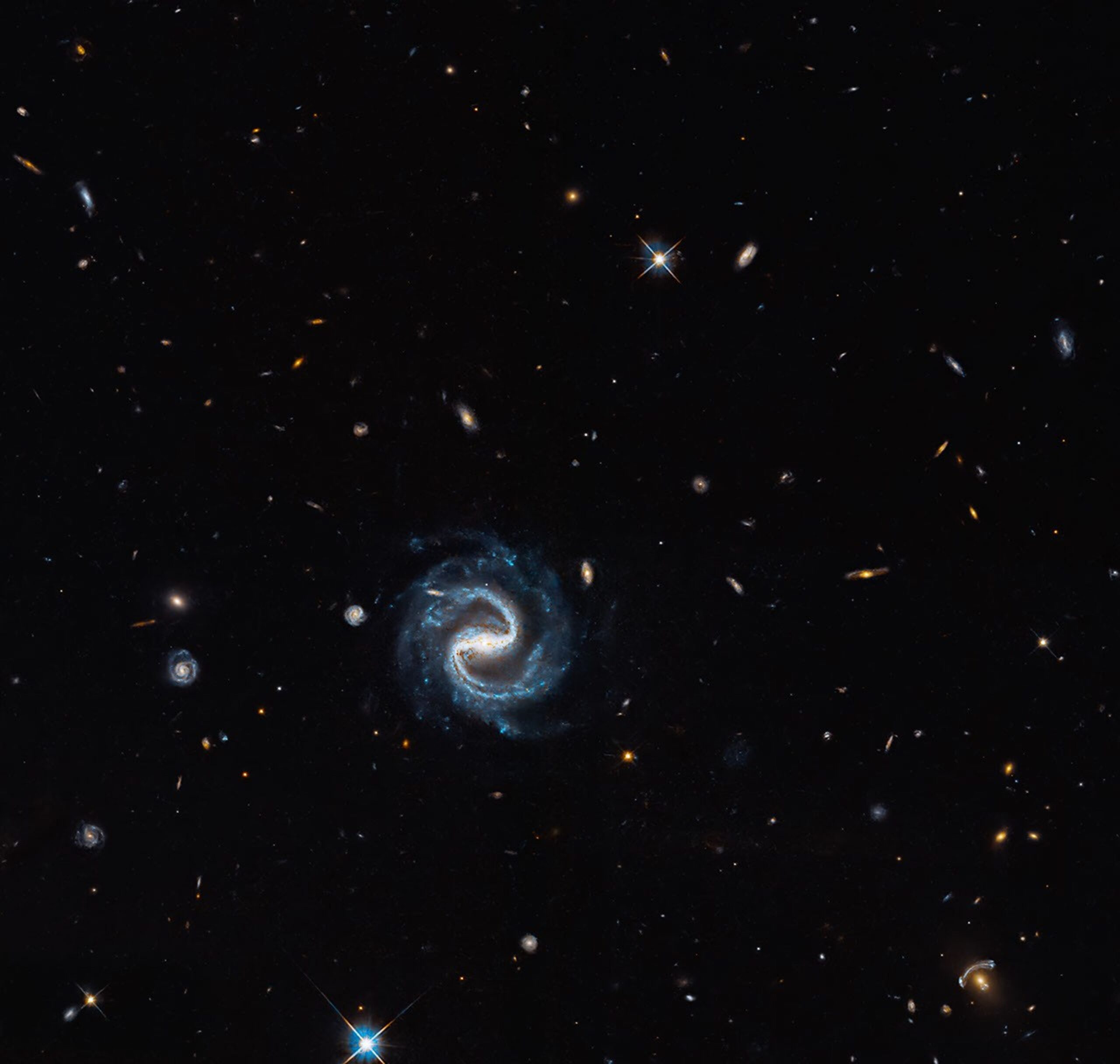
A Hubble field contains a barred spiral galaxy near the center and a strong gravitational lens at lower right. The lens consists of a reddish foreground elliptical galaxy and two blue images of a more distant background galaxy. Credit: NASA, ESA, and X. Huang (University of San Francisco); Processing: Gladys Kober (NASA/Catholic University of America)
Hubble’s new sample contains several forms of strong gravitational lensing produced when foreground mass bends and magnifies light from more distant galaxies. Researchers can reconstruct the distortions to estimate how mass is distributed through a foreground system, including mass that does not emit detectable light.
Cold dark matter models predict numerous small concentrations of dark matter with masses between about 1 million and 1 billion solar masses. Such structures do not have to emit detectable light to reveal their presence. Their gravity can produce small changes in the shapes and positions of lensed arcs, giving astronomers a way to search for dark matter structure below the scale of entire galaxies.
Strong gravitational lensing occurs when the gravity of a foreground galaxy or galaxy cluster redirects light from a more distant source. Depending on the alignment and mass distribution, the background source can appear as an arc, a ring or several separate images. Measuring those distortions allows astronomers to reconstruct the total foreground mass, including dark matter.
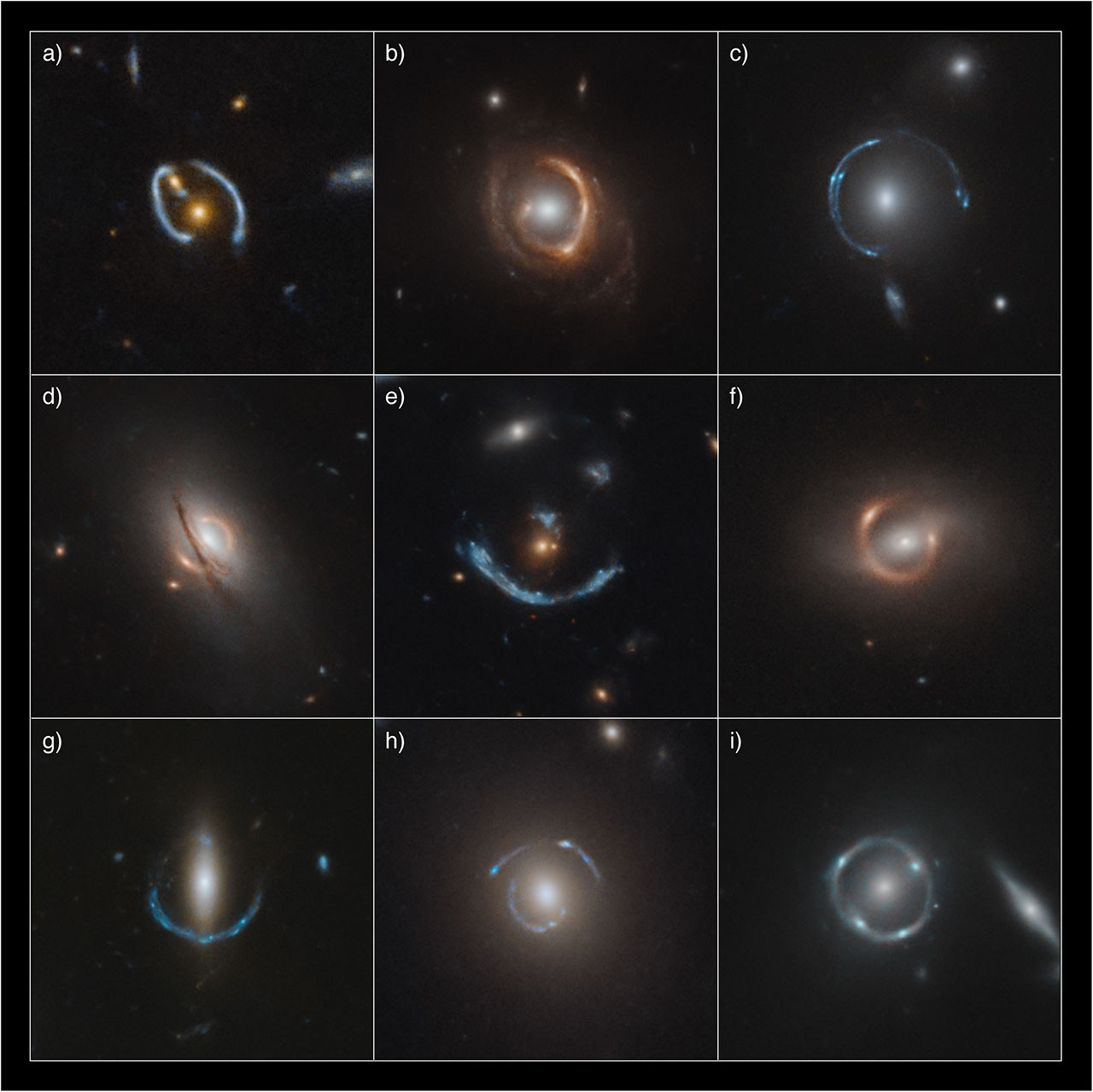
The November 12 collection includes several lens geometries that researchers can use to build and test models. Panel A contains an arc-counterarc configuration in which the same background galaxy appears as two distorted arcs. Panel F approaches a complete Einstein ring. Panels C and I contain quadruply lensed systems in which the same background galaxy appears four times around the foreground lens.
The strong lenses were first detected with the Dark Energy Spectroscopic Instrument at Kitt Peak before Hubble obtained the higher-resolution observations. NASA said researchers plan to use Hubble’s sharp images to construct lens models and develop an automated tool for identifying similar arcs in future Roman observations.
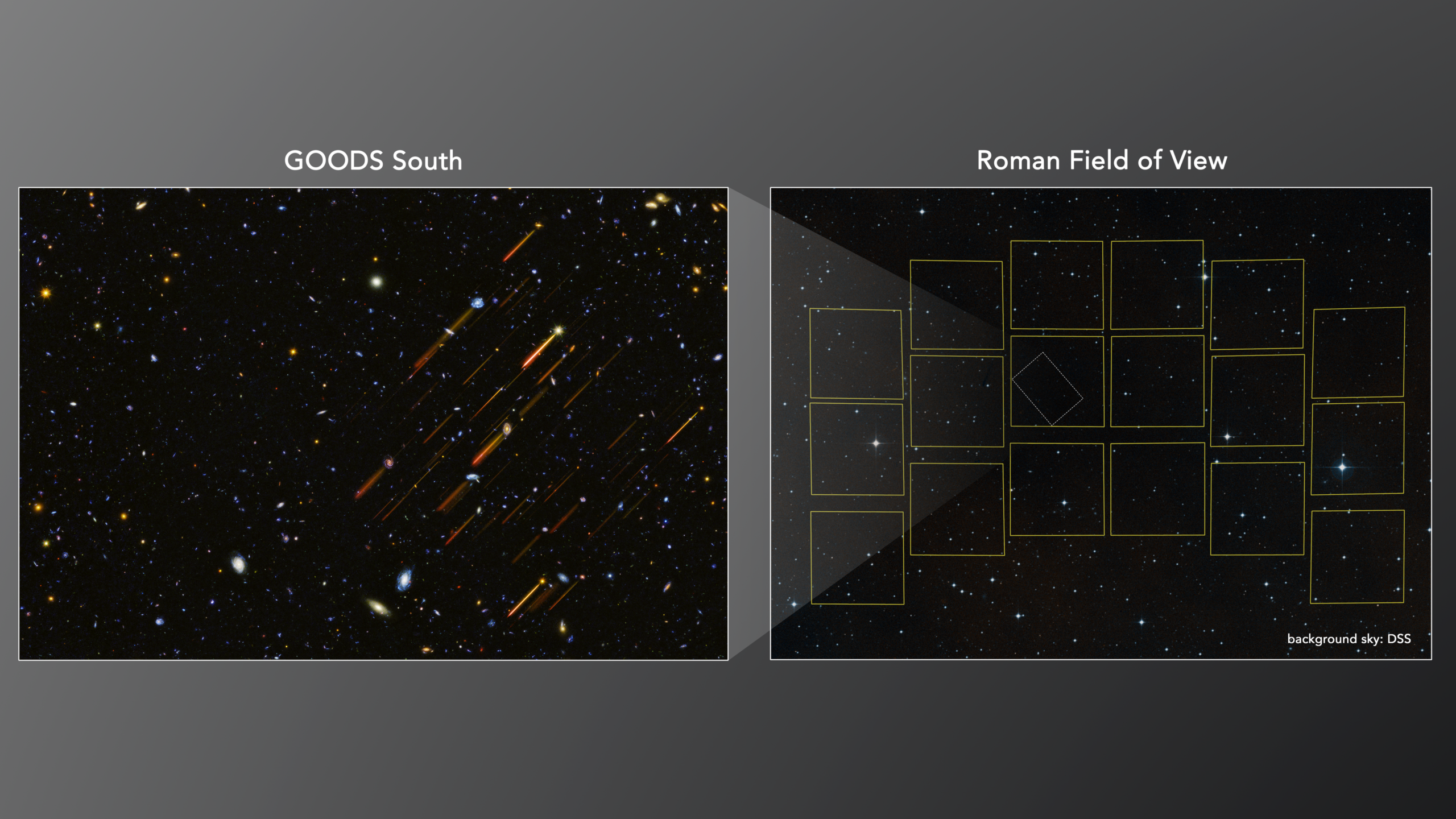
Hubble and Roman are suited to different parts of the work. Hubble observes mainly in ultraviolet and visible light, with some infrared coverage, and provides detailed views of individual lenses. Roman will work mainly in infrared with some visible-light capability and a much wider field of view, allowing astronomers to search large areas of sky for additional systems. Hubble can then provide targeted visible- and ultraviolet-light follow-up of selected Roman detections.
Roman launched in August 2026 and remains in commissioning. NASA reported on November 17 that the agency plans to unveil Roman’s first images on December 7, 2026. The commissioning process involves activating, adjusting and calibrating the observatory before routine science operations begin.
A peer-reviewed study by Wedig et al. (2025) modeled how strongly Roman could expand the available population of galaxy-galaxy strong lenses. For a fiducial configuration using individual 146-second exposures (2 minutes 26 seconds), the researchers predicted around 160 000 detectable strong lenses in the then-planned High Latitude Wide Area Survey. About 500 simulated systems had sufficient signal-to-noise ratio for detailed characterization of dark matter substructure.
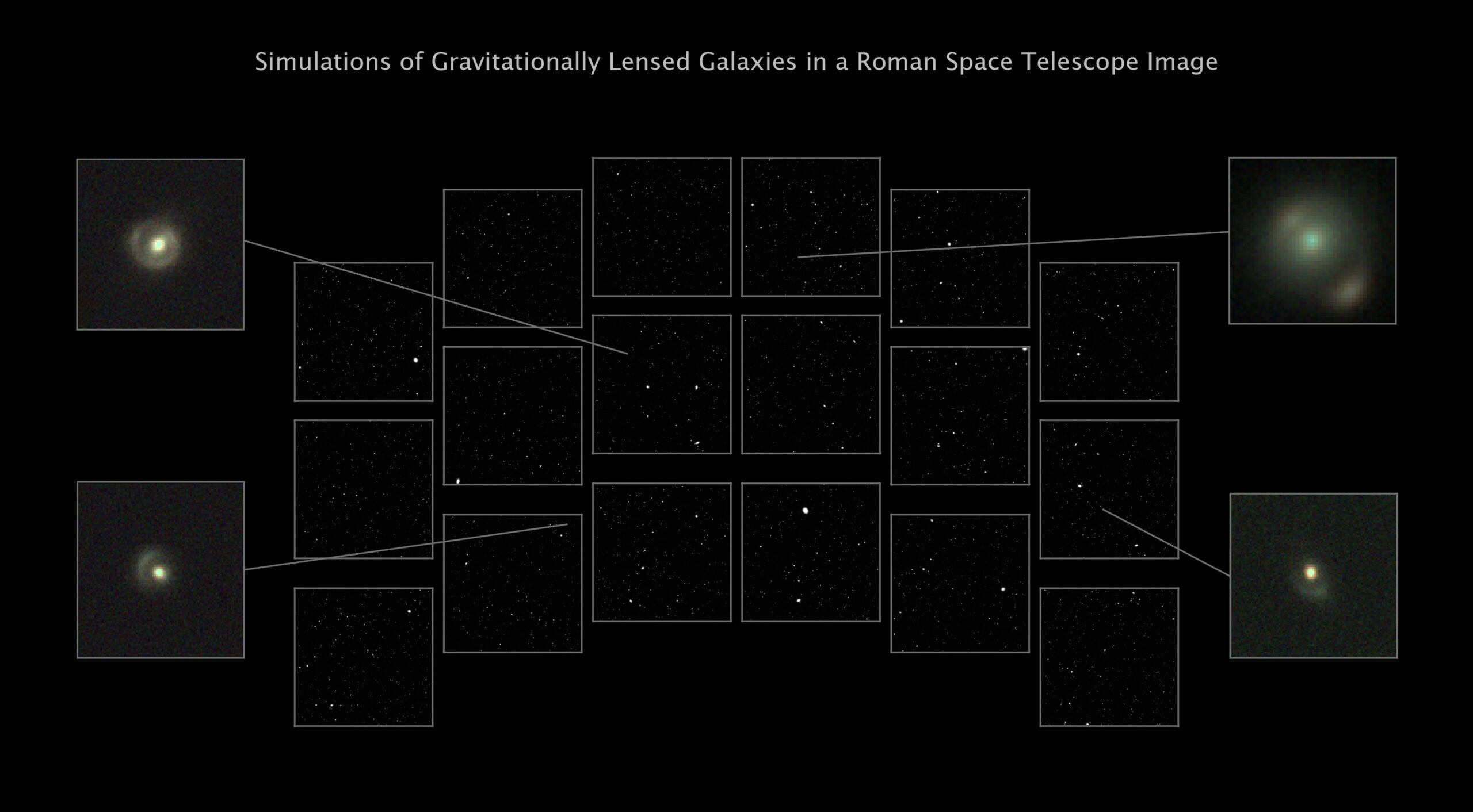
The 160 000 and 500 figures are simulation results, not observed Roman lens counts. The study modeled cold dark matter subhalos, Wide Field Instrument detector effects and variations in the point-spread function across Roman’s field. The synthetic observations were also developed to support neural-network training and validation of dark matter substructure analysis pipelines.
The yield estimates require another qualification. NASA reported in June 2025 that the published analysis used a previous version of Roman’s now-defined High-Latitude Wide-Area Survey. The researchers were preparing follow-up work aligned with the final survey specifications. The 160 000-lens estimate should therefore be treated as a pre-launch model result rather than a fixed operational count for Roman’s final survey.
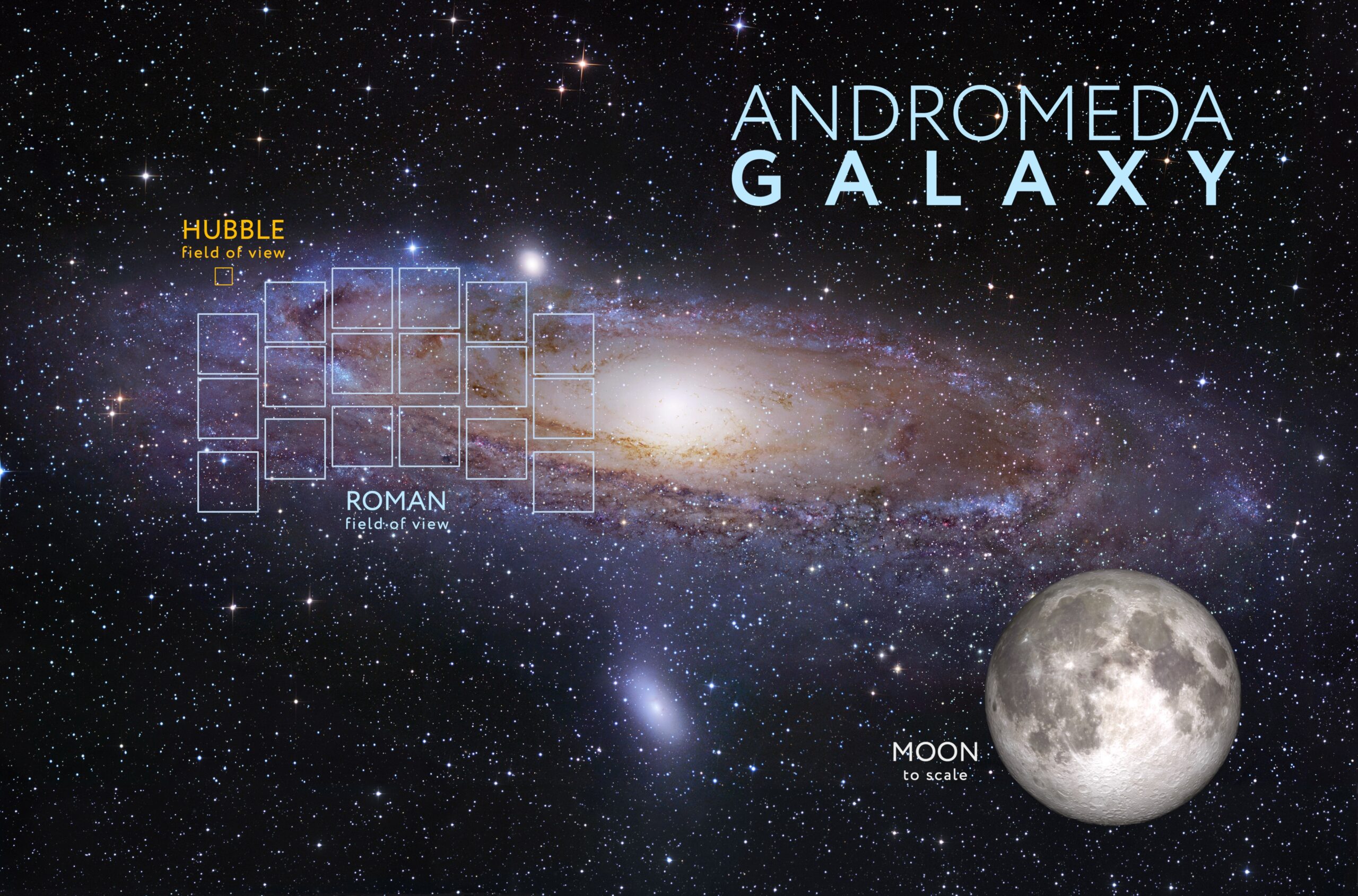
A much larger sample matters because strong gravitational lenses require unusual alignments between foreground and background galaxies. Hubble can examine individual systems in detail, while Roman’s wide-field surveys are expected to increase the number available for statistical analysis and identify candidates suitable for more sensitive dark matter measurements.

Hubble’s November collection also shows how observing wavelength can change what astronomers recover from a lens. A foreground galaxy in panel D contains a visible dust lane that interrupts the apparent ring. Because infrared light is less obscured by dust, NASA said future Roman infrared observations can help determine whether hidden sections form a more complete Einstein ring.
The lenses also contain information about galaxy evolution. NASA identified foreground systems dominated by elliptical galaxies, while some show possible spiral structure. Magnified background galaxies include blue and red arcs associated with different stellar populations, allowing researchers to study the galaxies as well as the mass responsible for the lensing.
The Hubble gallery does not report a new detection of dark matter and does not determine what particle or particles make up dark matter. It supplies resolved gravitational lenses in which predicted small-scale mass structure can be modeled and searched for. Roman is expected to add the much larger statistical sample needed to determine how often those signatures occur and which systems have sufficient image quality and geometry for detailed substructure measurements.
References:
1 NASA’s Hubble Offers Cosmic Sampler of Targets for Roman – NASA Science – November 12, 2026
2 NASA Invites Media, Public to View Roman Telescope’s First Images – NASA – November 17, 2026
3 Wedig, B., Daylan, T., Birrer, S., Cyr-Racine, F.-Y., Dvorkin, C., Finkbeiner, D. P., Huang, A., Huang, X., Karthik, R., Khadka, N., Natarajan, P., Nierenberg, A. M., Peter, A. H. G., Pierel, J. D. R., Tang, X. T. Z., & Wechsler, R. H. (2025). The Roman view of strong gravitational lenses. The Astrophysical Journal, 986(1), Article 42. https://doi.org/10.3847/1538-4357/adc24f

I’m a science journalist and researcher at The Watchers, contributing to the Epicenter edition, where I cover peer-reviewed scientific research and emerging discoveries across Earth and space sciences. With a background in astronomy and a passion for environmental science, I’ve worked in shark and coral conservation in Fiji, conducting reef and shark-behavior research, contributing to mangrove restoration, and earning PADI Open Water and Coral Reef Certifications. I bring a blend of scientific rigor and storytelling to illuminate the discoveries shaping our planet and beyond.
Published in the last 24 hours
- Three Australian estuarine fish species maintain performance across thermal extremes Epicenter
- Lightning killed 323 wild reindeer at once on a Norwegian mountain plateau in 2016, and the crows and ravens that came to eat them left droppings full of crowberry seeds that could still sprout, clustered around the bodies Epicenter
- Helicopters plucked almost 100 people from the Cornish village of Boscastle when a flash flood hit in 2004, and not one person died Epicenter
- A Kansas farmer looked straight up into a tornado in 1928 and saw a hollow tube at least half a mile tall, its walls lit by constant flashes of lightning Epicenter
