
Hurricane Genevieve briefly reaches Category 5, hazardous marine conditions continue along parts of Mexico’s Pacific coast
Genevieve became the first eastern Pacific hurricane to reach Category 5 strength since Hurricane Kristy in 2024 after rapidly intensifying on Monday, July 27, 2026. The hurricane weakened back to Category 4 later in the day as it entered an eyewall replacement cycle, with gradual weakening forecast over cooler waters during the coming days.
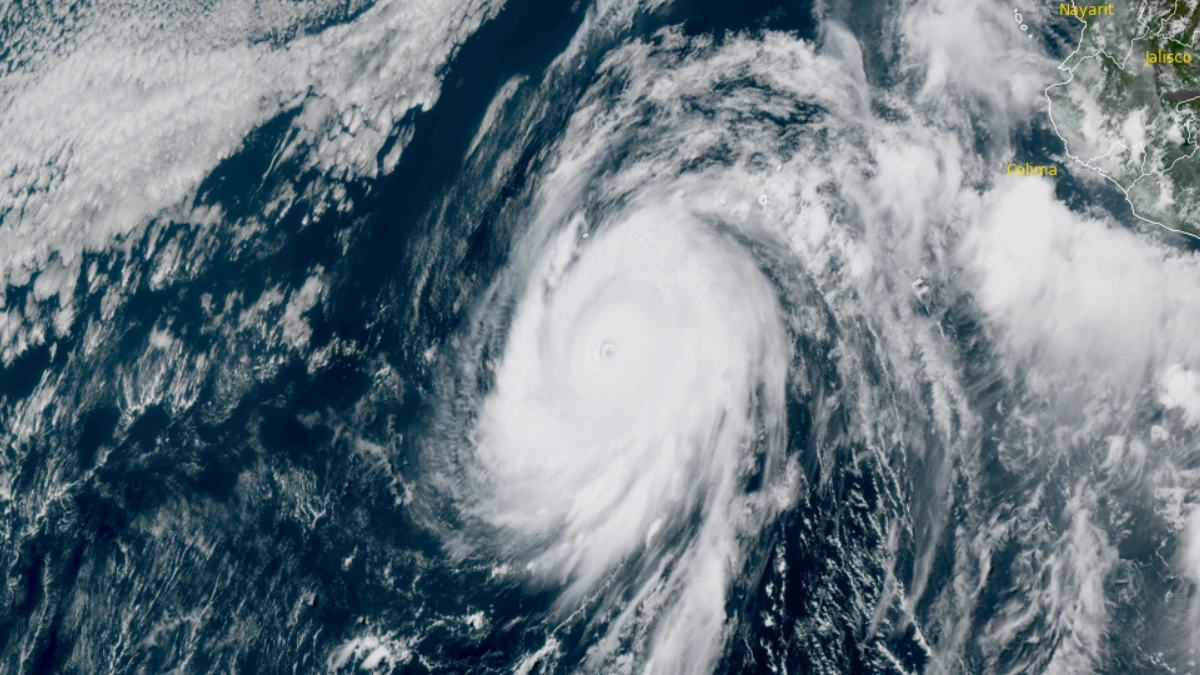
Satellite image of Hurricane Genevieve at 19:00 UTC on July 27, 2026. Credit: NOAA/GOES-19, RAMMB/CIRA, The Watchers
Hurricane Genevieve remained a high-end Category 4 hurricane over the eastern North Pacific on July 27 after briefly reaching Category 5 intensity during a period of explosive rapid intensification earlier.
Genevieve strengthened rapidly on July 27, with the National Hurricane Center (NHC) assigning it Category 4 status in a bulletin issued at 03:00 UTC.
By 09:00 UTC, the system had reached Category 5 strength. One-minute sustained winds reached 260 km/h (160 mph). At the time, the system was located 850 km (530 miles) south-southwest of the southern tip of Baja California. It had an estimated minimum central pressure of 925 hPa.
It was the first hurricane to reach Category 5 strength in the eastern Pacific since Hurricane Kristy in 2024.
By 15:00 UTC on July 27, the system had weakened back to Category 4 strength. It was located about 835 km (520 miles) south-southwest of the southern tip of Baja California at the time.
The cyclone was moving northwest at 20 km/h (13 mph) with maximum sustained winds of 250 km/h (155 mph). It had an estimated minimum central pressure of 929 hPa. No coastal watches or warnings were in effect.
Satellite imagery showed the hurricane retaining a distinct warm eye, although its infrared cloud pattern had become less organized than during its peak, indicating that the rapid intensification phase had ended.
Microwave satellite imagery indicated that the hurricane had entered an eyewall replacement cycle, a structural process frequently observed in very intense tropical cyclones.
During this process, a secondary eyewall develops around the original eye, temporarily reducing maximum winds before the storm reorganizes. Guidance referenced in your source placed the probability of an eyewall replacement cycle during the following 24 hours at 42%, allowing for additional short-term fluctuations in intensity.
Environmental conditions remained supportive of a powerful hurricane, including sea surface temperatures near 29°C (84°F), low vertical wind shear, and favorable upper-level outflow.
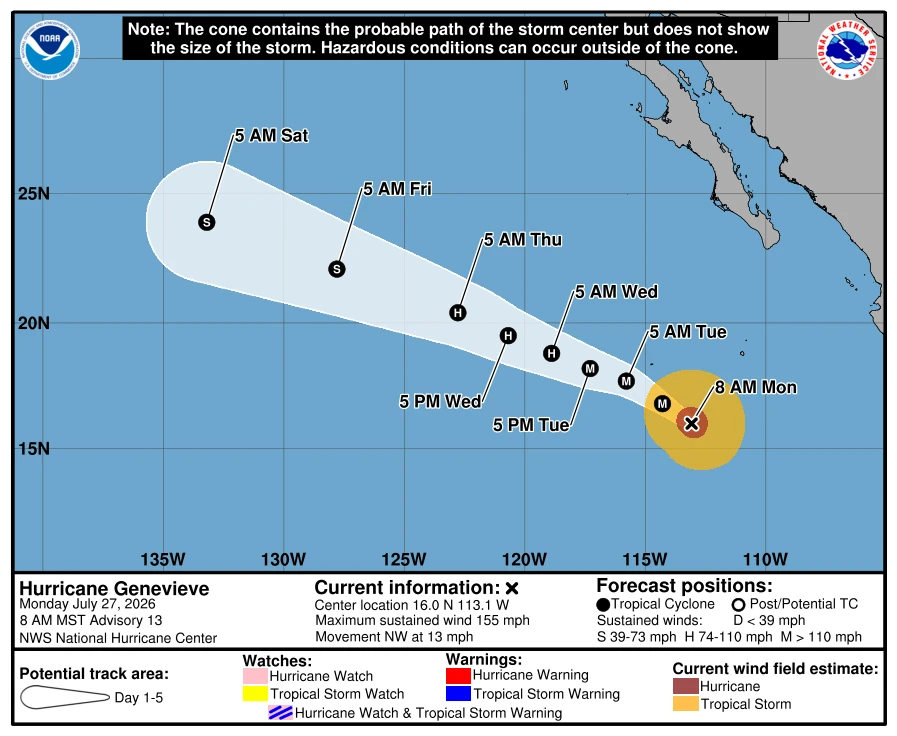
Conditions were forecast to become less favorable later on July 27 as Genevieve tracked over progressively cooler waters while encountering a drier mid-level environment. By approximately 72 hours, the cyclone was forecast to move north over cooler waters with temperatures below 26°C (79°F), which would lead to a faster weakening trend.
Genevieve was forecast to continue moving generally northwest to west-northwest while gradually slowing over the next several days. It was expected to remain well offshore of Mexico, with no direct impacts expected along the country’s coastline.
Despite its offshore track, Genevieve was already generating hazardous marine conditions along parts of Mexico’s Pacific coast.
Swells produced by the hurricane were affecting southwestern Mexico and the southern Baja California Peninsula and were forecast to expand northward along the remainder of Baja California’s Pacific coastline by the night of July 28. These swells can generate life-threatening surf and rip current conditions, posing a hazard to residents and visitors along affected beaches.
References:
1 Hurricane Genevieve Advisory Number 13 – NOAA/NHC – July 27, 2026
2 Hurricane Genevieve Discussion Number 13 – NOAA/NHC – July 27, 2026

I am an Assistant Editor and Severe Weather & Science Journalist at The Watchers, specializing in real-time severe weather coverage, geophysical event reporting, and research-driven scientific analysis. You can reach me at rishav(at)watchers(.)news.

Commenting rules and guidelines
We value the thoughts and opinions of our readers and welcome healthy discussions on our website. In order to maintain a respectful and positive community, we ask that all commenters follow these rules.