
A meteorite blew a crater beside a village near Lake Titicaca in 2007, and dozens of villagers who went to see it got headaches and nausea, though tests found nothing the rock had added to the water
At 11:40 local time (16:40 UTC) on September 15, 2007, an H4-5 stony meteorite struck the high Altiplano near Carancas, Peru, fast enough to excavate a 13.5 m (44-foot) crater—an outcome that challenged prevailing models of how small stony meteoroids survive atmospheric entry. Scores of residents later reported headaches, nausea, dizziness and vomiting after approaching the site, but subsequent testing found arsenic concentrations inside the crater lower than in some local wells and no firm evidence that more than a few people, if any, were harmed by gases released during the impact.
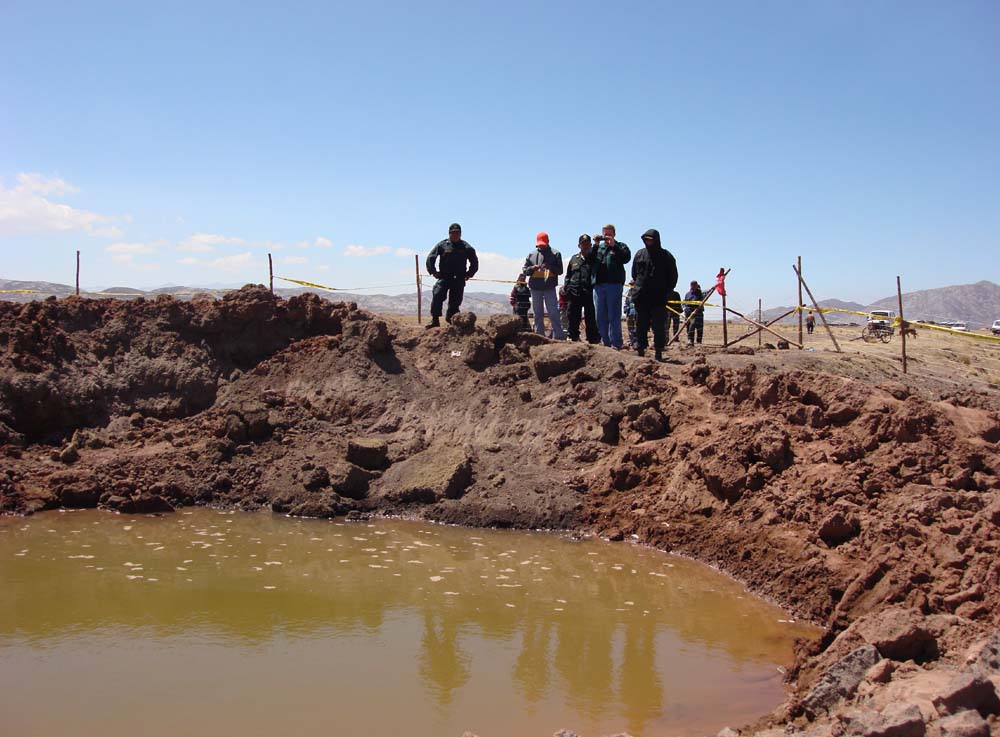
The water-filled Carancas impact crater in southern Peru after the September 15, 2007 meteorite impact. Field surveys later measured the crater at roughly 13.5–14.2 m (44–47 feet) across. Credit: Michael Farmer
Seismic and infrasound instruments recorded the Carancas event as the meteoroid crossed the atmosphere and struck the ground. Tancredi et al. later used arrivals at regional seismic stations to refine the impact time to 16:40:14.1 UTC, while eyewitness accounts placed the bright daytime fireball on a broadly east-to-west path before a large explosion and rapidly expanding dust cloud appeared near Carancas.
The impact produced far more than a shallow meteorite pit. Brown et al. estimated that the collision released energy on the order of 1010 J, equivalent to about 2–3 tons of TNT, with modeling placing the surviving impact mass at roughly a few metric tons and its ground speed in the range of 1.5–4 km/s (0.9–2.5 miles/s). Their reconstruction gave a best-fit atmospheric entry speed close to 12 km/s (7.5 miles/s).
The rock itself was an ordinary H4-5 chondrite, a class of stony meteorite. That made the crater especially difficult to reconcile with the standard picture of small stony meteoroids, which normally lose much of their cosmic velocity through ablation, fragmentation and atmospheric drag before surviving fragments reach the surface. Carancas instead arrived with enough remaining speed to generate shock waves in the target and excavate a true impact crater.

The crater formed in unconsolidated, water-saturated sediment near an ephemeral stream channel. Groundwater rose across its floor within minutes. Early accounts repeatedly described boiling water, steam and noxious fumes, but the later field investigation found a more complicated picture: police officers interviewed by the researchers said the crater was neither hot nor steaming when they entered it about an hour after impact, while video taken only minutes after the event showed bubbling water without evidence that the water itself was boiling.
The researchers considered trapped subsurface gases a plausible explanation for at least part of the bubbling. The impact breached the shallow water table and compressed the surrounding sediment, providing a way for gases beneath the surface to escape through the water without requiring the meteorite to remain hot enough to keep the crater boiling.
Reports of illness spread almost as quickly as news of the crater. ABC Science and AFP reported on September 19, 2007 that scores of Carancas residents had vomited or complained of headaches and dizziness after approaching the site. The mayor of nearby Desaguadero said about 200 people were being treated, although none was reported in serious condition. The Peruvian Nuclear Energy Institute said measurements had found no radiation and initially considered sulfur, arsenic or other substances already in the terrain as possible sources of the reported symptoms.

The later investigation did not validate those early numbers as a single casualty count. Tancredi et al. interviewed the nurse in charge of the Carancas health center in October 2008. She told the researchers that nobody from the community had initially approached the center reporting symptoms linked to visiting the crater. Approximately 180 people came forward after a medical team from Puno announced that it would visit Carancas to provide treatment.
The Dirección Regional de Salud de Puno (DIRESA) conducted blood and urine tests on 11 people. The later investigation found that some of those tested had not been close to the crater during the first days after the impact. Lead concentrations were within the ranges reported by the researchers as acceptable for people without occupational lead exposure, while elevated arsenic was detected in a few cases.
DIRESA also sampled water inside the crater and water from wells used by the people who were tested. Arsenic was present in some well samples, and the arsenic concentration in the crater water was lower than in those wells. The result undermined the idea that the meteorite itself had delivered arsenic to the site; instead, the suspected element was already present in local groundwater.
That finding did not establish a single physical cause for every headache, episode of nausea or other complaint reported after the impact. Tancredi et al. concluded that there was no firm evidence that more than a few people, if any, had been affected by gases released from underground during the collision. Their interpretation was that the scale of the health effects in early media reports had been greatly exaggerated, with pre-existing conditions and the availability of free medical care contributing to the later number of reported cases.
The physical impact was much less ambiguous. The 13.5 m (44-foot) crater, embedded meteorite fragments, disrupted sediments, seismic signals and infrasound all showed that a comparatively small stony body had reached the surface at unusually high speed. Brown et al. found that the impact site’s elevation of about 3 800 m (12 500 feet) helped preserve more velocity than the same object would have retained during descent to sea level, while unusually high material strength was proposed as another reason the body avoided complete atmospheric disruption.
Carancas therefore forced impact researchers to reconsider how confidently average material strength, fragmentation and ablation parameters can be applied to individual stony meteoroids. Tancredi et al. argued that models need to account for a wider range of physical properties because rare strong bodies can survive atmospheric passage in ways that average assumptions would not predict.
References:
1 Tancredi, G., Ishitsuka, J., Schultz, P. H., Harris, R. S., Brown, P., ReVelle, D. O., Antier, K., Le Pichon, A., Rosales, D., Vidal, E., Varela, M. E., Sánchez, L., Benavente, S., Bojorquez, J., Cabezas, D., & Dalmau, A. (2009). A meteorite crater on Earth formed on September 15, 2007: The Carancas hypervelocity impact. Meteoritics & Planetary Science, 44(12), 1967–1984. DOI: 10.1111/j.1945-5100.2009.tb02006.x
2 Brown, P., ReVelle, D. O., Silber, E. A., Edwards, W. N., Arrowsmith, S., Jackson, L. E., Jr., Tancredi, G., & Eaton, D. (2008). Analysis of a crater-forming meteorite impact in Peru. Journal of Geophysical Research: Planets, 113(E9), E09007. DOI: 10.1029/2008JE003105
3 Peru ‘meteorite’ strike leaves 200 sick – ABC Science / AFP – September 19, 2007

I’m a science journalist and researcher at The Watchers, contributing to the Epicenter edition, where I cover peer-reviewed scientific research and emerging discoveries across Earth and space sciences. With a background in astronomy and a passion for environmental science, I’ve worked in shark and coral conservation in Fiji, conducting reef and shark-behavior research, contributing to mangrove restoration, and earning PADI Open Water and Coral Reef Certifications. I bring a blend of scientific rigor and storytelling to illuminate the discoveries shaping our planet and beyond.
Published in the last 24 hours
- The people who pay closest attention to the weather are the ones storms have already cost the most, a study of 946 students found, with one damaging storm making little difference to how much attention a student paid, but two or more making a clear one Epicenter
- The sea is falling in Juneau, Alaska, because land freed from melted glaciers is rising about 0.6 inches a year Epicenter
- A dam above Los Angeles collapsed just before midnight on March 12, 1928, and the flood killed more than 400 people, hours after the engineer who built it had spent two hours looking at a new leak and decided there was no danger Epicenter
- In 1903, 17 coal miners in Frank, Alberta, dug their own way out of a mountain after a rockslide sealed the mine, and came up 13 hours later to find part of their town buried Epicenter
