
A dam above Los Angeles collapsed just before midnight on March 12, 1928, and the flood killed more than 400 people, hours after the engineer who built it had spent two hours looking at a new leak and decided there was no danger
At about 10:30 a.m. on March 12, 1928, dam keeper Tony Harnischfeger discovered muddy runoff from a new leak at St. Francis Dam above Los Angeles and alerted William Mulholland. Mulholland, Harvey Van Norman and Harnischfeger spent about two hours examining the structure and found nothing they considered dangerous; at 11:57:30 p.m., roughly 13½ hours after the leak was discovered, the dam collapsed and the resulting flood killed more than 400 people.
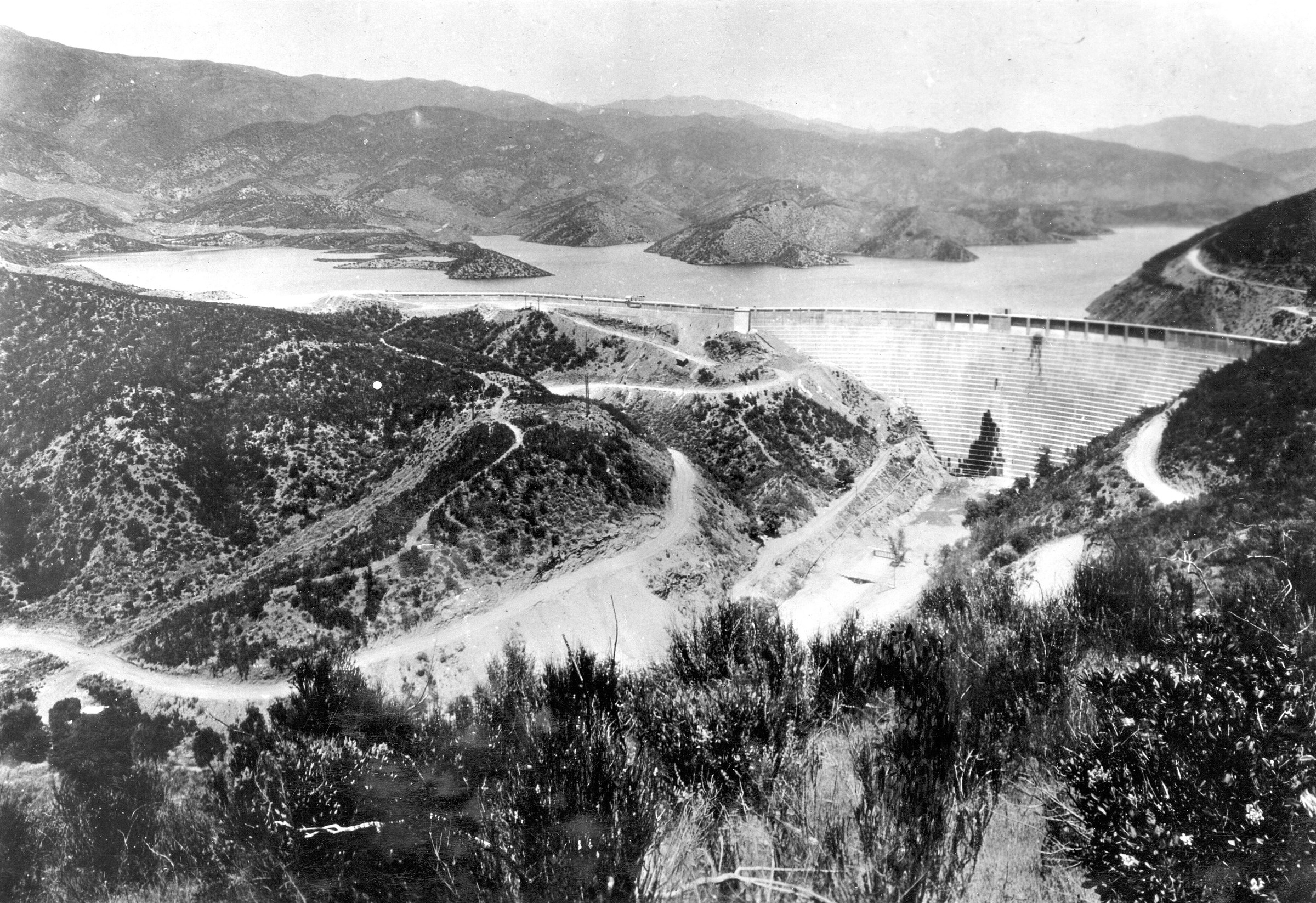
The St. Francis Dam. Credit: Stearns, H.T. USGS (public domain), via Wikimedia Commons.
The new leak was on the western side of the dam. Historical chronology compiled from testimony and other records places its discharge at an estimated 0.06–0.085 m³/s (2–3 cubic feet per second). Its muddy appearance was initially concerning because sediment in seepage can indicate that flowing water is carrying material from a dam or its foundation.
Van Norman followed the runoff and concluded that the water itself was emerging clear before passing through loose soil beside a recently cut access road. The 1928 coroner’s jury later reached the same basic conclusion about the observed discoloration, finding that water from the seepage points was picking up surface soil after it emerged rather than carrying foundation material out from beneath the dam.
Mulholland, Van Norman and Harnischfeger continued examining the dam and its seepage for about two hours. The historical timeline records that Mulholland and Van Norman considered the new leak no threat and returned to Los Angeles. The coroner’s jury described the inspection as occurring about twelve hours before the failure and found that the amount and character of the leakage observed at the dam were not enough to cause those responsible for it to doubt the safety of the structure.

The reservoir was near its highest level. On March 7, five days before the collapse, the water stood about 7.6 cm (3 inches) below the spillway crest, according to the historical timeline. Mulholland then ordered that no more water be brought into the reservoir.
At about 11:50 p.m. on March 12, carpenter Ace Hopewell rode his motorcycle past the dam while traveling up San Francisquito Canyon. He later testified that he saw nothing alarming at the structure. After continuing up the canyon, he heard a sound he interpreted as rocks rolling down a mountainside and assumed it was a landslide.
At 11:57:30 p.m., electrical systems serving the area registered a sudden interruption. Historical investigators used that interruption to establish the failure time. The St. Francis Dam collapsed within minutes, releasing the reservoir into San Francisquito Canyon.

The U.S. Geological Survey (USGS) says approximately 46.9 million m³ (12.4 billion U.S. gallons) of water rushed down the canyon after the failure. Floodwaters struck communities downstream, including Santa Paula and Fillmore, before reaching the Pacific coast.
The exact number of people killed has never been established. USGS gives a figure of at least 431 deaths and states that the final number is unknown. A separate victim reconstruction by archaeologist Ann Stansell, based on claim files, death certificates, morgue records, inquest material, cemetery records and other historical documents, currently places the possible total between 308 recovered victims and a maximum of 403 when unresolved missing-person cases are included.
The two figures use different historical records and counting methods and should not be treated as directly interchangeable. Both, however, support the statement that the disaster killed more than 400 people when the upper documented historical totals are used. Earlier round estimates such as 450 or 600 should not be presented as established counts.

Mulholland and Van Norman reached the broken dam at about 2:30 a.m. on March 13. Much of the structure and its abutments had disappeared, while a large central section remained standing in the canyon. The surviving section later became widely known as the Tombstone.
The Los Angeles County coroner’s jury was summoned on March 21 to investigate the deaths and the circumstances surrounding the failure. Its verdict, signed on April 12, 1928, ruled the deaths accidental but found that the dam had been defective because its foundation rock was unsuitable and because the dam’s design was not properly adapted to those foundation conditions.
The jury identified what it called an error in engineering judgment in determining the character of the foundation and selecting the type and dimensions of the dam. It also identified a broader public-policy failure, concluding that the construction and operation of a great dam should not depend on the sole judgment of one person without independent expert review. The jury found no evidence of criminal intent and recommended against criminal prosecution.
Later engineering and geological work altered the understanding of how the collapse began. J. David Rogers, in a detailed reassessment published in 1995, argued that failure initiated on the eastern side of the dam, where the structure was founded against Pelona Schist affected by an ancient landslide that the original engineers had not recognized.
Rogers’ reconstruction linked the eastern-abutment failure to several interacting conditions rather than a single defect. These included the ancient landslide, hydraulic uplift beneath the dam, seepage conditions and the structural consequences of changes made while the dam was being built. The Association of State Dam Safety Officials (ASDSO) also identifies foundation geology, uplift pressure and engineering decisions as important elements in the failure.
The dam had originally been planned at about 56 m (185 feet) high and was raised twice during construction to about 62 m (205 feet), without a proportional increase in the width of its base. Rogers and later dam-safety analyses identified that change as one of the structural decisions that reduced the dam’s margin against sliding and overturning.
Drainage intended to reduce uplift pressure was also limited. Relief wells were installed beneath the central section of the structure but did not extend beneath the sloping abutment sections. Uplift develops when water pressure acts upward beneath a dam, reducing the effective weight holding the structure against its foundation and lowering its resistance to sliding or overturning.
The morning leak does not by itself establish the mechanism that caused the collapse. What the historical record establishes is that the leak prompted the inspection, that Mulholland and Van Norman did not consider the observed seepage dangerous, and that the dam failed later that night. Rogers’ later interpretation concerned a broader interaction among foundation geology, hydraulic uplift, structural design and construction decisions.
The 1928 jury and later geological studies therefore answer different parts of the failure question. The jury assessed responsibility and the evidence available immediately after the disaster, while later investigators were able to reconsider the site using developments in engineering geology and knowledge of ancient landslides. The precise initial sequence has remained a subject of historical and engineering debate.
The disaster also changed how California regulated dams. The California Department of Water Resources says the failure directly led the state legislature to create the California Dam Safety Program on August 14, 1929. The new system gave the state authority to examine existing dams, approve plans for new and modified dams, supervise construction and oversee maintenance of dams within its jurisdiction.
That change addressed one of the central institutional weaknesses identified by the coroner’s jury: a major dam capable of placing thousands of people downstream at risk had been designed, altered, operated and judged safe without mandatory independent state review. The St. Francis failure became both an engineering disaster and a turning point in California’s system for deciding who has authority to determine whether a dam is safe.
References:
1 Rogers, J. D. (1995). A man, a dam and a disaster: Mulholland and the St. Francis Dam. Southern California Quarterly, 77(1–2), 1–109. DOI: 10.2307/41171757
2 Verdict of Coroner’s Jury in St. Francis Dam Inquisition – Los Angeles County Coroner, archived by SCVHistory.com – April 12, 1928
3 St. Francis Dam Disaster and Los Angeles Aqueduct: A Timeline – St. Francis Dam National Memorial Foundation – 2014
4 St Francis Dam Disaster – U.S. Geological Survey – March 2024
5 Victims of the St. Francis Dam Disaster: A Comprehensive Listing – St. Francis Dam National Memorial Foundation / Ann Stansell – updated July 2020
6 St. Francis Dam (California, 1928) – Association of State Dam Safety Officials – accessed November 9, 2026
7 History of California Dam Safety – California Department of Water Resources – accessed November 9, 2026

I’m a science journalist and researcher at The Watchers, contributing to the Epicenter edition, where I cover peer-reviewed scientific research and emerging discoveries across Earth and space sciences. With a background in astronomy and a passion for environmental science, I’ve worked in shark and coral conservation in Fiji, conducting reef and shark-behavior research, contributing to mangrove restoration, and earning PADI Open Water and Coral Reef Certifications. I bring a blend of scientific rigor and storytelling to illuminate the discoveries shaping our planet and beyond.
Published in the last 24 hours
- In 1903, 17 coal miners in Frank, Alberta, dug their own way out of a mountain after a rockslide sealed the mine, and came up 13 hours later to find part of their town buried Epicenter
- Brownsville, Texas, on the Mexican border, had not seen measurable snow since 1895, until it fell on Christmas Eve 2004 Epicenter
- China's giant sinkholes shelter endangered Magnolia but leave isolated populations genetically vulnerable Epicenter
- How did one flash of lightning, lasting about seven seconds, stretch 829 km across five US states, beat the previous record by 61 km, and only be recognized as the longest ever measured nearly eight years later?
