
Cyclone Arnab leaves 3 dead after landfall in Andhra Pradesh, India
Cyclone Arnab crossed India’s Andhra Pradesh–Yanam coast southwest of Yanam on October 28, 2026, as a very severe cyclonic storm before weakening inland. The National Disaster Response Force (NDRF) later reported three deaths in Andhra Pradesh, while the India Meteorological Department (IMD) estimated landfall winds of 125–135 km/h (78–84 mph), gusting to 150 km/h (93 mph).
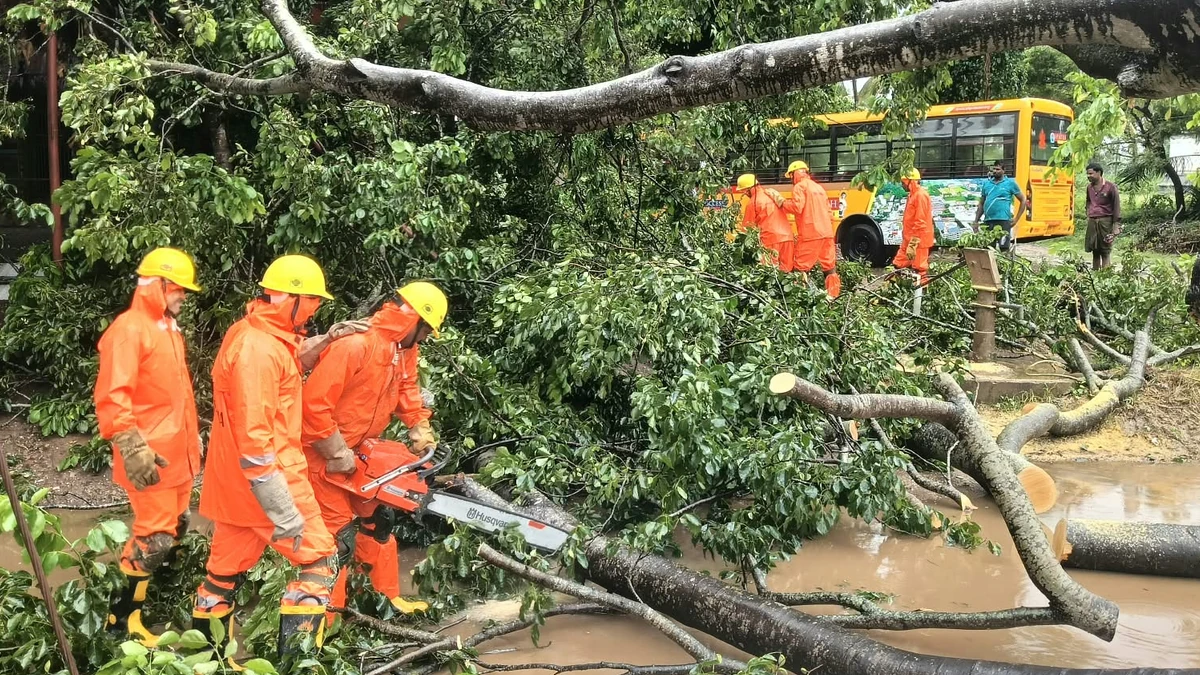
NDRF operatives removing fallen trees at Nakapalli, Anakapalli District, Andhra Pradesh after Cyclone Arnab's landfall on October 28, 2026. Credit: NDRF Cuttack
IMD placed the crossing of the coast about 20 km (12 miles) east-northeast of Narsapur, 40 km (25 miles) southwest of Yanam and 60 km (37 miles) southwest of Kakinada.
The landfall process ran from 02:00 to 08:00 IST on October 28 — 20:30 UTC on October 27 to 02:30 UTC on October 28.
At 12:30 IST (07:00 UTC), Arnab remained a severe cyclonic storm with 10-minute sustained winds of 95–105 km/h (59–65 mph), gusting to 115 km/h (71 mph). At 13:50 IST (08:20 UTC), IMD placed the center about 30 km (19 miles) north-northeast of Narsapur.
Inspector General of the National Disaster Response Force (NDRF) Narendra Singh Bundela said today that northern Andhra Pradesh and southern Odisha have been the worst-affected regions so far by Cyclone Arnab.

NDRF Deputy Inspector General (Operations) S. S. Soodan told ANI on October 28 that the Andhra Pradesh State Emergency Operations Center had reported three deaths.
PTI reported that a 53-year-old man died in Visakhapatnam district on October 27 after contacting a fallen live wire over an agricultural field channel.
A 55-year-old woman died after stepping on an exposed wire outside her home in Yellamanchili, Anakapalli district, on October 28, police said. The circumstances of the third fatality were not released at the time of reporting.
More than 180 000 people had been evacuated across Andhra Pradesh and Odisha ahead of the cyclone. Trees and electricity poles were uprooted, power supplies were disrupted, and some train and flight services were canceled.
Kakinada Superintendent of Police G. Bindu Madhav reported a few hundred uprooted trees and fewer than 100 uprooted electricity poles in the district. He also reported washout damage to the Uppada coastal road.

IMD’s National Bulletin 25 recorded 260 mm (10.2 inches) at Garividi during the 24 hours ending at 08:30 IST (03:00 UTC) on October 28. Anakapalle, Srungavarapukota, Vepada and Cheepurupalle each recorded 250 mm (9.8 inches), while Visakhapatnam recorded 220 mm (8.7 inches).
In Odisha, the same bulletin listed 250 mm (9.8 inches) at Mahendragarh and 190 mm (7.5 inches) at Pottangi over that period. Disaster Management Minister Suresh Pujari said more than 30 000 people had been moved to safety as evacuations continued in low-lying and landslide-prone areas.
Pujari said Odisha had 2 037 shelters ready and had deployed 313 response teams: 60 Odisha Disaster Rapid Action Force teams, nine NDRF teams and 244 Fire and Emergency Services teams. He said all 19 143 fishing boats included in the state count had returned to shore. Schools and Anganwadi centers were closed in 16 districts on October 28.

The Ministry of Civil Aviation said in an October 27 release that operations at Visakhapatnam had been suspended that afternoon, while flights at Vijayawada and Rajahmundry were suspended after 19:00 IST (13:30 UTC). The ministry advised passengers to confirm flight status before traveling to airports.
IMD continued to forecast heavy to very heavy rain with isolated extremely heavy falls over coastal Andhra Pradesh, southern Odisha and southern Chhattisgarh on October 28. Its warnings also covered heavy to very heavy rain in eastern Telangana, with flooding and landslides among the identified hazards.
Hourly Bulletin 18 retained a forecast of 0.5–1 m (1.6–3.3 feet) of residual storm surge above astronomical tide in vulnerable low-lying coastal areas of Andhra Pradesh.
IMD forecast continued north-northwestward movement and further weakening into a cyclonic storm and then a deep depression. Naidu instructed officials to clear blocked roads, restore electricity once winds eased, maintain food, water and medical services at shelters, and prepare preliminary crop-damage assessments.
References:
1 National Bulletin No. 25 — BOB/08/2026 – India Meteorological Department – October 28, 2026
2 Ministry of Civil Aviation reviews Cyclone Arnab situation and operational readiness – PIB – October 27, 2026

Rishav Kothari is Editor-in-Chief of The Watchers, where he runs the newsroom and covers earthquakes, volcanoes, severe weather and space weather.
Published in the last 24 hours
- The storms drenching California this week are fed by a river in the sky, a band of water vapor that can carry up to 15 times the flow of the Mississippi River, and this winter’s near-record El Niño could keep aiming more of them at the West Coast
- Malawi continues Bris AI weather forecasting tests ahead of operational integration Epicenter
- Right about now, Voyager 1 is crossing a line no human-made object has ever reached, a full light-day from Earth, which means a message NASA sends tonight won't arrive until tomorrow night, and the spacecraft's answer won't make it home until the night after that
- G1 geomagnetic storm watch remains in effect as NOAA forecasts Kp 4.67 late on November 17 and early on November 18
