
Widespread flooding kills 10, damages more than 23 000 homes in Chile
Heavy rain and flooding associated with a prolonged frontal system have killed 10 people and left four missing across Chile since July 14, with the most extensive isolation concentrated in the Atacama and Coquimbo regions. The National Service for Disaster Prevention and Response (SENAPRED) reported 104 271 people isolated, 2 281 affected, and 1 031 in shelters on July 21.
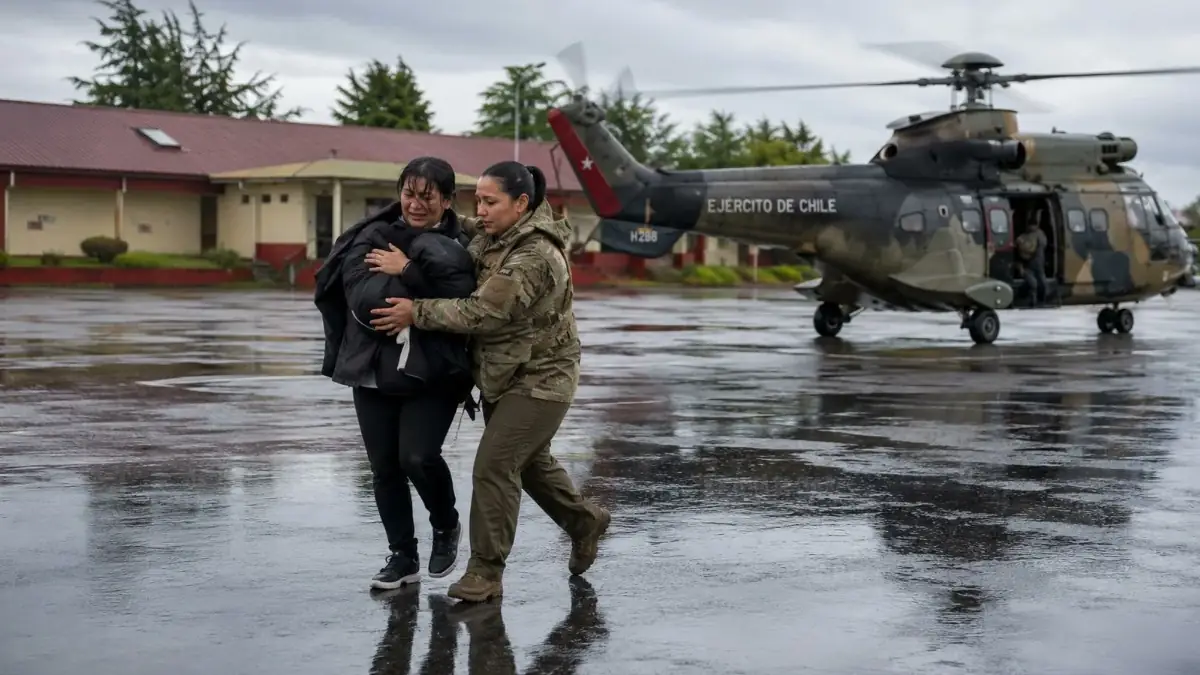
Flood evacuations in Chile - July 2026. Credit: Ejército de Chile
The system brought sustained rainfall to a wide section of Chile and produced flooding, rising rivers, debris flows, inundated streets, and road failures. Rainfall at Combarbalá in the Coquimbo Region reached 150.8 mm (5.9 inches) by July 18, according to SENAPRED, which said the emergency had been active since July 14.
The Chilean Meteorological Directorate recorded 36.6 mm (1.4 inches) at La Florida station in La Serena during the 24 hours ending at 12:00 UTC (08:00 local time) on July 21. The station had accumulated 177 mm (7 inches) during 2026, compared with a 1991–2020 normal-to-date value of 56.4 mm (2.2 inches).
On July 21, SENAPRED confirmed 10 deaths between the Atacama and La Araucanía regions, 16 injuries and four missing people. Two of the missing-person reports were in Atacama, and two were in Coquimbo.
Housing assessments identified 81 homes destroyed, 2 661 with major damage and 18 957 with minor damage. Another 1 771 homes remained under evaluation, bringing the combined number of destroyed, damaged or under-evaluation homes to 23 470.
The number of isolated residents increased from 16 607 on July 19 to 104 271 on July 21 as road closures, elevated river levels and other connectivity problems restricted access, mainly in Atacama and Coquimbo. The number of people affected increased from 1 652 to 2 281 over the same period, while the number in shelters fell from 1 519 to 1 031.
The government declared a State of Constitutional Exception of Catastrophe due to Public Calamity for the entire Coquimbo Region and Huasco Province in the Atacama Region on July 20. The Ministry of the Interior said rainfall had exceeded forecasts and caused isolation, road closures, inundated streets and sewer-system problems.
Military commanders were appointed to lead operations in each declared area. Brigadier General Eugenio Alejandro Ribba Thormann was assigned to the Coquimbo Region, while Brigadier General Claudio Andrés Paredes Araneda was appointed for Huasco Province.
Access work in Huasco Province focused on clearing Route C-46 toward Alto del Carmen and San Félix so technical teams, military personnel and relief supplies could reach isolated communities. Three helicopters operated by Carabineros, the Army and the Air Force were deployed for reconnaissance and rescue operations.
Rain damaged five of the seven operating rooms at the Provincial Hospital of Ovalle in the Coquimbo Region, forcing authorities to transfer an Army modular hospital to the city to maintain medical services while repairs continued.
Electricity failures reached a national peak of 658 128 customers during the emergency before falling to 255 683 by the night of July 18. At the July 21 government briefing, authorities reported that the number had fallen from 128 745 on Monday afternoon to 118 905 at 07:00 local time on Tuesday.
More than 155 000 customers in Coquimbo remained without potable-water service, including approximately 135 000 in La Serena–Coquimbo and 15 584 in Ovalle. Ovalle had restored water for sanitary use, but 50 alternative supply points remained active because the service was not yet suitable for drinking.
A Chilean Air Force C-130 transported approximately 6 tonnes of emergency supplies to La Serena on July 20. The shipment included 216 food kits designed for four people for four days, 291 hygiene kits, 108 household-cleaning kits and 14 533 flood-defense sacks. Additional trucks carried mattresses, blankets, bedding, water and roof-repair materials.
SENAPRED Director Alicia Cebrián warned that river levels can continue rising after rainfall ends because water accumulated in foothill catchments takes time to reach downstream channels. The agency instructed residents to remain away from rivers and ravines, follow official information, and evacuate immediately when an SAE emergency message is received.
References:
1 Gobierno decreta Estado de Catástrofe para la Región de Coquimbo y la provincia de Huasco en Atacama – Ministry of the Interior – July 20, 2026
2 Gobierno concentra despliegue en Coquimbo, Huasco y Tiltil para enfrentar las zonas más críticas del sistema frontal – SENAPRED – July 19, 2026

I'm a dedicated researcher, journalist, and editor at The Watchers. With over 20 years of experience in the media industry, I specialize in hard science news, focusing on extreme weather, seismic and volcanic activity, space weather, and astronomy, including near-Earth objects and planetary defense strategies. You can reach me at teo /at/ watchers.news.

Commenting rules and guidelines
We value the thoughts and opinions of our readers and welcome healthy discussions on our website. In order to maintain a respectful and positive community, we ask that all commenters follow these rules.