
Negative Southern Annular Mode develops, bringing snow, storms and colder conditions to southern Australia
A negative Southern Annular Mode (SAM) developed over the Southern Hemisphere on July 18, 2026, triggering a sharp shift in Australia’s winter weather. The change is expected to push cold fronts farther north through the remainder of July, bringing heavy rain, damaging winds, hail and low-level snow to Tasmania while leaving much of eastern New South Wales dry and unusually mild, according to Weatherzone meteorologist Ben Domensino. Forecast models indicate the negative phase is likely to persist for the rest of the month.
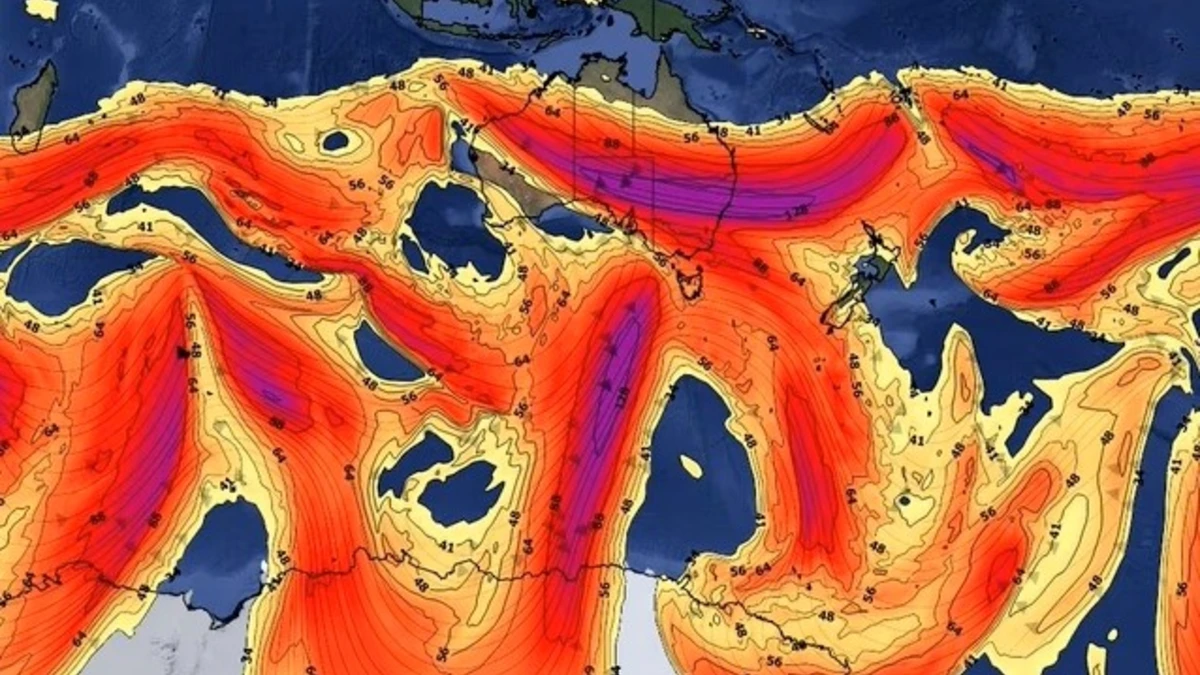
Modelled 300 hPa jet stream winds at 12:00 AM UTC on July 23, 2026. Credit: Weatherzone
The Southern Annular Mode (SAM) is an index that measures the position and strength of the belt of westerly winds that circles Antarctica. During a negative phase, these winds expand farther north towards Australia, allowing cold fronts and low-pressure systems to affect southern parts of the country more frequently. Unlike El Niño and La Niña, which typically take months to develop, the SAM can shift between positive and negative phases within days.
The current event follows a prolonged positive SAM phase that persisted from late May to early July. The index reached exceptionally high values during June before returning to neutral around July 9 and continuing to fall. It reached approximately -1.83 on July 18, its lowest value since December 2025, and forecast models indicate the negative phase is likely to persist through the remainder of July.
The reversal marks a significant change from the atmospheric pattern that contributed to a slow start to Australia’s 2026 snow season. During a positive SAM, the westerly wind belt contracts closer to Antarctica, reducing the number of cold fronts reaching southern Australia. A negative phase produces the opposite effect, increasing the frequency of winter weather systems across southern states.
Tasmania is expected to experience the strongest impacts over the coming days as a deep low-pressure system crosses the state between Wednesday and Friday.
Weatherzone forecasts widespread rain, damaging winds, hail and snow, with snow expected to fall to low elevations as Antarctic air spreads across the island. Apparent temperatures in Hobart are expected to remain below 1°C (33.8°F) for much of Thursday, while western Tasmania is forecast to receive the heaviest rainfall accumulations during the next seven days.
Showers and colder conditions are also forecast for Victoria, South Australia, southern Western Australia and southern New South Wales as successive cold fronts move across the region.
Eastern New South Wales will experience the opposite pattern. Dry westerly winds are expected to suppress rainfall and bring several days of sunshine to Sydney. Maximum temperatures are forecast to reach between 19–21°C (66.2–69.8°F), well above the city’s July average maximum of 16.5°C (61.7°F).
The Bureau of Meteorology says the Southern Annular Mode is one of Australia’s primary climate drivers alongside the El Niño-Southern Oscillation and the Indian Ocean Dipole.
While the SAM is expected to dominate weather conditions over the coming weeks, the Indian Ocean Dipole remains neutral. Most international climate models continue to indicate a positive IOD is likely to develop during winter and persist into spring, a pattern that typically favors below-average rainfall across southern Australia.
The Bureau’s July to September seasonal outlook continues to favor below-average rainfall across large parts of southern and western Australia despite periods of active weather associated with passing cold fronts. Above-average daytime temperatures are also forecast across much of the country, highlighting the difference between short-term weather events and longer-term seasonal climate patterns.
References:
1 The Southern Annular Mode (SAM) has gone negative – what this means for Australia – Weatherzone – July 21, 2026

I’m a science journalist and researcher at The Watchers, contributing to the Epicenter edition, where I cover peer-reviewed scientific research and emerging discoveries across Earth and space sciences. With a background in astronomy and a passion for environmental science, I’ve worked in shark and coral conservation in Fiji, conducting reef and shark-behavior research, contributing to mangrove restoration, and earning PADI Open Water and Coral Reef Certifications. I bring a blend of scientific rigor and storytelling to illuminate the discoveries shaping our planet and beyond.

Commenting rules and guidelines
We value the thoughts and opinions of our readers and welcome healthy discussions on our website. In order to maintain a respectful and positive community, we ask that all commenters follow these rules.