
Dangerous heat expands across the Southern U.S. with major to locally extreme HeatRisk
Dangerous heat is forecast to persist across the southern United States for several days while expanding into the Central and Southern Plains. The National Weather Service is forecasting widespread Major to locally Extreme HeatRisk, daytime highs of 35–41°C (95–105°F), heat index values reaching 41–46°C (105–115°F), and record warm overnight lows of 24–27°C (75–80°F) through Sunday, July 26, 2026. The prolonged combination of hot afternoons and unusually warm nights is expected to produce cumulative heat stress, particularly for people without adequate cooling or hydration.
Image credit: Pexels
The National Weather Service’s Weather Prediction Center (WPC) forecasts hot and humid conditions to expand along the Gulf Coast and into the Southern Plains through the upcoming weekend.
High humidity combined with daytime temperatures of 35–41°C (95–105°F) is expected to push heat index values above 41–46°C (105–115°F) in some locations. The forecast also calls for record warm overnight lows of 24–27°C (75–80°F), reducing nighttime relief and increasing the cumulative effects of prolonged heat exposure.
Through Sunday, July 26, widespread Major HeatRisk is forecast across much of Texas, Oklahoma, Arkansas, Louisiana, Mississippi, Alabama, Georgia and Tennessee, with pockets of Extreme HeatRisk centered over parts of the Lower Mississippi Valley.
The WPC HeatRisk map depicts the core of the event extending from south Texas into the southern Plains and the Southeast, encompassing metropolitan areas including San Antonio, Dallas, Oklahoma City, Jackson, New Orleans, Atlanta, Nashville, Louisville and Kansas City, while elevated heat risk also extends toward Raleigh, Savannah, Tampa and Miami. Goodland, Kansas, marks the northern extent of the highest-risk corridor shown on the map, while Monterrey, Mexico, is included for geographic reference south of the U.S. border.
The NWS Little Rock office has issued Extreme Heat Warnings for parts of Arkansas where heat index values are forecast to reach up to 46°C (115°F). The Memphis office has issued Extreme Heat Warnings covering eastern Arkansas, northern Mississippi and the Missouri Bootheel, while the NWS Jackson office warns that heat index values are expected to exceed 43°C (110°F) in parts of Mississippi.
Heat Advisories remain in effect across portions of Texas, Louisiana, Oklahoma, Kansas and parts of the Southeast as dangerous heat expands across the region.
The dangerous heat is forecast to spread farther west and north during the following week. The WPC forecasts extreme heat expanding into the Desert Southwest and the Great Plains, where heat index values may reach or exceed 43°C (110°F) as far north as the Central Plains. Air temperatures across parts of the Desert Southwest are forecast to reach 43–46°C (110–115°F).
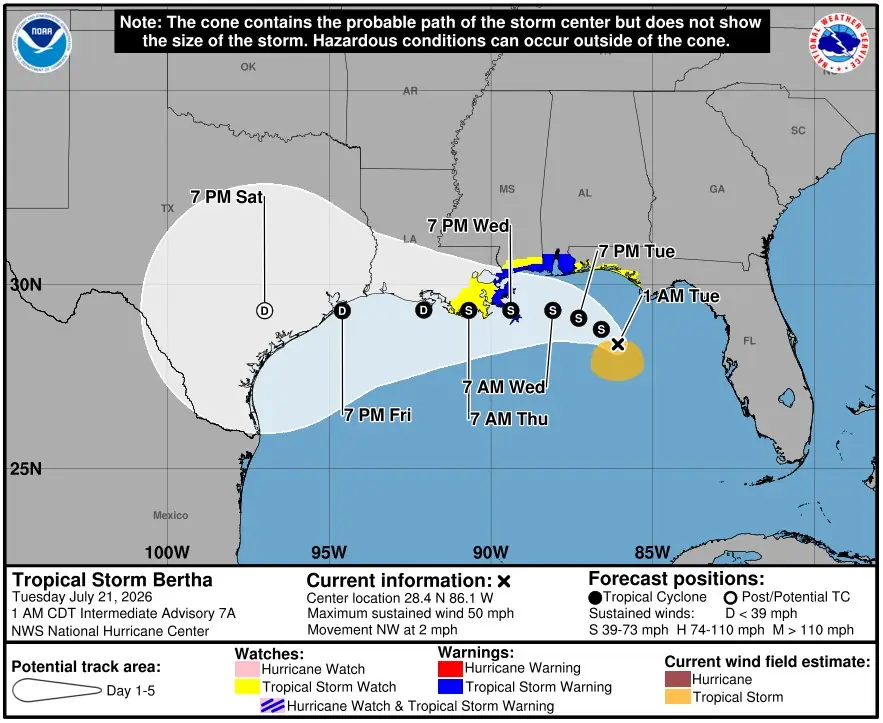
Cloud cover and rainfall associated with Tropical Storm Bertha may keep temperatures lower along parts of the Gulf Coast. The WPC identifies this corridor as the region of greatest forecast uncertainty because the tropical system could locally reduce daytime temperatures while increasing cloud cover and rainfall.
The Climate Prediction Center’s Week-2 Hazards Outlook, valid July 28 through August 3, assigns a Moderate Risk (40–60%) of extreme heat across parts of the southern Great Plains and Southwest during July 28–30, surrounded by a broader Slight Risk (20–40%) extending across portions of the southern Plains, Southwest and adjacent regions through August 3.
The National Weather Service advises residents to limit outdoor activity during the hottest hours of the afternoon, remain hydrated, use air-conditioned buildings or cooling centers whenever possible, check on vulnerable family members, friends and neighbors, and ensure animals have access to fresh water and shade.

I’m a science journalist and researcher at The Watchers, contributing to the Epicenter edition, where I cover peer-reviewed scientific research and emerging discoveries across Earth and space sciences. With a background in astronomy and a passion for environmental science, I’ve worked in shark and coral conservation in Fiji, conducting reef and shark-behavior research, contributing to mangrove restoration, and earning PADI Open Water and Coral Reef Certifications. I bring a blend of scientific rigor and storytelling to illuminate the discoveries shaping our planet and beyond.
Published in the last 24 hours
- 2 atmospheric rivers to bring heavy Sierra snow and California flood risk
- Weipa hits 41 straight days above 36°C as severe heatwave grips Far North Queensland through November 19
- Bay of Bengal system to become Cyclone Akvan, landfall forecast between Nellore and Tuni on November 20, India
- El Niño floods kill 2 in Guayaquil as 172.8 mm of rain swamps Milagro, Ecuador's toll rises to 14
