
A South Dakota man put the widest and heaviest hailstone on US record in his freezer, and a power cut melted part of it before NOAA measured it at 8 inches across and nearly 2 pounds in 2010
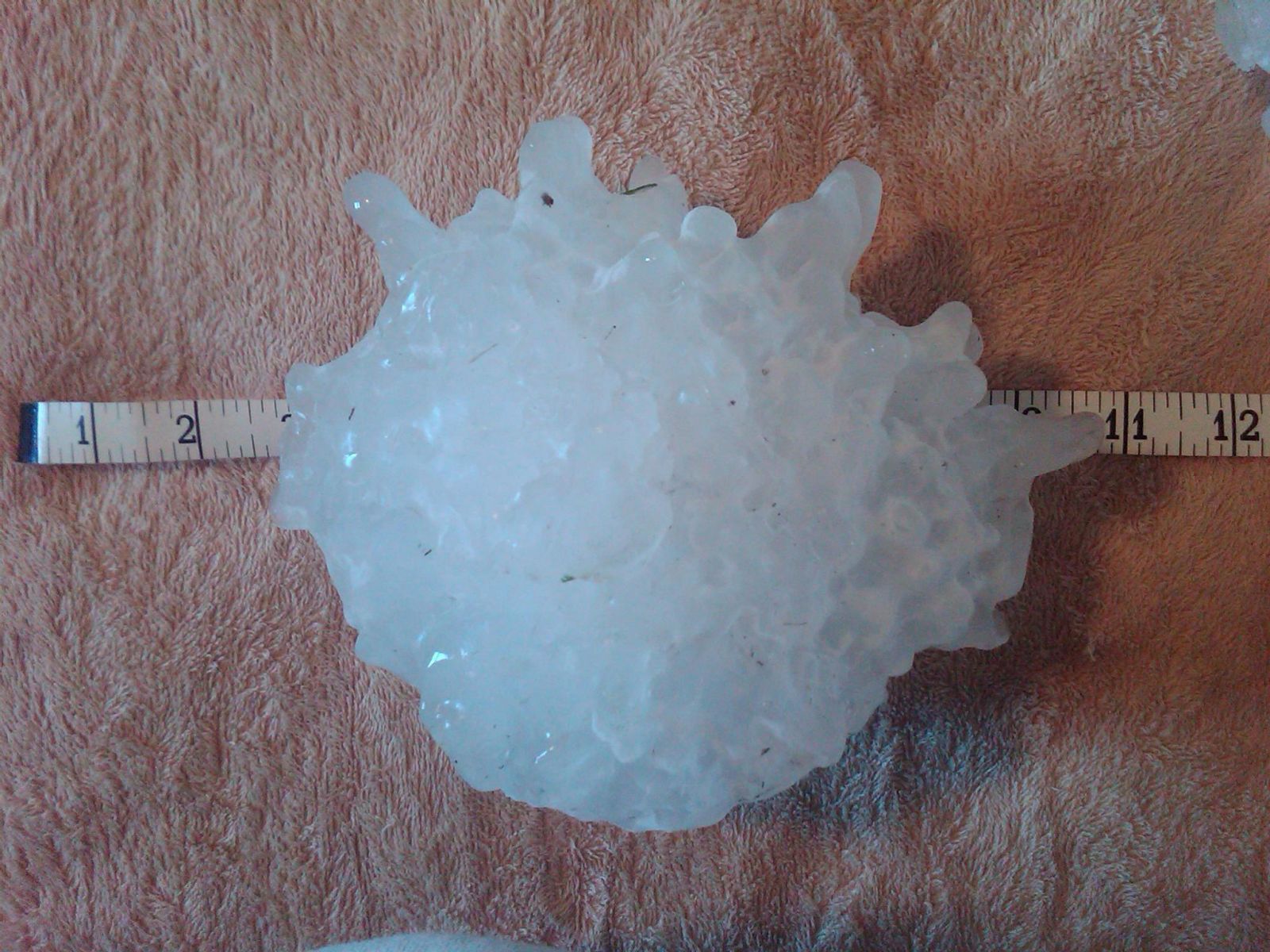
When Les Scott stepped outside after a severe supercell struck Vivian, South Dakota, on July 23, 2010, he collected several enormous hailstones and put the largest in his freezer. A storm-related power failure melted part of it before National Weather Service personnel measured it at 20.32 cm (8.0 inches) across and 0.879 kg (1.9375 lb); NOAA later certified those dimensions as U.S. records for hailstone diameter and weight.
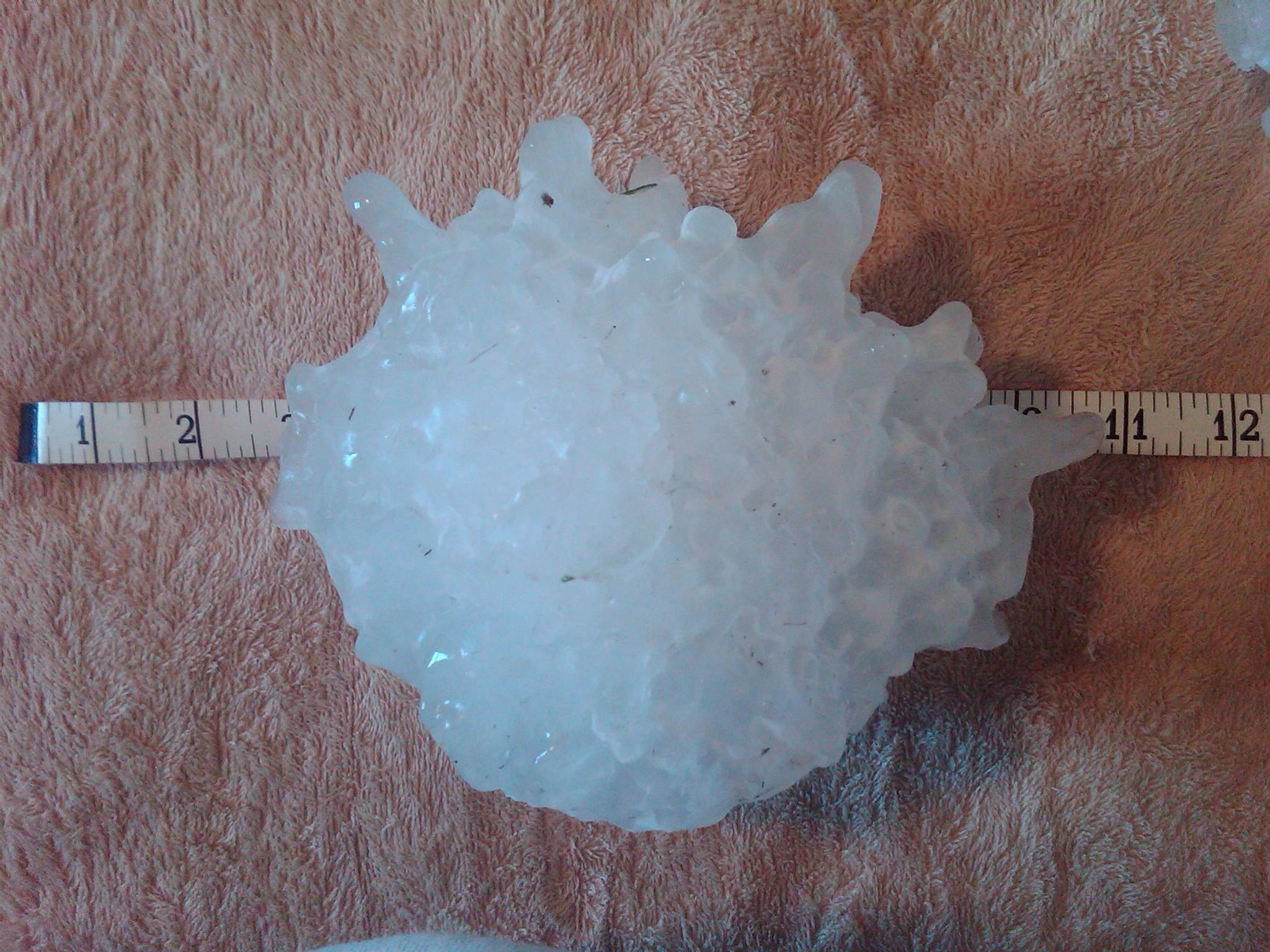
Record hailstone Vivian, SD. Credit: NWS Aberdeen, SD (public domain), via Wikimedia Commons.
The official record is based on what survived long enough to be measured, not an estimate of the stone at impact. NOAA’s National Climate Extremes Committee placed the fall at about 18:00 CDT on July 23, 2010. Scott reported that the largest stone appeared to be about 11 inches across when he first went outside, but that figure was his recollection rather than an official measurement.
Scott kept the stone in his freezer, but the specimen was uncovered and the storm knocked out power. By the time National Weather Service (NWS) personnel from Aberdeen reached Vivian the next morning, melting and sublimation had reduced it. They measured its maximum diameter at 20.32 cm (8.0 inches). Several days later, it weighed 0.879 kg (1 lb 15 oz), or 1.9375 lb, on a scale supplied by the U.S. Post Office in Vivian.
Key takeaways
- NOAA certified the Vivian stone as the U.S. record for hailstone diameter and weight, not circumference.
- The official measurements were 20.32 cm (8.0 inches) across and 0.879 kg (1.9375 lb), taken after the stone had already lost ice through outdoor exposure, handling and a storm-related power outage.
- Scott’s reported 11-inch figure describes what he remembered seeing before preservation; NOAA did not certify 11 inches as the stone’s original diameter.
- The NWS Aberdeen record for the event continues to identify Vivian as the U.S. record holder for hailstone diameter and weight.
The record was already melting before NWS arrived
The freezer and power-outage sequence is documented in NOAA’s official record. Scott collected several very large hailstones after the storm and placed them in his freezer, but electricity was lost because of the parent thunderstorm. A NOAA/NWS press release issued one week later documented the same sequence, with warning coordination meteorologist David Hintz saying the outage caused some melting before the stone could be measured.
NOAA did not try to reconstruct an exact pre-melt diameter. The committee concluded that outdoor exposure before retrieval, repeated handling and the power loss contributed to melting or sublimation and that the stone was almost certainly larger when it hit the ground. The national record nevertheless uses the dimensions recorded at the time of official measurement.
Vivian broke two U.S. records, while Aurora kept a third
Vivian broke separate U.S. records for diameter and weight. Its 20.32 cm (8.0-inch) maximum diameter exceeded the 17.78 cm (7.0-inch) diameter of the Aurora, Nebraska stone from June 22, 2003, while its 0.879 kg (1.9375 lb) weight exceeded the 0.758 kg (1.67 lb) Coffeyville, Kansas record set on September 3, 1970.
Vivian did not take the circumference record. Its measured circumference was 47.31 cm (18.625 inches), slightly below Aurora’s 47.63 cm (18.75 inches). NOAA’s committee validated the Vivian measurement while leaving the Aurora record in place.
The storm had the structure needed for exceptional hail
The hailstone came from a powerful supercell that moved southeast across Stanley, Jones and Lyman counties during the late afternoon and early evening of July 23. Vivian was hit by extremely large hail, destructive winds reaching about 130 km/h (80 mph) and a brief tornado. NOAA’s verification memorandum also documented five hail-related injuries, structural damage in Vivian and major vehicle damage along Interstate 90.

Radar gave forecasters a view of the storm’s internal organization. NWS Aberdeen identified three-body scatter spikes at several radar elevation angles, a pronounced bounded weak echo region and an intense mesocyclone, radar signatures associated with the storm’s strongly rotating updraft. The office’s initial estimate placed updraft speeds at roughly 260–290 km/h (160–180 mph); that figure was an estimate from the storm analysis rather than a direct in-cloud wind measurement.
The surrounding atmosphere was also highly unstable. NOAA’s committee reported estimated convective available potential energy approaching 4 500 J/kg, a measure of the buoyant energy available to thunderstorm updrafts. Radar reflectivity exceeded 70 dBZ, which the committee said indicated a near-certainty of large hail associated with the storm.
How a supercell can keep a hailstone growing
Hail grows when ice particles collide with supercooled liquid water inside a thunderstorm. These droplets remain liquid even though the surrounding air is below freezing, then freeze onto a hailstone when they collide with it. Repeated collisions add layers of ice while the storm’s updraft keeps the developing stone aloft.
NOAA describes two main growth processes. During wet growth, liquid water spreads across the hailstone before slowly freezing, allowing air bubbles to escape and creating clearer ice. During dry growth, water freezes rapidly on contact and traps air bubbles, producing cloudier ice.
Supercells are particularly effective producers of large hail because their sustained updrafts can repeatedly lift hailstones into very cold parts of the storm where additional supercooled water is available. Once a hailstone can no longer be supported by the updraft, it falls toward the ground.


Scott’s 11-inch recollection is not an official measurement
Scott told investigators that the largest stone was about 11 inches in diameter when he first went outside. His account supports the conclusion that the specimen changed before NWS arrived, but NOAA did not treat the 11-inch figure as a measured dimension. The committee separated the eyewitness recollection from the measurements it could document and validate.
That distinction prevents the record from becoming larger simply because melting was known to have occurred. NOAA could establish the direction of the change — the stone lost ice — without assigning an unsupported measurement to the missing material. The official diameter therefore remains 20.32 cm (8.0 inches), even though the committee considered a larger impact size almost certain.
Vivian still anchors the U.S. hailstone record
Later giant-hail cases have faced the same problem of preserving or reconstructing a rapidly melting object. On April 30, 2026, NOAA’s National Centers for Environmental Information certified a Texas state-record hailstone from the June 2, 2024 Vigo Park storm at 18.03 cm (7.10 inches) in diameter. The specimen had not been preserved, so the review relied on photographs and photogrammetric analysis rather than measurements of a surviving stone.
The Texas stone remained smaller than Vivian’s 20.32 cm (8.0-inch) national benchmark. The NWS Aberdeen record for the 2010 event continues to identify Vivian as the U.S. record holder for both diameter and weight. Exceptionally large hail has also produced national records elsewhere, including the Canadian record established in 2022.
The contrast between Vivian and the Texas case shows why recovery history belongs beside the final number. Photogrammetry can produce a defensible measurement when a stone is no longer available, while Vivian was physically measured only after some of its ice had already been lost. For the South Dakota stone, NOAA can support one conclusion beyond the certified dimensions — it was almost certainly larger at impact — but the evidence does not establish exactly how much larger.
References:
1 Official Documentation of the Verification of the Vivian, SD record setting hailstone of 2010 – NOAA National Centers for Environmental Information – November 1, 2010
2 South Dakota Storm Produces Record Hailstone – National Oceanic and Atmospheric Administration / National Weather Service – July 30, 2010
3 Record Setting Hail Event in Vivian, South Dakota on July 23, 2010 – National Weather Service Aberdeen – accessed November 10, 2026
4 Thunderstorm Hazards – Hail – NOAA JetStream – accessed November 10, 2026
5 New Texas Hailstone Record Confirmed by NOAA and Partners – NOAA National Centers for Environmental Information – April 30, 2026

I’m a science journalist and researcher at The Watchers, contributing to the Epicenter edition, where I cover peer-reviewed scientific research and emerging discoveries across Earth and space sciences. With a background in astronomy and a passion for environmental science, I’ve worked in shark and coral conservation in Fiji, conducting reef and shark-behavior research, contributing to mangrove restoration, and earning PADI Open Water and Coral Reef Certifications. I bring a blend of scientific rigor and storytelling to illuminate the discoveries shaping our planet and beyond.
Published in the last 24 hours
- Black kites and brown falcons in northern Australia have been seen snatching smoldering sticks from wildfires, flying them into unburned grass and dropping them, starting new fires that send lizards, rodents and insects running straight toward the waiting birds Epicenter
- A levee protecting a highway north of San Francisco is pocked with animal burrows and only 3 feet wide in places, and a report warns this winter's El Niño could push water over the top Epicenter
- In January 2000, chunks of ice weighing up to 6 pounds fell out of clear blue skies over Spain for 10 days. One smashed through a car windshield, and scientists still can’t fully explain where they came from Epicenter
- The fastest wind gust ever measured on Earth, 253 mph, hit an oil island off Australia during Cyclone Olivia in 1996, and nobody noticed for more than a decade, until experts reading old data quietly took the record from New Hampshire's Mount Washington Epicenter
