
Monster 18 cm (7.1 inch) hailstone sets new state record in Texas
What initially looked like a discarded gallon jug in a roadside ditch turned out to be a record-breaking hailstone, now confirmed as the largest ever documented in Texas at roughly 18 cm (7.1 inches). It was discovered near Vigo Park in Swisher County by storm chaser Val Castor and his associates on June 2, 2024. They clicked several pictures of the hailstone and submitted them to the Insurance Institute for Business and Home Safety (IBHS). The size of the hailstone was determined using photogrammetry and AI analysis along with the estimates from the storm chasers.

Record-breaking hailstone in Swisher County, Texas. Credit: Val Castor
A hailstone measuring roughly 18 cm (7.1 inches), that was photographed in 2024, has set a new state record for the largest hailstone on record in Texas. It was found in a roadside ditch approximately 4.8 km (3 miles) west-northwest of Vigo Park in Swisher County by Val Castor, a storm chaser.
This broke the previous record of 16.5 cm (6.5 inches), set by a hailstone found in Hondo in 2021, the National Oceanic and Atmospheric Administration (NOAA) confirmed on April 30, 2026.
The hailstone was so large that Castor initially mistook it for a discarded gallon jug of milk in a ditch, but when he went to check and dug it out of the mud, he was certain it would be a record.
“As I was chasing this tornadic supercell, I started to notice large hail on the ground the size of softballs and some still falling sporadically. I was thinking about stopping and getting a quick picture of a few softballs when I noticed what looked like a gallon jug of milk in the ditch. As I drove past it, I was thinking no way was this a hailstone, but I turned around and went back,” said Castor to NOAA.
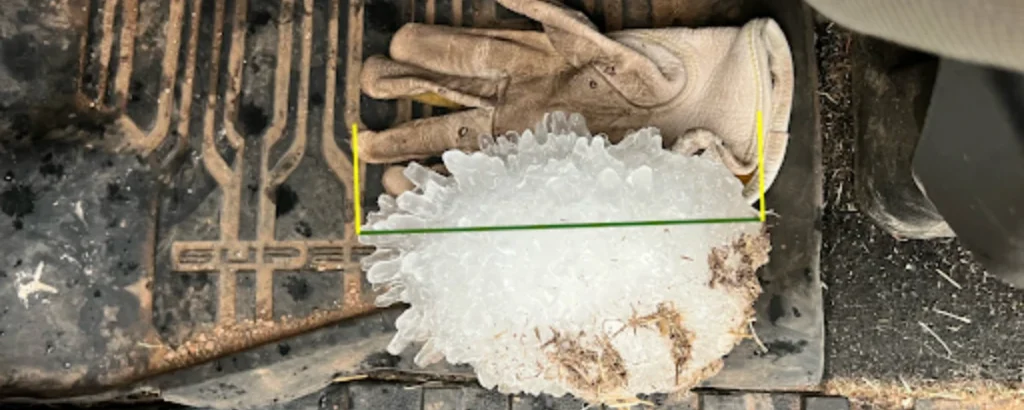
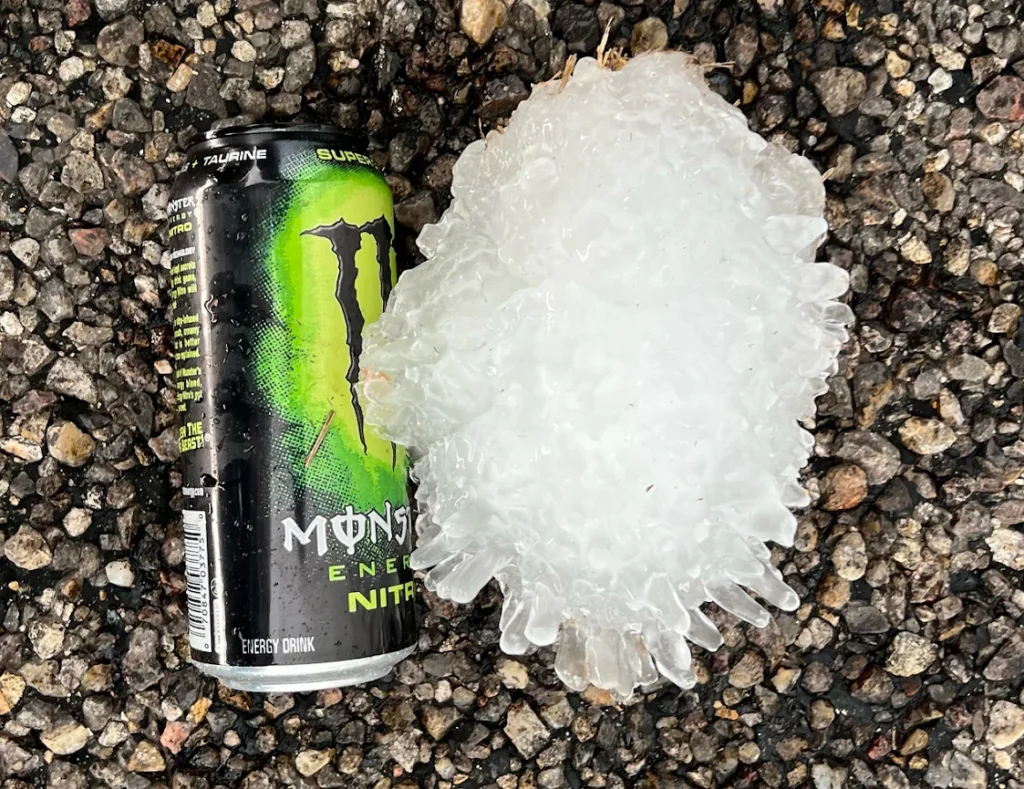
However, Castor had neither the means to prevent melting nor any way to measure the hailstone when he found it. The only things he had to visually compare it with were a can of energy drink and a glove.
Castor and his associates took multiple pictures of the stone and submitted them to the Insurance Institute for Business and Home Safety (IBHS) as evidence.
“When I went to pick it up, it was about half buried in the mud. I didn’t have a tape measure, and about the only thing I had to compare it to was an empty Monster energy drink can. It was about the size and shape of a good-sized pineapple. I didn’t have an ice chest or any way to keep it, so sadly, I had to throw it back. Catch and release, I guess lol. I’ve seen lots of large hail in my 35 years of storm chasing, but this was by far the largest,” said Castor.
“In the past, IBHS has measured hail size through detailed laser-based measurements of recovered hailstones, or indirectly through photogrammetric analysis (photogrammetry is the science of creating accurate 3D models or measurements from 2D photos),” reported NOAA.
Three size estimates were used to determine the size of the hailstone: the initial estimate of 18.4 cm (7.25 inches) made by the storm chasers, an AI-based estimate of 17.9 cm (7.06 inches), and a photogrammetric estimate of 18.2 cm (7.16 inches), both by IBHS.
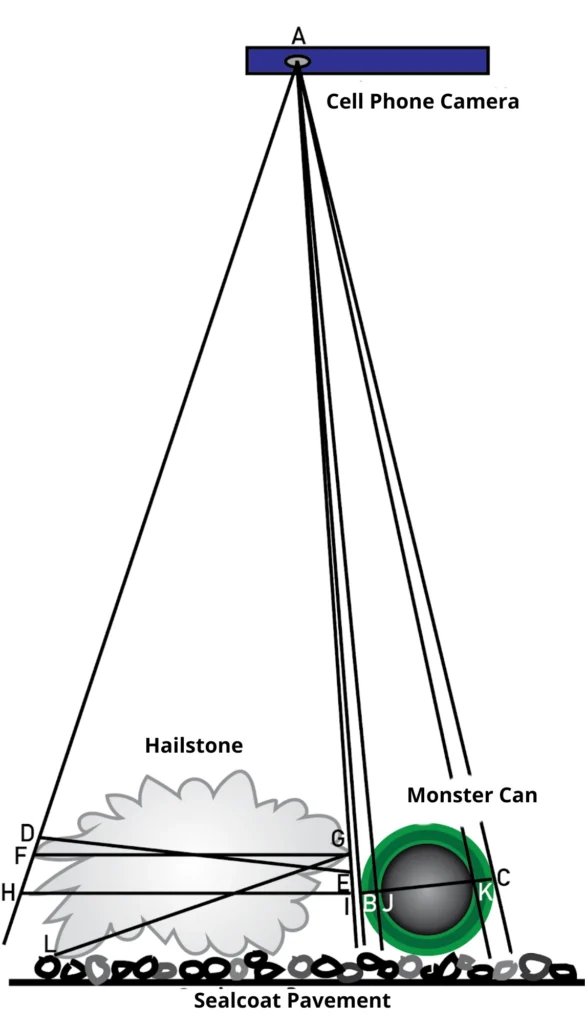
The analysis indicated that the storm was slightly larger than 17.8 cm (7 inches), surpassing the previous record. However, other metrics, such as volume or mass of the hailstone, could not be estimated from the photographs.
Due to the lack of a definitive way to measure the hailstone’s diameter, the best conservative estimate was determined to be 18 cm (7.1 inches), setting the new record for the state.
References:
1 New Texas Hailstone Record Confirmed by NOAA and Partners – NOAA – April 30, 2026

Rishav Kothari is Editor-in-Chief of The Watchers, where he runs the newsroom and covers earthquakes, volcanoes, severe weather and space weather.
Published in the last 24 hours
- Dust shed by Halley's Comet gives Earth the Eta Aquarids every May and the Orionids every October, and the comet itself, which passed 4.94 million km away on 10 April 837 at about magnitude -3.5, is due to reach perihelion on 28 July 2061. Epicenter
- Detonations from Krakatoa on 26 and 27 August 1883 were heard over nearly one thirteenth of the globe, as far as Rodrigues about 4,800 km away, where the chief of police logged roars like heavy guns until 3 p.m., the Royal Society reported in 1888. Epicenter
- One dead, 15 injured and 152 homes left uninhabitable across five regions of Peru after the M6.7 Junín earthquake of 20 November, COEN-INDECI reports.
- WPC flags a Slight Risk of excessive rainfall for the coastal Carolinas on Wednesday as a low forms off Florida and tracks up the East Coast on Thanksgiving Day.
