
Increased seismicity and gas emissions at Kupreanof volcano, Alaska
Seismic activity and sulfur dioxide emissions have increased at Kupreanof volcano in Alaska over recent months, likely due to magmatic intrusion beneath the volcano. Kupreanof is a heavily glaciated stratovolcano on the Alaska Peninsula with no known historical eruptions. Current data do not indicate an eruption is imminent.
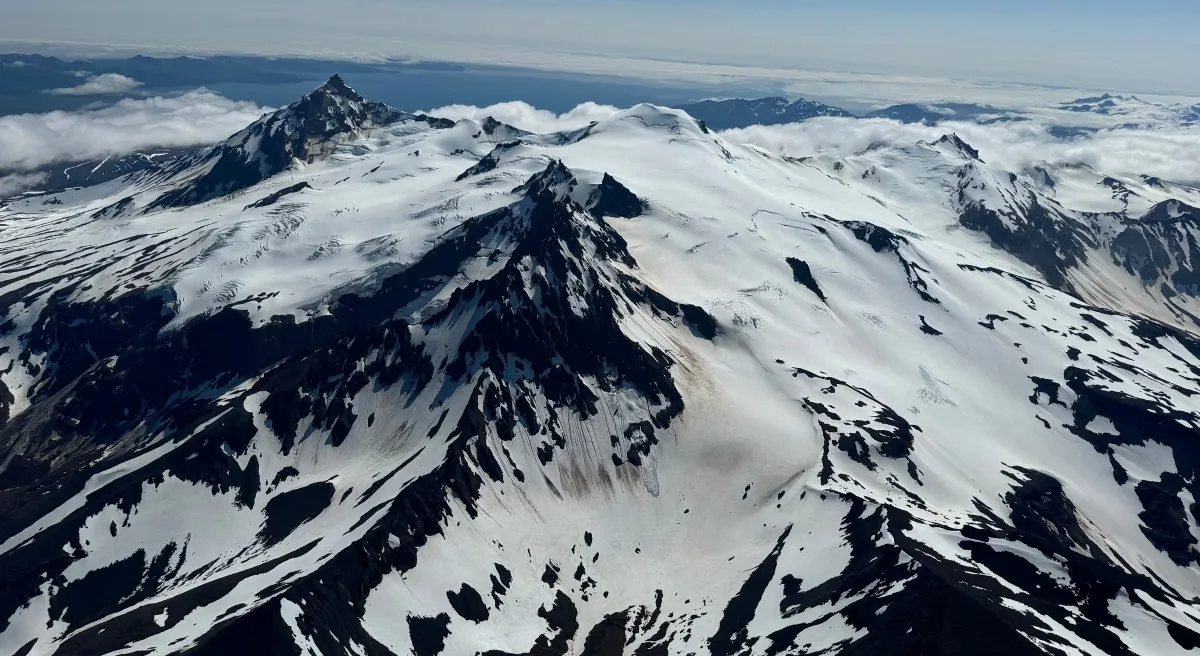
Kupreanof flyby during transit from Veniaminof to Cold Bay on July 22, 2024. Credit: USGS/AVO, Ellie Boyce
The unrest began in February 2026, when seismicity increased beneath Kupreanof Volcano, according to the Alaska Volcano Observatory (AVO). The observatory reported multiple pulses of deep low-frequency earthquakes in early February and early March, including events deeper than 20 km (12 miles).
Seismicity during the second half of April and early May has consisted of intermittent shallow earthquakes, mostly less than magnitude 2.5, along with occasional deep low-frequency events.
Since April 4, sulfur dioxide (SO2) emissions from Kupreanof volcano have been seen in satellite data on 8 occasions with emission rates of ~100 to 1 000 tons per day. While Kupreanof is known to have persistent gas emissions from a fumarole field active just west of the summit, SO2 emissions from this volcano have not been seen previously in satellite data.
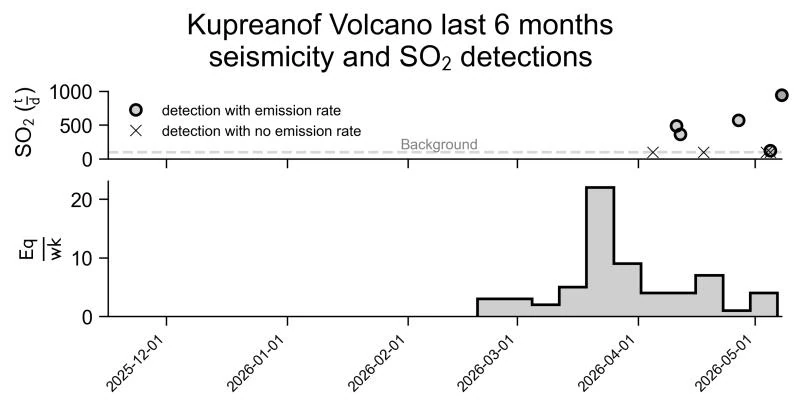
Airborne gas surveys conducted by helicopter in 2019 and 2022 measured less than 100 tons per day. While some volcanic gases can originate from crustal sources such as carbonate rocks or hydrothermal systems, SO2 is almost always associated with direct degassing from magma.
Collectively, the observations suggest an increase above background levels in volcanic gas emissions, likely due to the intrusion of new magma beneath the volcano.
The earthquake types and locations, along with the observed SO2, suggest magma has likely intruded at depth beneath Kupreanof volcano and has migrated to shallower levels (<5 km / 3 miles), activating a fumarole field at about 1.5 km (5 000 feet) elevation west of the summit.
“Because of this, if eruptive activity does occur, it may be either hydrothermal or magmatic,” AVO volcanologists said.
“If the magma rises closer to the surface, this will likely lead to increased unrest, such as a change in the rate and style of earthquake activity, surface heating, and increased gas emissions. Therefore, it is very likely that if an eruption were to occur, it would be preceded by additional signals that would allow advance warning.”
Intrusions of new magma under volcanoes do not always result in volcanic eruptions, AVO added. The earthquake activity and gas emissions at Kupreanof may cease with no eruption occurring.
Kupreanof is a heavily glaciated stratovolcano on the Alaska Peninsula with no known historical eruptions, and little is known about its eruptive history. A single debris-flow or block-and-ash-flow deposit of suspected Holocene age has been mapped in a valley south of the volcano.
Future eruptions at Kupreanof would likely generate lahars and pyroclastic flows on the volcano’s flanks and into surrounding uninhabited valleys. Ash plumes could affect downwind communities and aircraft, while a vigorous fumarole field west of the summit continues to produce persistent steam plumes.
Kupreanof has no real-time geophysical monitoring network. The nearest seismometers are about 16 km (10 miles) east of the volcano within the Veniaminof network. AVO monitors the volcano using satellite data, remote infrasound and lightning networks, and visual observations from pilots and mariners.
References:
1 Information statement for Kupreanof volcano, Alaska – USGS/AVO – May 8, 2026

I'm a dedicated researcher, journalist, and editor at The Watchers. With over 20 years of experience in the media industry, I specialize in hard science news, focusing on extreme weather, seismic and volcanic activity, space weather, and astronomy, including near-Earth objects and planetary defense strategies. You can reach me at teo /at/ watchers.news.

Commenting rules and guidelines
We value the thoughts and opinions of our readers and welcome healthy discussions on our website. In order to maintain a respectful and positive community, we ask that all commenters follow these rules.