
Bárðarbunga volcano Aviation Color Code raised to Yellow after intense earthquake swarm, Iceland
The Icelandic Meteorological Office (IMO) raised the Aviation Color Code for Bárðarbunga volcano to Yellow at 00:43 UTC on June 14, 2026, after an intense earthquake swarm began in the northwestern part of the caldera following a M4.8 earthquake at 20:14 UTC on June 13.
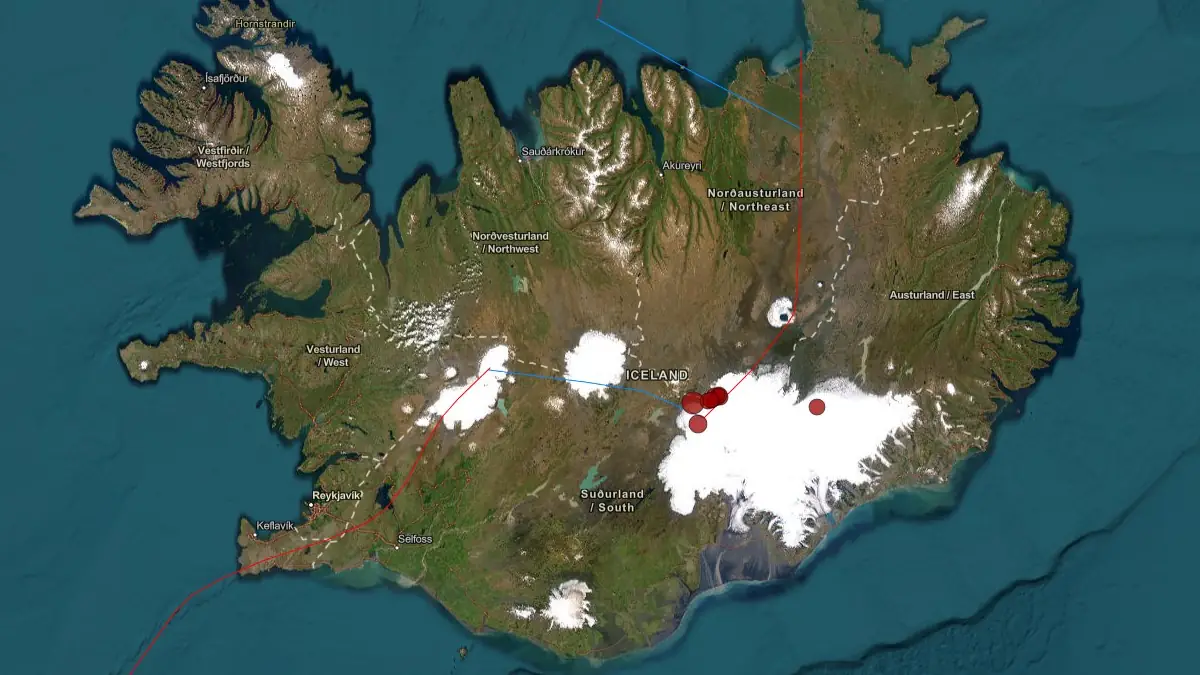
Earthquake swarm under Bárðarbunga volcano on June 13 and 14, 2026. Credit: TW/SAM, ESRI
According to IMO, intense seismic activity began shortly after the M4.8 earthquake at 20:14 UTC. Several earthquakes exceeding M3 and more than 180 smaller earthquakes were detected by the time the Yellow code was issued. IMO said the Aviation Color Code was increased due to seismic unrest and that the situation would be reassessed in the following hours.
By 08:46 UTC on June 14, approximately 400 earthquakes had been detected since the swarm began, with activity concentrated in the northwestern part of the Bárðarbunga caldera. According to the agency, earthquake activity was strongest until around 03:00 UTC, after which it began to decrease, although earthquakes continued to be detected in the area.
IMO volcanologists said it was too early to determine whether the swarm is subsiding and kept the Aviation Color Code at Yellow due to uncertainty surrounding the evolution of the event.
The strongest earthquakes recorded during the swarm included the M4.8 earthquake at 20:14 UTC on June 13, followed by an M4.1 earthquake at 00:55 UTC on June 14 and an M3.7 event at 22:30 UTC on June 13.
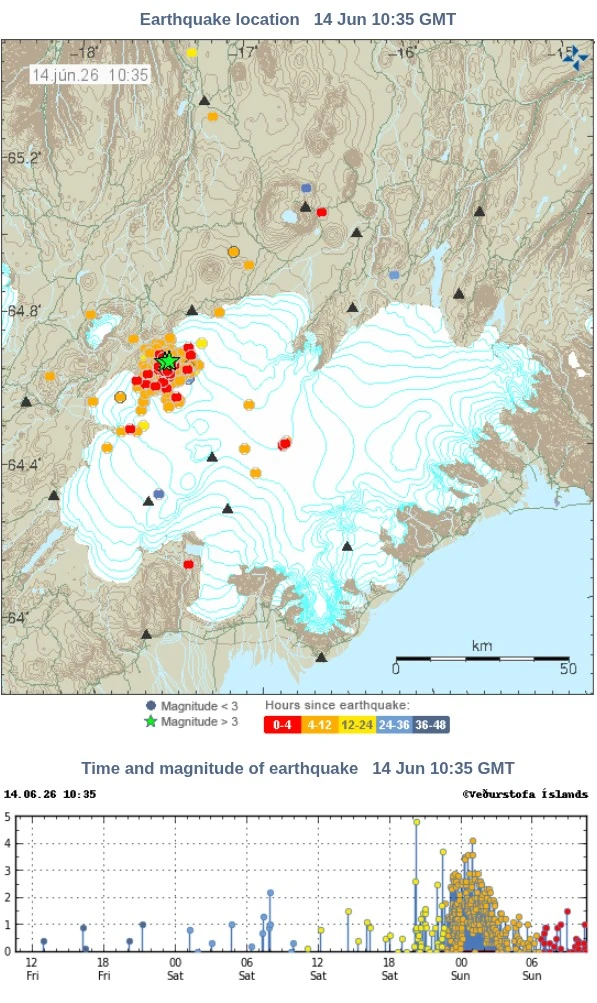
Despite the elevated seismic activity, IMO reported no eruption in both aviation notices, and the agency’s earthquake specialist assessment said no volcanic tremor was detected in the area.
IMO compared the current activity to an earthquake swarm recorded in the Bárðarbunga caldera in January 2025, when elevated seismic activity also prompted heightened monitoring and a temporary Yellow Aviation Color Code.
Bárðarbunga is a large central volcano and volcanic system beneath the Vatnajökull ice cap in central Iceland. It sits along Iceland’s active rift zone and has a history of major eruptions, large earthquake swarms, and magma intrusions.
The volcanic system drew international attention during the 2014–2015 Holuhraun eruption, one of Iceland’s largest eruptions in centuries. The eruption followed an intense seismic crisis and magma migration away from the Bárðarbunga caldera toward the Holuhraun lava field northeast of the glacier.
Although the eruption occurred outside the ice cap and did not produce prolonged ash-rich explosive activity comparable to Eyjafjallajökull in 2010, it generated extensive lava flows and substantial sulfur dioxide (SO2) pollution, affecting air quality across parts of Iceland.
The 2014–2015 unrest also produced repeated large earthquakes, including events above M5, associated with subsidence of the Bárðarbunga caldera as magma drained into the Holuhraun fissure system. The episode lasted for months and remained under close international monitoring due to concern that a subglacial eruption beneath Vatnajökull could produce ash emissions capable of disrupting aviation.
Volcanic unrest in Iceland receives close scrutiny because eruptions beneath glaciers can inject ash into major North Atlantic air routes linking Europe and North America. The most significant recent example was the 2010 Eyjafjallajökull eruption, which disrupted air traffic across Europe after ash clouds spread through heavily traveled air corridors, affecting millions of passengers.
References:
1 Specialist remark – IMO – June 14, 2026

I'm a dedicated researcher, journalist, and editor at The Watchers. With over 20 years of experience in the media industry, I specialize in hard science news, focusing on extreme weather, seismic and volcanic activity, space weather, and astronomy, including near-Earth objects and planetary defense strategies. You can reach me at teo /at/ watchers.news.

Great summary, thank you, we shall wait for uplift data from Copernicus, inSAR, etc. with interest.