
Large asteroid 1997 NC1 makes its closest Earth pass in over four centuries – live watch
Asteroid (152637) 1997 NC1 will pass Earth at 6.67 lunar distances (about 0.017 AU), or 2.5 million km (1.6 million miles) above Earth’s surface, at 11:16 UTC on June 27, 2026. The object has an estimated diameter between 750–1 650 m (2 460–5 410 feet), making this an unusually close encounter for an object of this size. The Virtual Telescope Project will stream the flyby live at 23:00 UTC on June 26 and 27, offering real-time views as the asteroid reaches peak brightness.
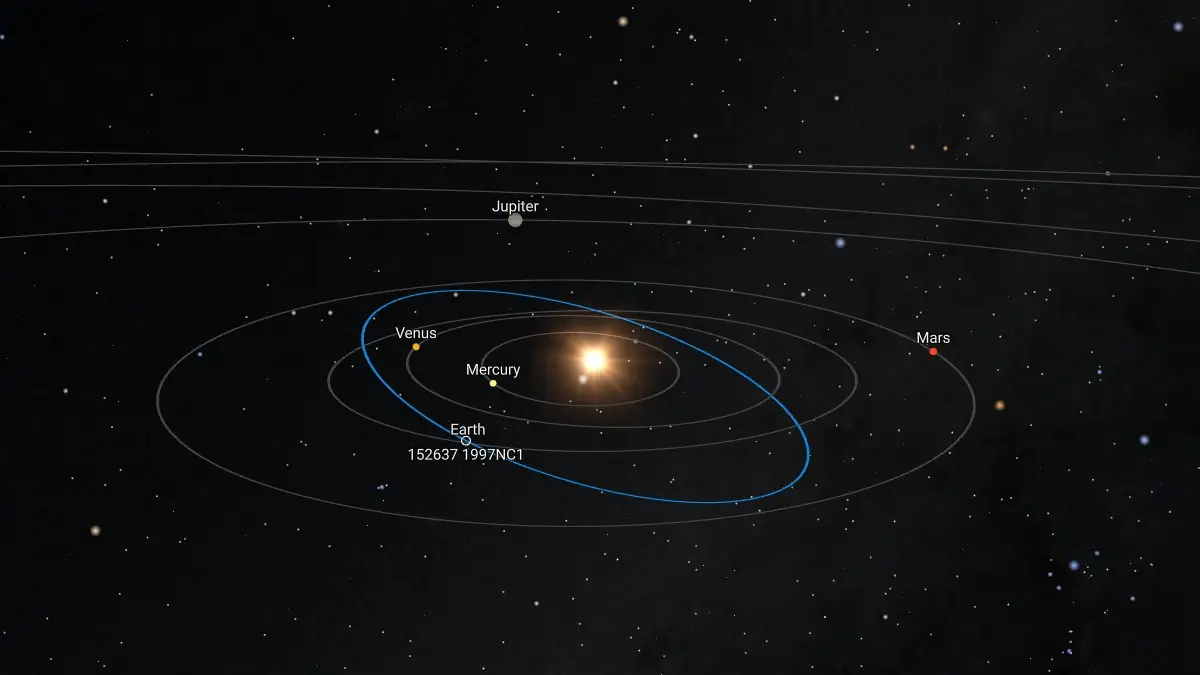
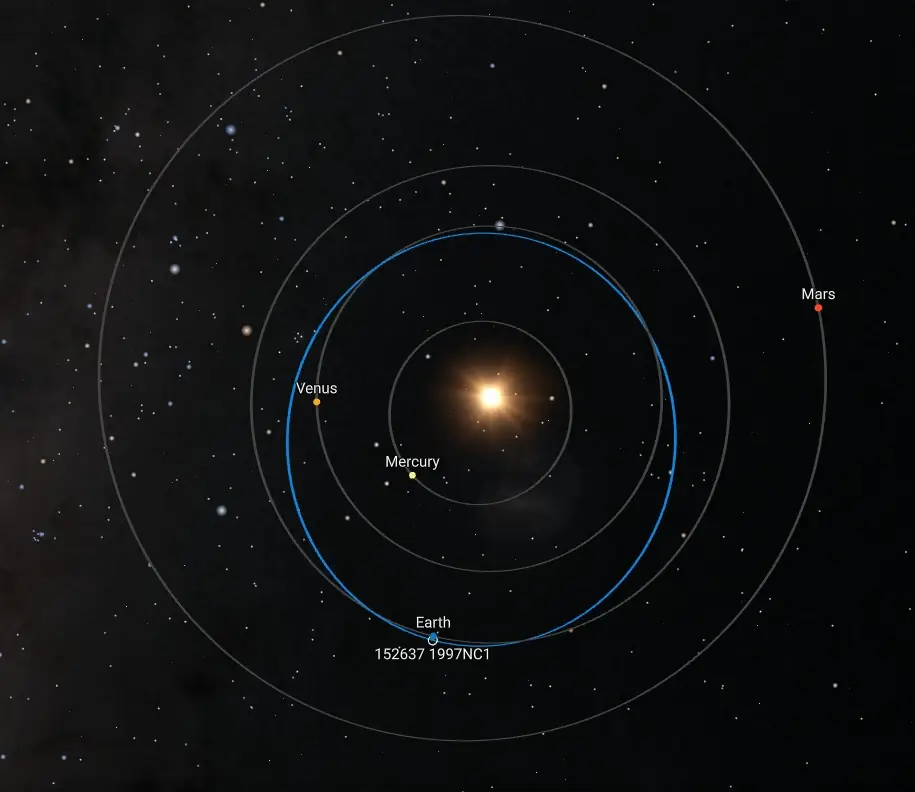
Asteroid 2026 NC1 making close approach to Earth on June 27, 2026. Credit: ESA/NEOCC
Asteroid 1997 NC1 will fly past Earth at a relative speed of 8.9 km/s (19 900 mph) at 11:16 UTC on June 27 at 6.67 LD (0.017 AU), marking its closest computed approach since before 1600, according to orbital data provided by NASA’s Jet Propulsion Laboratory (JPL).
The object is classified as a Potentially Hazardous Asteroid (PHA) and belongs to the Aten group of near-Earth asteroids. It was discovered by the Near-Earth Asteroid Tracking (NEAT) survey at Haleakala, Hawaii, on July 5, 1997.
JPL puts the diameter at approximately 0.9 km (0.56 miles) using an S-type albedo assumption, roughly 20-25% surface reflectivity, while ESA’s broader estimate ranges from 750 to 1 650 m (2 460-5 410 feet) depending on assumed albedo between 5% and 25%. Albedo measures how reflective a surface is – a darker asteroid reflects less light and must be larger to appear equally bright, which is why size estimates carry uncertainty until radar or thermal data confirms the actual diameter.
The last closer encounter by an asteroid with a brighter absolute magnitude, and therefore a presumably larger diameter, was 1994 PC1, which passed at 5.2 LD (0.0133 AU) in January 2022.
ESA lists a peak brightness near magnitude 10, making the asteroid theoretically observable with small telescopes or large binoculars under dark skies, although the bright nearby Moon might interfere. Inbound visibility is favored over northern locations, near-global visibility around closest approach, and outbound visibility over the Southern Hemisphere.
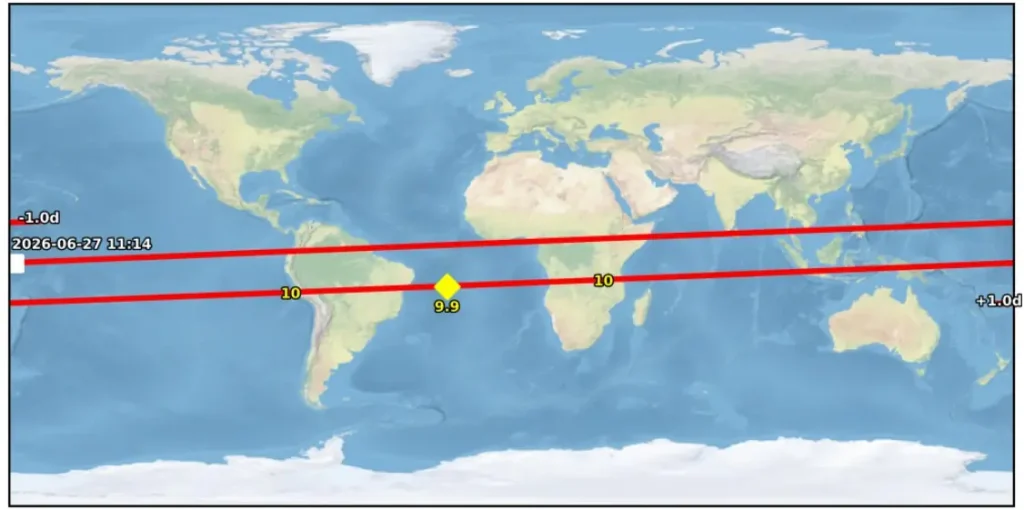
The following figure, courtesy of ESA’s NEOCC, gives a representation of the sub-asteroid point ground track over the Earth. The plot provides an indication of the closest approach point and of the visual magnitudes at different points in the path as observed from the surface of the Earth. In the plot, the white square represents the closest approach point, and the yellow diamond indicates the brightest visual magnitude point.
If you’d like to witness this flyby with expert commentary by Gianluca Masi from the comfort of your home or phone, the Virtual Telescope Project will host live online sessions on June 26 and 27, starting at 23:00 UTC. The sessions broadcast from robotic telescopes in Manciano, Italy, and are part of the Asteroid Day 2026 celebrations.
References:
1 Asteroid (152637) 1997 NC1 – NASA SSD/JPL – Accessed June 26, 2026

I'm a dedicated researcher, journalist, and editor at The Watchers. With over 20 years of experience in the media industry, I specialize in hard science news, focusing on extreme weather, seismic and volcanic activity, space weather, and astronomy, including near-Earth objects and planetary defense strategies. You can reach me at teo /at/ watchers.news.

Commenting rules and guidelines
We value the thoughts and opinions of our readers and welcome healthy discussions on our website. In order to maintain a respectful and positive community, we ask that all commenters follow these rules.