
Reservoir breaches and Maysak floods leave 6 dead, 11 missing in Guangxi, China
Severe flooding caused by Tropical Cyclone Maysak left 2 people dead in Nanning, Guangxi, on July 6, 2026, after extreme rainfall caused Liulan and Yunbiao reservoirs in Hengzhou to overtop and develop breaches. The Nanning flood-control briefing reported about 55 000 people affected and 48 000 evacuated, as of late Monday, July 7.
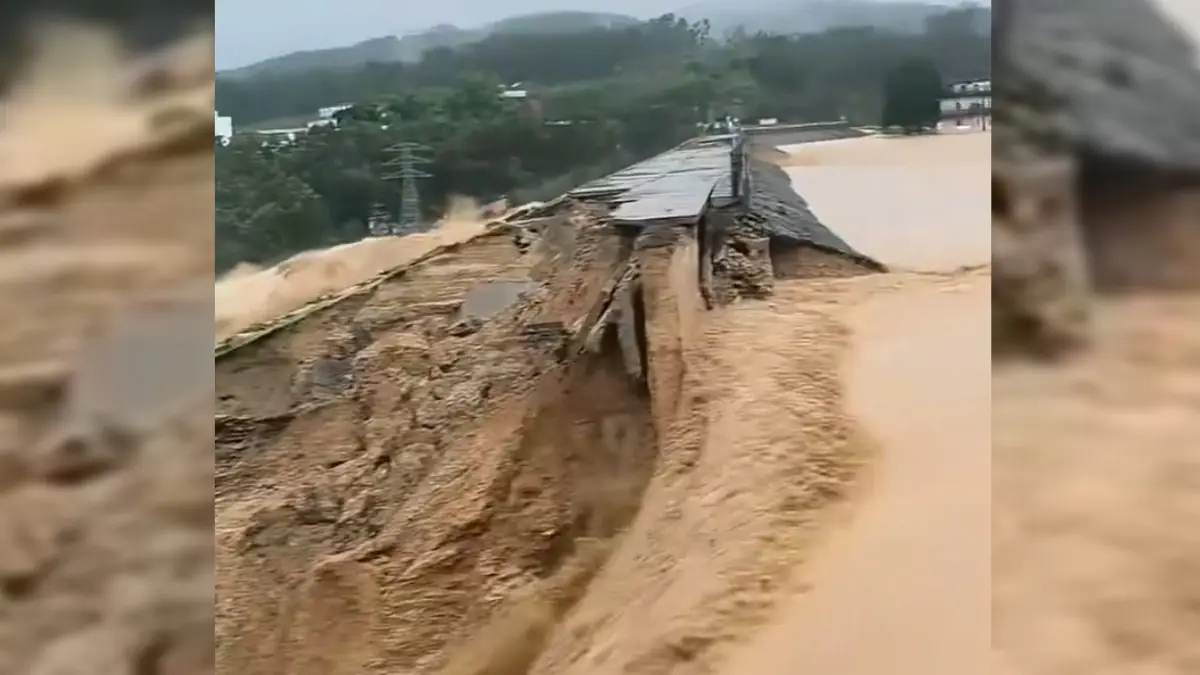
Reservoir breach in Nanning, Guangxi, China on July 6, 2026. Credit: X
Typhoon Maysak caused overtopping at three reservoirs and breaches at two of them in the Nanning region of Guangxi, China, on July 6, prompting authorities to raise the city’s flood-control emergency response to Level I at 11:30 LT (03:30 UTC). Level I is the highest tier in China’s flood-control emergency response system.
Nanning city government reported that the Liulan and Yunbiao reservoirs in Hengzhou, a county-level city under Nanning’s jurisdiction, both overtopped and breached, while Liuwang Reservoir in Binyang County overtopped.
Unofficial reports placed rainfall in Bafeng Village, Luxu Town, Binyang County, at 713.3 mm (28.1 inches) between 08:00 LT on July 5 and 08:00 LT on July 6. The reported total was described as the highest 24-hour rainfall accumulation recorded in Guangxi during the event.
The Nanning flood-control briefing reported approximately 55 000 people had been affected by flooding and about 48 000 evacuated from Nanning’s flood-control area.
At Liulan Reservoir, two sections of the dam failed at around 11:00 LT, creating a gap approximately 50 m (164 feet) wide and releasing a large volume of water downstream.
China Business Network reported that more than 300 people near the medium-sized Liulan Reservoir were evacuated to higher ground after serious cracks developed in the dam during the morning of July 6, following several days of thunderstorms that pushed water levels beyond the reservoir’s capacity.
Emergency management, water resources, fire and rescue, and other local departments were deployed across Hengzhou and Binyang County to control flooding and relocate residents from high-risk areas near reservoirs, rivers and low-lying communities.
[ Field Footage ] 🚨 On July 6, in Hengzhou City, Nanning, Guangxi, the Liulan Reservoir experienced a severe emergency. The dam suddenly developed a breach, releasing a massive torrent of floodwater that rapidly submerged the downstream areas. Many local residents who were… pic.twitter.com/vH41ywKFcY
— Aric Chen (@aricchen) July 6, 2026
Nanning’s emergency management committee said rainfall near Liuwang and Liulan reservoirs was expected to ease, potentially reducing pressure on the damaged and overtopped structures.
The events followed several days of heavy rainfall linked to Typhoon Maysak, described by Chinese media as the year’s tenth named storm. Maysak made landfall in Hainan on July 3 before weakening and moving through Guangxi toward Vietnam.
In Fangchenggang, farther southwest in Guangxi, overflowing rivers submerged vehicles up to their roofs. Residents cited by local media described the flooding as the worst in approximately two decades.
Update
09:45 UTC, July 8
The confirmed toll from flooding linked to Typhoon Maysak in Guangxi has risen to 6 fatalities and 11 people missing as of the evening of July 7, according to local authorities.
The torrential rain and flooding have affected 375 000 people across Guangxi, while 130 000 people have been evacuated from affected areas.
In Nanning, authorities said record-breaking rainfall and flooding in Hengzhou had left 4 people dead and 8 missing as of 10:00 LT on July 7. Hengzhou reported 84 700 people affected and 53 808 evacuated, while Binyang County reported 8 606 people affected, with all 8 150 people requiring evacuation already relocated.
Hengzhou City and Binyang County both recorded rainfall that broke local 24-hour meteorological records. By 07:00 LT on July 7, water levels at 70 monitoring stations on 55 rivers in Guangxi remained up to 7.46 m (24.5 feet) above warning levels, according to the regional hydrology center.
The Liulan Reservoir breach in Hengzhou was reported to have stabilized at about 110 m (361 feet) wide, China News Service reported on July 8. Emergency works, search operations, relief distribution, and downstream evacuations continued in the affected areas.
China’s State Flood Control and Drought Relief Headquarters maintained a Level II flood-control emergency response for Guangxi, while the Ministry of Emergency Management maintained a Level III national geological-disaster emergency response for the region. The national disaster relief commission maintained a Level IV national disaster relief emergency response.
More than 36 000 additional disaster-relief items, including woven bags and rubber boats, were allocated to Guangxi, while about 40 000 additional emergency items, including food, lighting equipment, raincoats, rain boots, and moisture-proof mats, were also sent to the region.
References:
1 广西南宁多个水库出现险情 当地正组织转移群众 – Xinhua – July 6, 2026
2 南宁:水库下游洪涝灾害已致约5.5万人受灾2人死亡 – Xinhua – July 6, 2026
3 广西横州六蓝水库坝体现缺口,村民:水库连发4条紧急泄洪通知,洪水向下游倾泻,溃口约50米长 – The Paper – July 6, 2026
4 台风环流北上 国家防总办公室持续调度 部署重点地区防汛防台风工作 – Ministry of Emergency Management – July 5, 2026

I'm a dedicated researcher, journalist, and editor at The Watchers. With over 20 years of experience in the media industry, I specialize in hard science news, focusing on extreme weather, seismic and volcanic activity, space weather, and astronomy, including near-Earth objects and planetary defense strategies. You can reach me at teo /at/ watchers.news.

Commenting rules and guidelines
We value the thoughts and opinions of our readers and welcome healthy discussions on our website. In order to maintain a respectful and positive community, we ask that all commenters follow these rules.