
Severe floods hit eastern and northern China after Typhoon Bavi’s double landfall
Typhoon Bavi battered eastern China after making two landfalls in Zhejiang Province late Saturday, July 11, 2026. More than 2.68 million people were relocated in Zhejiang alone ahead of landfall, while rainfall exceeded 300 mm (12 inches) in some areas. As the system moved northward, severe flooding submerged roads under more than 2 m (6.6 feet) of water in parts of Hebei, stranded approximately 1 800 people and disrupted railway services in Liaoning, while 46 rivers nationwide exceeded warning levels.
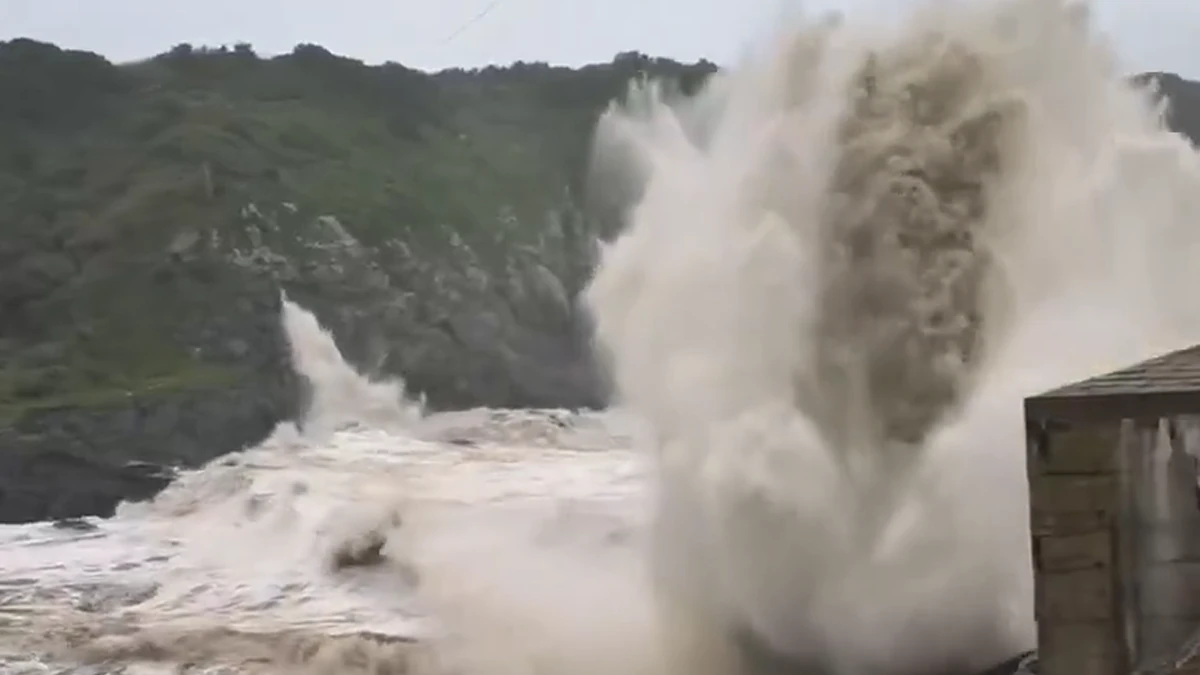
Strong winds associated to Typhoon Bavi bringing large waves to Dachen islands, Taizhou, Zhejiang, China. Credit: CMA
Typhoon Bavi battered eastern China after making two landfalls along Zhejiang Province late Saturday. Over 2 million people were evacuated across the affected regions, disrupting air and rail travel, and bringing torrential rain, damaging winds, and widespread flooding across several provinces as authorities mounted large-scale emergency response operations.
According to the Zhejiang provincial meteorological observatory, Bavi made its first landfall near Yuhuan City at approximately 23:20 local time (15:20 UTC) Saturday with maximum sustained winds of 144 km/h (89 mph). Less than one hour later, the cyclone made a second landfall around midnight near Yueqing City before continuing northwestward while gradually weakening inland.
Chinese authorities stepped up flood-control and disaster relief operations as Bavi tracked farther inland. Emergency agencies deployed response teams, while ports suspended operations and cargo vessels sought shelter ahead of the storm’s arrival. Officials warned that the system would continue to produce heavy rainfall across parts of eastern and northeastern China, increasing the risk of flash flooding, landslides and urban inundation.
After Typhoon Bavi made landfall in Yuhuan, Zhejiang, the wind force in the area continued to increase. pic.twitter.com/t24AjOXq42
— Jim (@yangyubin1998) July 11, 2026
Typhoon Bavi, the ninth typhoon of the year, made two powerful landfalls on the coast of east China's Zhejiang Province within less than one hour on the night of July 11and the morning of July 12, bringing fierce winds and torrential rain. pic.twitter.com/eVSdkW0oIr
— CCTV+ (@CCTV_Plus) July 12, 2026
Authorities evacuated more than 2.2 million residents from Zhejiang Province ahead of the storm, while approximately 290 000 people were moved to safety in Shanghai and more than 180 000 were evacuated in neighboring Fujian Province as precautionary measures.
By Sunday afternoon, Bavi had moved into eastern Anhui province and was forecast to turn northeast before entering the northern Yellow Sea on Tuesday, July 14 China’s National Meteorological Center said.
The storm is expected to dump heavy to torrential rain across the provinces of Jilin, Liaoning, Hebei, Shandong, Jiangsu and Anhui from Monday, July 13 exacerbating flood risks in areas that have already been soaked by earlier downpours.
363.3 mm (14.3 inches) of rainfall was reported in Hebei province’s northern Tangshan in 24 hours between Saturday and Sunday. Meanwhile nearly 190 mm (8 inches) of rain fell in Qianxi county during the same period.
Bavi toppled more than 1 300 trees in Yueqing. In some areas floodwaters reached roughly halfway up vehicle tires. Multiple landslides were also reported due to the heavy rain. Emergency crews deployed heavy equipment to clear debris and reopen flooded roads while rescue teams responded to multiple weather-related emergencies.
Local authorities have intensified emergency response efforts as Typhoon Bavi, the ninth typhoon of the year, batters east China's Zhejiang Province.#China #TyphoonBavi pic.twitter.com/ugATFeUBYG
— CCTV+ (@CCTV_Plus) July 12, 2026
In one overnight operation, police rescued five villagers stranded by floodwaters in Zhejiang after making three trips through rapidly rising water before dawn.
Before reaching mainland China, Bavi passed north of Taiwan, where authorities reported 134 injuries, most related to weather-induced accidents. More than 190 flights were canceled as strong winds and heavy rain disrupted transportation across the island.
Updates
08:50 UTC, July 13
Severe flooding expanded into Hebei and Liaoning provinces on Monday, July 13, as Bavi’s weakening circulation moved northward across China.
Floodwaters exceeded 2 m (6.6 feet) on roads in Kuancheng County, Hebei, where approximately 1 800 villagers were stranded and vehicles were swept away by strong currents.
Liaoning authorities raised the flash flood alert to red. More than 30 railway sections around Shenyang were affected, forcing the suspension of multiple train services, while schools were closed in several northeastern areas, including parts of Jilin Province.
China’s Ministry of Water Resources reported that 46 rivers nationwide had exceeded warning levels.
New official information shows that more than 2.68 million people were relocated in Zhejiang before Bavi made landfall, up from 2.2 million reported yesterday. More than 19 000 emergency shelters were opened across the province.
References:
1 China steps up flood control, disaster relief efforts as Typhoon Bavi moves inland – Xinhua – July 12, 2026
2 Police save villagers stranded by Typhoon Bavi floodwaters in E China – Xinhua – July 12, 2026

I am an Assistant Editor and Severe Weather & Science Journalist at The Watchers, specializing in real-time severe weather coverage, geophysical event reporting, and research-driven scientific analysis. You can reach me at rishav(at)watchers(.)news.

Commenting rules and guidelines
We value the thoughts and opinions of our readers and welcome healthy discussions on our website. In order to maintain a respectful and positive community, we ask that all commenters follow these rules.