
Webb reveals hidden history of Centaurus A with new images marking fourth year of science
New observations from NASA’s James Webb Space Telescope, released on July 6, 2026, to mark the observatory’s fourth year of science operations, have revealed the nearby active galaxy Centaurus A in remarkable infrared detail, exposing dust structures, hidden stellar populations, and activity surrounding its central supermassive black hole. Combined with findings from a preprint published on arXiv on July 6, 2026, and a study published in Astronomy & Astrophysics on July 18, 2025, the observations provide one of the clearest views yet of how an ancient galactic merger continues to shape star formation and the galaxy’s energetic nucleus billions of years later.
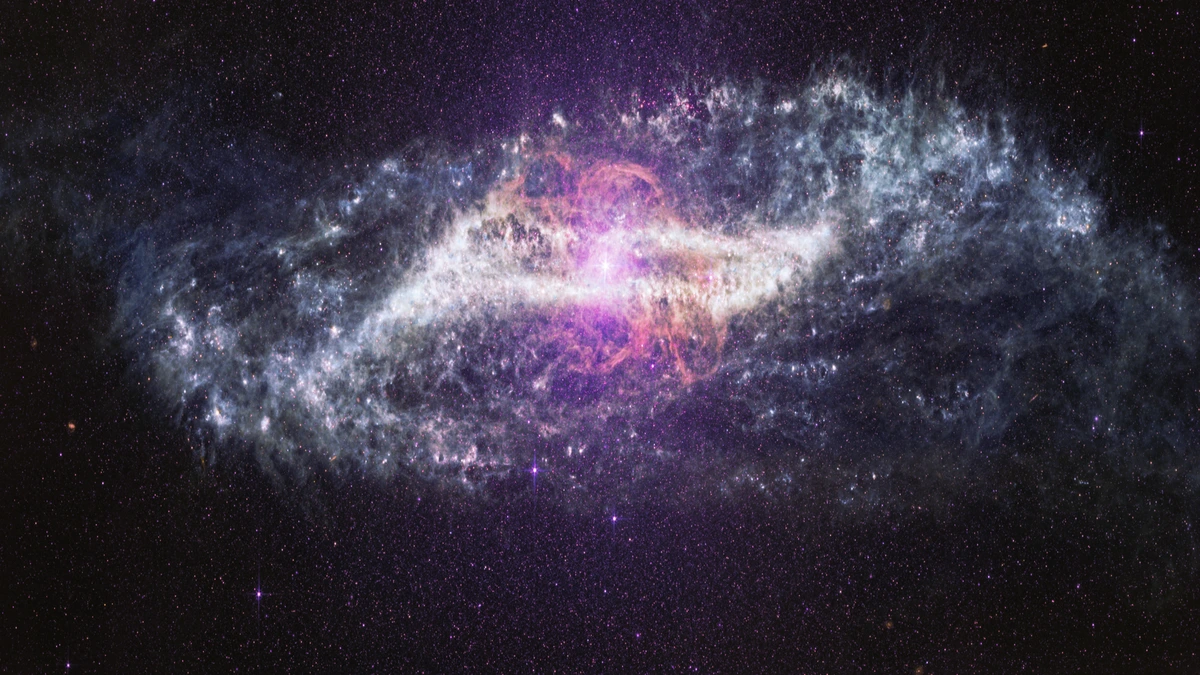
Centaurus A (MIRI Image). Credit: NASA, ESA, CSA, STScI; Image Processing: Alyssa Pagan (STScI), Joseph DePasquale (STScI), Macarena Garcia Marin (ESA Office at STScI)
Four years after beginning routine science operations, the James Webb Space Telescope continues to expand astronomers’ understanding of the nearby Universe. To celebrate the mission’s fourth science anniversary, NASA and the European Space Agency released new observations of Centaurus A (NGC 5128), a galaxy about 11 million light-years away whose chaotic appearance preserves the aftermath of a major collision with another galaxy roughly 2 billion years ago.
Although relatively nearby, Centaurus A differs from most galaxies in its neighborhood. It hosts a feeding supermassive black hole that drives powerful jets extending far beyond the galaxy itself, while a warped dust lane cuts across its center, the enduring signature of the ancient merger that fundamentally altered its structure. That combination makes Centaurus A one of astronomy’s most important laboratories for investigating how galaxy mergers, black hole activity, and star formation evolve together.
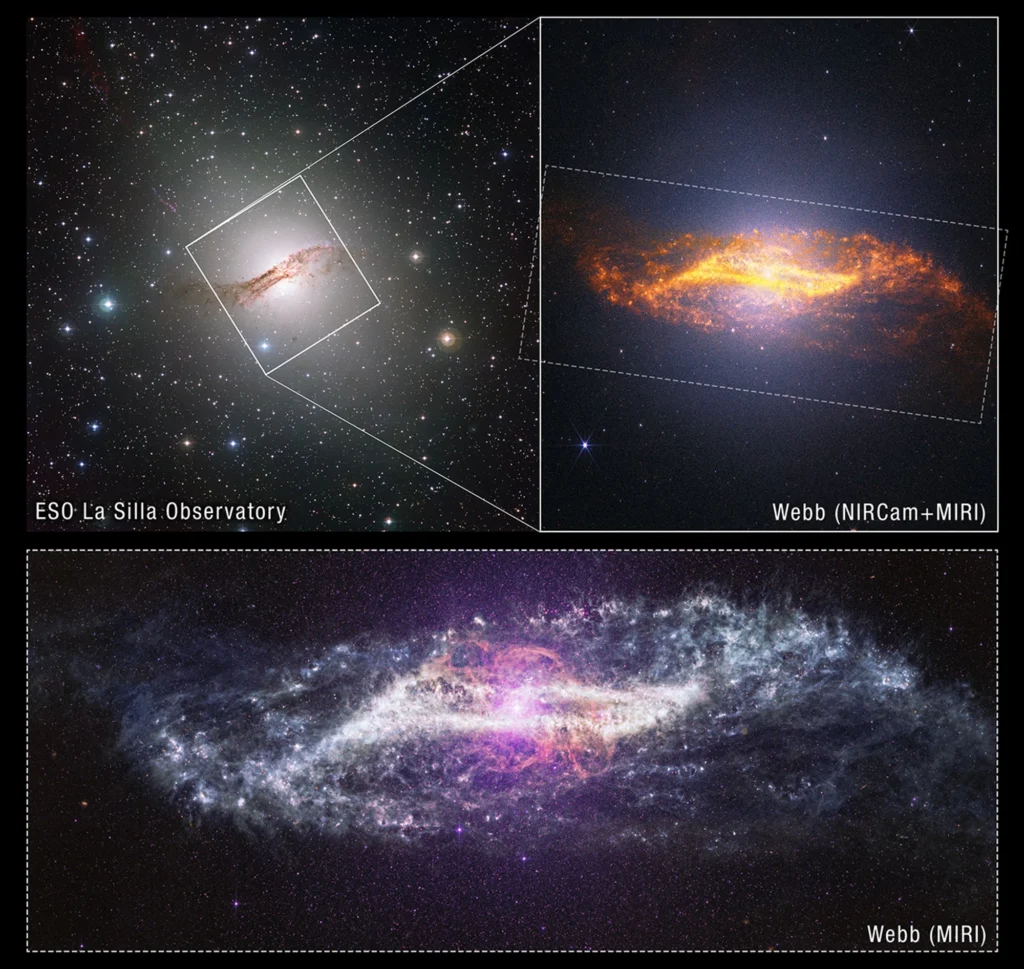
Previous observations with the Hubble Space Telescope captured the galaxy in visible light but could not see through its dense dust lane, while NASA’s retired Spitzer Space Telescope traced the warm dust on much larger scales without resolving individual stars. Webb combines far greater infrared sensitivity with substantially higher spatial resolution, allowing astronomers to penetrate the obscuring dust and examine the galaxy’s central regions, star by star.
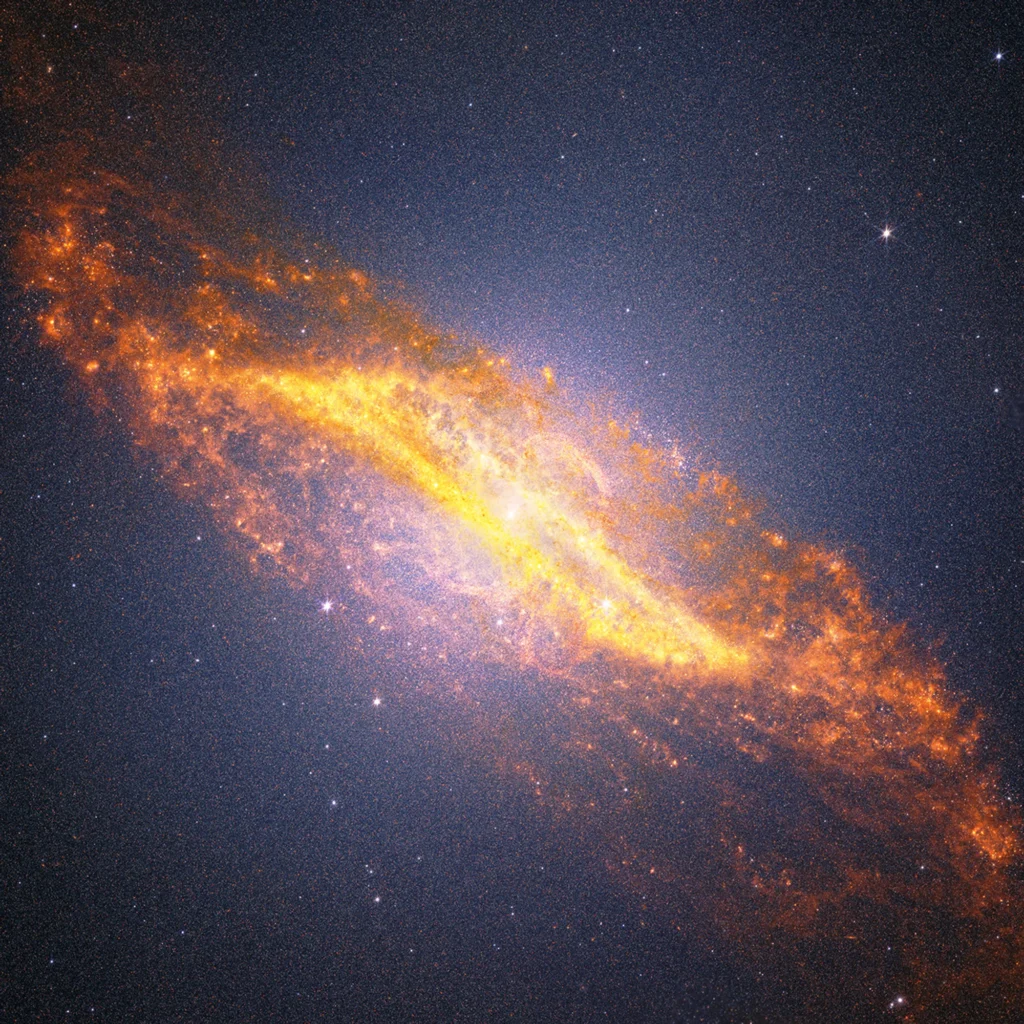
The anniversary release combines observations from Webb’s Near-Infrared Camera (NIRCam) and Mid-Infrared Instrument (MIRI). NIRCam resolves dense stellar populations hidden within the dust, while MIRI highlights warm dust, embedded star-forming regions, and the intricate structure of the warped central disc. Together, they reveal a galaxy whose apparent disorder records billions of years of evolution.
Among the most striking features is the warped dust lane crossing the galaxy’s center, accompanied by faint looping filaments and an unusual S-shaped structure visible most clearly at mid-infrared wavelengths. Astronomers have not yet determined the origin of this feature. It may reflect the complex geometry of the merger remnant, the influence of the active nucleus, or interactions between both processes, making it an important target for future investigation rather than a settled interpretation.
Scattered throughout the dusty disc are numerous bright infrared sources associated with dust-rich evolved stars and regions where new stars are forming. Rather than presenting a smooth glow, Webb resolves what previously appeared as diffuse emission into millions of individual stars, allowing researchers to reconstruct different phases of the galaxy’s history.
By comparing stellar populations of different ages, astronomers can trace when star formation accelerated following the merger and how the galaxy evolved into its present form — a process often described as galactic archaeology.
A companion study led by Olivia C. Jones uses JWST/MIRI imaging to investigate the stellar populations embedded within Centaurus A’s central dust disc. The researchers identified approximately 58 000 point sources across the observed field, with 2 558 high-quality detections suitable for detailed color analysis. Among them, they identified 928 infrared-excess sources whose colors and spatial distribution are consistent with embedded young stellar objects still surrounded by warm dust.
Those infrared-excess sources closely follow the warped dust disc and associated filamentary structures rather than the direction of the galaxy’s prominent radio jet. The authors conclude that recent star formation in the central few kiloparsecs is most naturally explained by gas supplied during the ancient merger, finding no strong evidence that interactions between the radio jet and the surrounding interstellar medium are the dominant trigger for the newly formed stellar population in the central disc.
A second study, led by Almudena Alonso Herrero, examines a different aspect of the galaxy using Webb’s Mid-Infrared Instrument Medium-Resolution Spectrometer (MRS). Instead of imaging stars and dust, the spectroscopic observations measure the motion and physical properties of ionized and molecular gas within roughly the central 100 to 200 parsecs surrounding the active galactic nucleus.
Those observations reveal fast-moving ionized gas with velocities reaching approximately +1 000 km/s (+621 mi/s) and −1 400 km/s (−870 mi/s). The observed kinematics are consistent with a jet-driven bubble or outflow interacting with the surrounding interstellar medium, while mid-infrared emission-line ratios indicate the presence of shock excitation near the nucleus. In contrast, the warm molecular hydrogen behaves differently. Although it exhibits complex motions within the rotating circumnuclear disc, the researchers found no clear evidence for an equally fast warm molecular outflow, suggesting that the energetic feedback affects different phases of the gas in different ways.
The two studies present complementary views of the same galaxy. The imaging investigation focuses on what fuels recent star formation within the merger-created dust disc, while the spectroscopic study examines how energy released by the active nucleus influences the surrounding gas. Rather than contradicting one another, they show that the galaxy’s evolution is governed by multiple processes operating simultaneously: gas delivered by an ancient merger continues to form new stars, while the central black hole injects energy into its environment through powerful outflows.
The new observations also demonstrate the growing scientific reach of Webb as it enters its fifth year of operations. Although the observatory is widely recognized for exploring the distant Universe, the Centaurus A observations show that it is equally transformative for nearby galaxies, where individual stars, dust structures, and gas motions can all be studied in extraordinary detail.
By combining high-resolution imaging with infrared spectroscopy, Webb is providing astronomers with an increasingly complete picture of how galaxies assemble, how supermassive black holes influence their surroundings, and how the consequences of major mergers can remain visible billions of years after the collision itself. For one of the nearest active galaxies to Earth, Centaurus A has become an even more valuable benchmark for understanding the long-term relationship between galaxy interactions, star formation, and black hole feedback across the Universe.
References:
1 NASA Webb Uncovers Unusual Galaxy Shaped by Cosmic Collision – NASA – July 6, 2026
2 Webb reveals millions of stars in nearby galaxy – ESA – July 6, 2026
3 MICONIC: The spatial relationship between star formation and the AGN in Centaurus A revealed by JWST/MIRI – O. C. Jones, M. Jones, D. Dicken, G. S. Wright, M. García Marín, A. Alonso Herrero, P. Guillard, K. Justtanont, M. Meixner, A. Labiano, D. Rouan, P. van der Werf, L. Pantoni, V. A. Buiten, T. Böker, G. Östlin, L. Evangelista, M. Baes, L. Colina, L. Hermosa Muñoz, Th. Henning, M. Güdel, T. P. Ray, P.-O. Lagage – UK Astronomy Technology Centre / MICONIC JWST MIRI European Consortium – July 6, 2026 – DOI: https://doi.org/10.48550/arXiv.2607.04942 – OPEN ACCESS
4 MICONIC: JWST/MIRI MRS reveals a fast ionized gas outflow in the central region of Centaurus A – A. Alonso Herrero, L. Hermosa Muñoz, A. Labiano, P. Guillard, M. García-Marín, D. Dicken, S. García-Burillo, L. Pantoni, V. Buiten, L. Colina, T. Böker, M. Baes, A. Eckart, L. Evangelista, G. Östlin, D. Rouan, P. van der Werf, F. Walter, M. J. Ward, G. Wright, M. Güdel, Th. Henning, P.-O. Lagage – Astronomy & Astrophysics (EDP Sciences) – July 18, 2025 – DOI: https://doi.org/10.1051/0004-6361/202554823 – OPEN ACCESS

I’m a science journalist and researcher at The Watchers, contributing to the Epicenter edition, where I cover peer-reviewed scientific research and emerging discoveries across Earth and space sciences. With a background in astronomy and a passion for environmental science, I’ve worked in shark and coral conservation in Fiji, conducting reef and shark-behavior research, contributing to mangrove restoration, and earning PADI Open Water and Coral Reef Certifications. I bring a blend of scientific rigor and storytelling to illuminate the discoveries shaping our planet and beyond.

Commenting rules and guidelines
We value the thoughts and opinions of our readers and welcome healthy discussions on our website. In order to maintain a respectful and positive community, we ask that all commenters follow these rules.