
Underwater robot captures first confirmed sighting of Arctic bobtail squid in the wild
An underwater robot launched from a small expedition vessel has captured the first confirmed images of the elusive Arctic bobtail squid (Rossia moelleri) in its natural habitat, including a mature female alongside clusters of eggs in the icy waters of Northeast Greenland National Park. The discovery, published on July 18, 2026, in Polar Biology, provides the first confirmed in situ record of the species and the first direct evidence of it reproducing in its natural Arctic habitat.
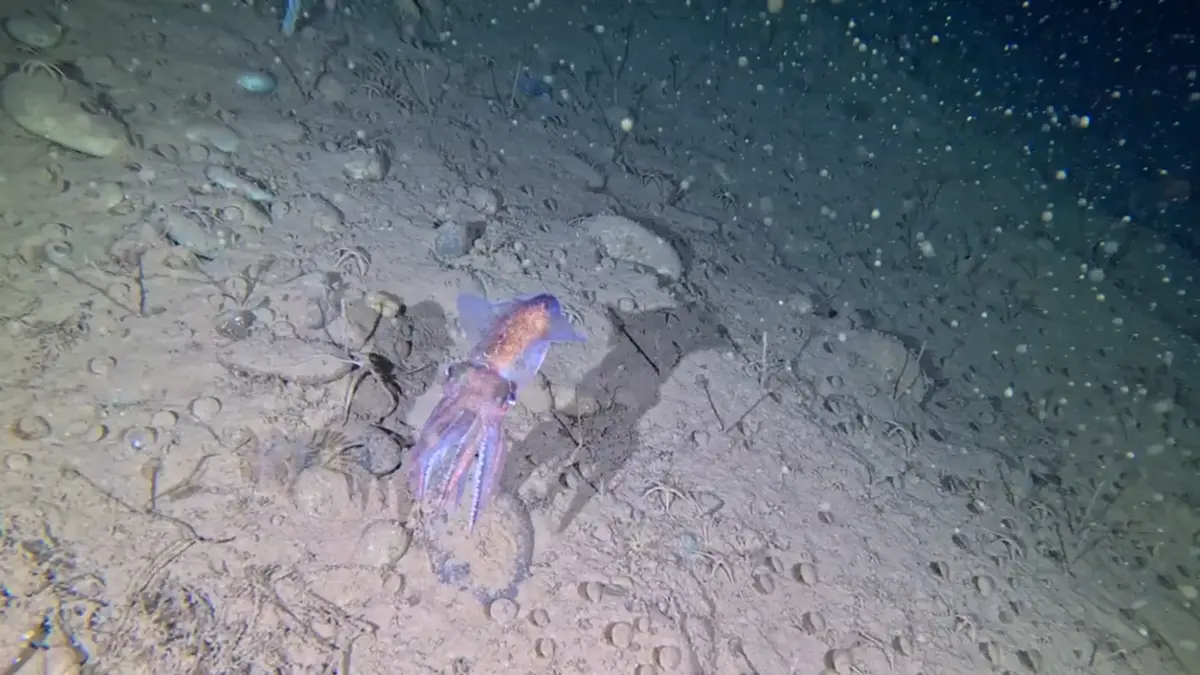
Remotely operated vehicle captures the first-ever sighting of an Arctic bobtail squid in its natural environment. The animal's eggs can be seen near the end of the video. Credit: Polar BLAST, Paige Maroni, Tim Macdonald
The discovery was made during a Polar BLAST expedition aboard a Secret Atlas Micro Cruise Expedition vessel, supported by Yachts for Science, where researchers deployed a lightweight remotely operated underwater vehicle (ROV) to explore the seafloor of Kong Oscar Fjord near Jameson Land. About 50 m (164 feet) below the surface, in water measuring -1.6°C (29.1°F), the ROV revealed a roughly 10 cm (4-inch) squid resting beside grape-like clusters of eggs attached directly to exposed rock, the first time the species has been documented alive in the wild.
“Northeast Greenland National Park is the largest national park on Earth but one of the least biologically documented marine regions in the Arctic,” said lead author Dr. Paige Maroni, from The University of Western Australia’s School of Biological Sciences.
The Arctic bobtail squid has been known to science since the late 1800s, but almost everything researchers knew about the species came from animals collected in fishing gear or scientific surveys. Until now, no one had observed it on the seafloor or documented its breeding behaviour in the wild.
The expedition recorded a mature female next to three egg masses containing 22, 33 and 50 eggs. The translucent egg capsules, arranged in bunches resembling grapes, were attached directly to bedrock, a key observation that helped researchers identify the species.
The egg masses differed from those of the Arctic bobtail squid’s closest relatives, Rossia palpebrosa and Rossia megaptera, which deposit smaller, smooth egg capsules inside living glass sponges. Combined with the animal’s size, appearance and the surrounding habitat, the egg-laying site provided strong evidence that the squid was R. moelleri.
“The squid and eggs were recorded at a depth of 50 m (122 feet) in water around -1.6°C (34.8°F) , which highlights the resilience of marine life in one of Earth’s most extreme environments,” Dr. Maroni said.
Cephalopods, including squid and octopus, are both predators and prey in Arctic marine ecosystems, feeding on crustaceans and fish while supporting larger predators such as seals, whales, seabirds and commercially important fishes.
Yet despite their ecological importance, many Arctic species remain poorly documented because vast areas of the region have rarely been explored.
“Establishing knowledge of the biodiversity in this region is crucial for understanding ecosystem function and resilience under accelerating climate change,” Dr. Maroni said.
The researchers say the observations provide an important reference point for monitoring ecological change in one of the world’s fastest-warming regions.
“This study provides a valuable new baseline for tracking ecological change in the rapidly warming Arctic,” Dr. Maroni added.
The discovery also demonstrates how compact underwater technology is expanding opportunities for research in some of the world’s most inaccessible marine environments. Rather than relying solely on large research vessels, scientists were able to document the rare squid using a lightweight ROV deployed from a small expedition cruise operating in one of the least-studied parts of the Arctic.
“Our results show low-impact science and expedition tourism can help fill major biodiversity gaps in remote polar regions,” Dr. Maroni said.
She added that even isolated observations can make an important contribution to understanding remote ecosystems.
References:
1 Maroni, P. C., et al. (2026). First in situ observations of the Arctic bobtail squid Rossia moelleri and egg masses in Northeast Greenland National Park. Polar Biology. https://doi.org/10.1007/s00300-026-03495-y
2 Rare sighting of Arctic bobtail squid and egg masses – The University of Western Australia – July 20, 2026.

I’m a science journalist and researcher at The Watchers, contributing to the Epicenter edition, where I cover peer-reviewed scientific research and emerging discoveries across Earth and space sciences. With a background in astronomy and a passion for environmental science, I’ve worked in shark and coral conservation in Fiji, conducting reef and shark-behavior research, contributing to mangrove restoration, and earning PADI Open Water and Coral Reef Certifications. I bring a blend of scientific rigor and storytelling to illuminate the discoveries shaping our planet and beyond.

Commenting rules and guidelines
We value the thoughts and opinions of our readers and welcome healthy discussions on our website. In order to maintain a respectful and positive community, we ask that all commenters follow these rules.