
Scientists discover first sugar in interstellar space, expanding the inventory of life’s molecular ingredients
Scientists have identified erythrulose, a simple four-carbon sugar found naturally in foods such as raspberries and used in some self-tanning cosmetics, in a giant molecular cloud near the center of the Milky Way. The discovery marks the first confirmed detection of a monosaccharide in interstellar space and adds another important piece to the puzzle of how the molecular ingredients for life may have formed long before planets existed.
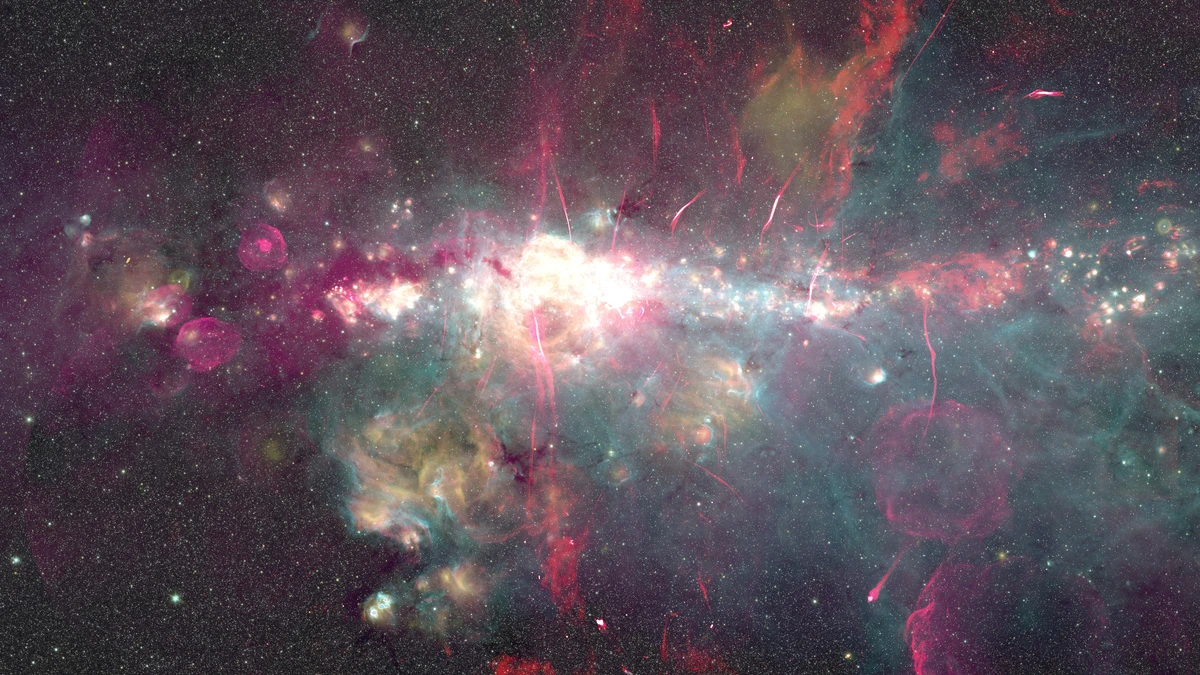
Image of the galactic center obtained from observations made with different telescopes. Credit: Ashley Barnes/Izaskun Jiménez-Serra/Juan García de la Concepción
An international team of astronomers has detected erythrulose (C4H8O4) in the giant molecular cloud G+0.693−0.027, located near the Galactic Center. Described in a study published in Nature Astronomy on July 13, 2026, the finding represents the first confirmed discovery of a monosaccharide, or simple sugar, in the interstellar medium and the largest non-cyclic molecular species yet identified there, containing 14 atoms.
Erythrulose is also a chiral molecule, meaning it exists in two mirror-image forms that cannot be superimposed on one another, much like left and right hands. Molecular handedness is considered one of the central questions in origin-of-life research because life on Earth overwhelmingly uses one orientation of many biological molecules. With this detection, erythrulose becomes only the second chiral molecule identified in interstellar space.
Researchers identified the molecule using observations from Spain’s Yebes 40-meter telescope and the IRAM 30-meter telescope, together with laboratory rotational spectroscopy performed at the University of the Basque Country (UPV/EHU). The team identified 12 spectral features corresponding to 17 rotational transitions, including six uncontaminated lines that firmly established the molecule’s presence.
“This result was unexpected, since the most widely accepted idea in astrochemistry is that interstellar molecules grow in size through the successive addition of carbon atoms. Therefore, we had to continue investigating,” Izaskun Jiménez-Serra, lead author of the study, said.
Chemical modeling instead indicates that erythrulose most likely formed through reactions involving the simpler molecules glycolaldehyde and ethylene glycol, both previously detected in interstellar clouds. The results point to reactions between these molecules on the icy surfaces of dust grains rather than growth through the gradual addition of individual carbon atoms.
G+0.693−0.027 is known for large-scale cloud collisions that generate shock waves traveling at about 20 km/s. These shocks sputter molecules from the icy mantles coating interstellar dust grains into the surrounding gas, where radio telescopes can detect their characteristic molecular fingerprints.
Based on astrochemical modeling, the team estimates that similar processes operating before the formation of the Solar System could have produced enough erythrulose for between 0.5 million and 50 million metric tons to have been delivered to the young Earth during the Late Heavy Bombardment. If delivered to Earth, those molecules may have contributed to the inventory of organic compounds available before life emerged.
“The detection of erythrulose in a molecular cloud is an exciting discovery, because it opens up the possibility of identifying larger sugars in the interstellar medium, such as ribose, which is part of RNA, and other molecules relevant to the origin of life,” said Carlos Briones, co-author of the work.
References:
1 Jiménez-Serra, I., García de la Concepción, J., Cuppen, H.M. et al. Detection of a four-carbon sugar in interstellar space. Nat Astron (2026). https://doi.org/10.1038/s41550-026-02905-7
2 La primera molécula de azúcar detectada en el espacio interestelar aporta nuevas claves sobre el origen de la vida – CSIC – July 13, 2026

I’m a science journalist and researcher at The Watchers, contributing to the Epicenter edition, where I cover peer-reviewed scientific research and emerging discoveries across Earth and space sciences. With a background in astronomy and a passion for environmental science, I’ve worked in shark and coral conservation in Fiji, conducting reef and shark-behavior research, contributing to mangrove restoration, and earning PADI Open Water and Coral Reef Certifications. I bring a blend of scientific rigor and storytelling to illuminate the discoveries shaping our planet and beyond.

Commenting rules and guidelines
We value the thoughts and opinions of our readers and welcome healthy discussions on our website. In order to maintain a respectful and positive community, we ask that all commenters follow these rules.