
New analysis sheds light on unexpected reversal in Earth’s molten outer core beneath the Pacific
A new analysis of geomagnetic observations from 1997 to 2025 shows that the unexpected reversal in Earth’s outer-core flow beneath the equatorial Pacific around 2010 has weakened since 2020, refining scientists’ understanding of one of the most unusual deep-Earth changes detected in recent decades.
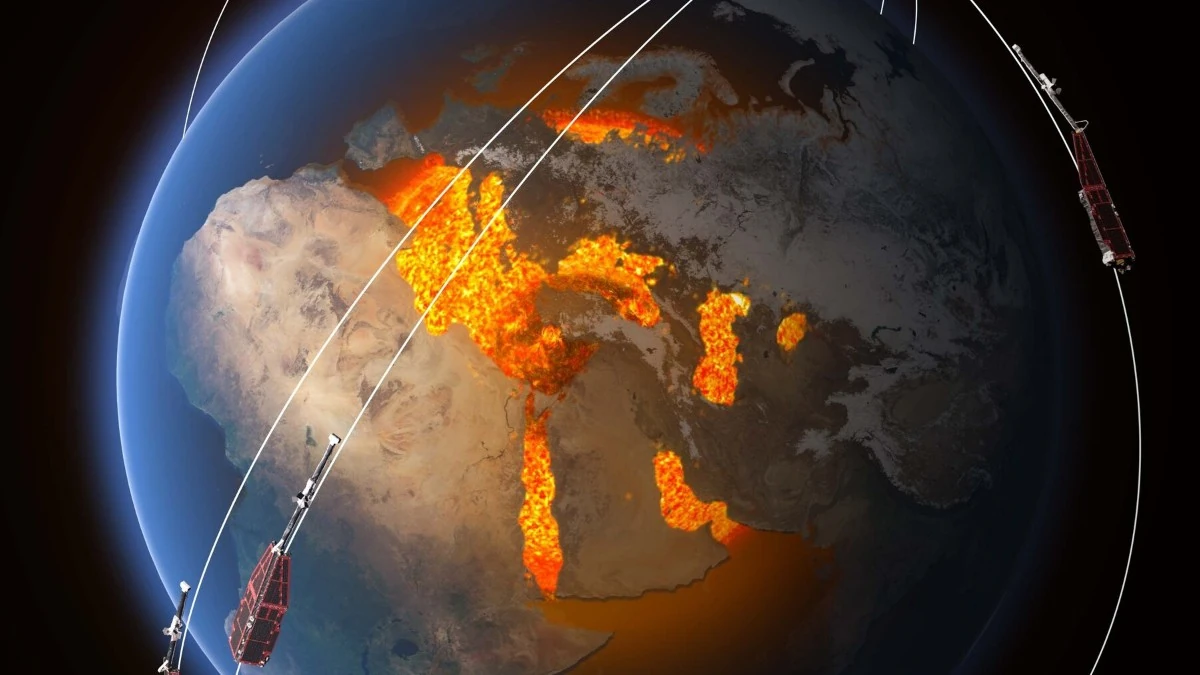
Image credit: ESA
A broad region of molten iron circulating within Earth’s liquid outer core beneath the equatorial Pacific reversed direction around 2010, shifting from weak westward motion to strong eastward flow, according to a study combining geomagnetic observations from 1997 to 2025 using ground observatories and satellite missions.
The research used data from the European Space Agency’s (ESA) Swarm constellation, Germany’s CHAMP mission, Denmark’s Ørsted mission, CryoSat data, and ground-based magnetic observatories. Swarm’s three satellites, launched in 2013, measure magnetic signals from Earth’s core, mantle, crust, oceans, ionosphere, and magnetosphere, helping researchers isolate changes linked to deep-Earth processes.
“Although Swarm was launched after the dramatic reversal event of 2010, it has provided high-precision data that tell us about Earth’s inner core in the period that followed,” said Anja Stromme, ESA’s Swarm Mission Manager.
The outer core lies about 2 200 km (1 367 miles) beneath Earth’s surface and consists mainly of electrically conducting molten iron circulating around the solid inner core. Motion in this layer generates Earth’s magnetic field through the geodynamo process, forming the magnetic shield that helps deflect charged particles from the Sun.
For decades, large-scale flow near the core–mantle boundary had generally been interpreted as predominantly westward, consistent with the westward drift of Earth’s magnetic field. The new analysis shows that flow beneath the equatorial Pacific changed around 2010, moving from weakly westward to strongly eastward.
The study reports that the Pacific eastward flow has weakened since 2020.
“The large-scale flow reversal beneath the Pacific raises new questions about the behavior of Earth’s deep interior,” said Frederik Dahl Madsen of the University of Edinburgh’s School of Geosciences. Researchers now need to determine whether the reversal was a short-lived fluctuation, part of a repeating oscillation, or a new stable state for core circulation, he said.
The cause of the reversal remains unresolved. Madsen and co-authors hypothesize that changes in Earth’s deep interior triggered the inferred flow change beneath the Pacific, noting that the rise of strong eastward flow was contemporary with a change in inner-core behavior observed from geodesy and seismology. That proposed link remains a hypothesis, not a confirmed mechanism.
Elisabetta Iorfida, ESA’s Swarm Mission Scientist, said the Pacific reversal challenges assumptions that the outer core is dominated by stable westward circulation. She said the findings may help scientists investigate interactions between Earth’s outer core, inner core, and lower mantle.
“This study shows that regional changes can emerge rapidly within just a decade. The findings may also help scientists investigate possible interactions between Earth’s outer core, inner core, lower mantle and, therefore, give more insights into core-mantle boundary, which is a critical region for the deep Earth dynamics.”
References:
1 Insights into Earth’s molten outer core from space – ESA – May 21, 2026
2 Madsen, F. D., Howard, I., Brown, W., & Whaler, K. (2026). Principal component analysis of the 2010 reversal of core-surface flow beneath the Pacific Ocean (Version 4, Vol. 1084). Journal of Studies of Earth’s Deep Interior. https://doi.org/10.46298/jsedi.17268

I'm a dedicated researcher, journalist, and editor at The Watchers. With over 20 years of experience in the media industry, I specialize in hard science news, focusing on extreme weather, seismic and volcanic activity, space weather, and astronomy, including near-Earth objects and planetary defense strategies. You can reach me at teo /at/ watchers.news.

That thumbnail image from ESA, 31E above Giza, is someone on the team cognizant of certain matters?
We note this is remote-sense data, no mechanism mentioned of the leap from this to a notional volume of phase-aligned, presumed ‘ferric-rich’ material moving, I felt publication’s wording deliberately lead to that impression by the authors. So purely a field measurement which could be better communicated in the publication, not Teo’s as-usual excellent summary here.
How much this gives beyond the already known NOAA world magnetic map series, not sure.
In the addendum we are shown a field-change and vector with time map over about 20 years, that’s interesting, seeing how this PAC change speaks to, for example, the northern polar field changes.
The same addendum also shows some poloidal and toroidal differentiated phase-change data which gives useful insight to our unclassified eyes, irrespective of the authors discussions.
Inner-core nested toroids? ‘The interesting stuff always happens at the gradients’.
Publication made no mention of LLSVPs, MHD absent in the discussion, yet space to include ‘iron-fluid’ and ‘geo-dynamo’ which beggars-belief authors so illiterate or weak while acknowledging mission objective of applied earth-sciences.
Kudos to the engineers and technicians, please will the academics step-aside, you are in the way, this is a systems-engineering issue.
Team Cunningham’s hypothetical ECDO framework builds as we push to falsify it. Thank you once again, Teo.