• Magnetic flows surge at the Sun’s south pole, defying solar physics models

    Data from ESA’s Solar Orbiter, published on November 5, 2025 in The Astrophysical Journal Letters, show magnetic fields at the Sun’s south pole flowing toward the pole at 10–20 m/s (33–66 ft/s). The discovery overturns decades of theory about how the Sun’s magnetic field circulates.

  • X45 superflare of 2003 rivaled Carrington Event and carried potential to trigger a planetary-scale power-grid collapse

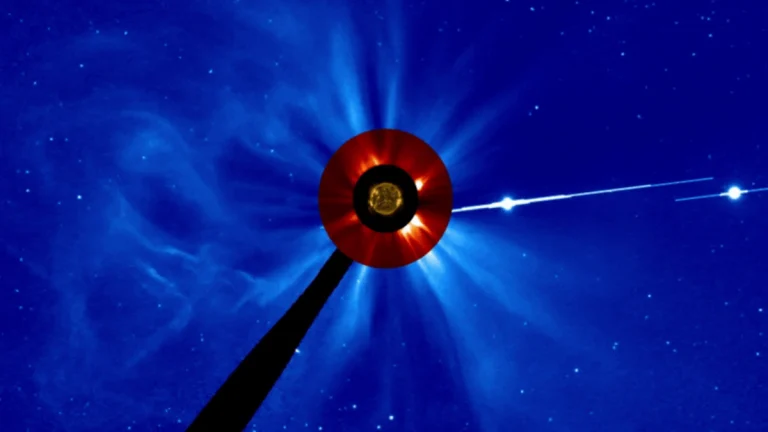
    A solar flare of extraordinary intensity erupted from Active Region 10486 at 19:29 UTC on November 4, 2003, overwhelming every X-ray detector in orbit and leaving scientists temporarily blind to its true scale. Only later would they learn it reached about X45 — the most powerful ever measured in the Space Age. Its radiative power rivaled that of the 1859 Carrington Event, yet most of its debris was ejected harmlessly sideways into space. Had Active Region 10486 faced Earth, researchers estimate the geomagnetic index Dst could have dropped below –850 nanoteslas — enough to trigger a planetary-scale power-grid collapse.

  • Rare fragmented auroras and picket fence structures observed together, challenging long-held latitude boundary assumptions

    Fragmented aurora-like emissions and picket fence structures were simultaneously observed over northern Scandinavia during a geomagnetic storm on January 1, 2025, marking the first recorded coexistence of these two rare phenomena within auroral latitudes. The discovery adds to the growing understanding that Earth’s upper atmosphere is far more dynamic than once thought, with electric-field structures that can stretch over thousands of kilometres but reorganize in seconds.

  • Marine cores record Cascadia megathrust earthquakes followed by near-simultaneous San Andreas fault rupture

    A new study published recently in Geosphere finds that some of the largest earthquakes along the Cascadia subduction zone may have triggered nearly simultaneous ruptures on California’s San Andreas fault. The discovery suggests that the “really big one” in the Pacific Northwest could cascade southward, affecting much of the U.S. West Coast in a single sequence.

  • Twin 15th-century eruptions plunged the planet into decades of cold

    A new analysis of Antarctic ice cores reveals that two volcanoes—Kuwae in Vanuatu and a yet-unidentified Southern Hemisphere volcano—erupted almost simultaneously around 1458–1459 CE, releasing sulfur and ash that triggered one of the coldest decades of the last millennium.

  • South Atlantic Anomaly, weak spot in Earth’s magnetic field, expanding steadily since 2014

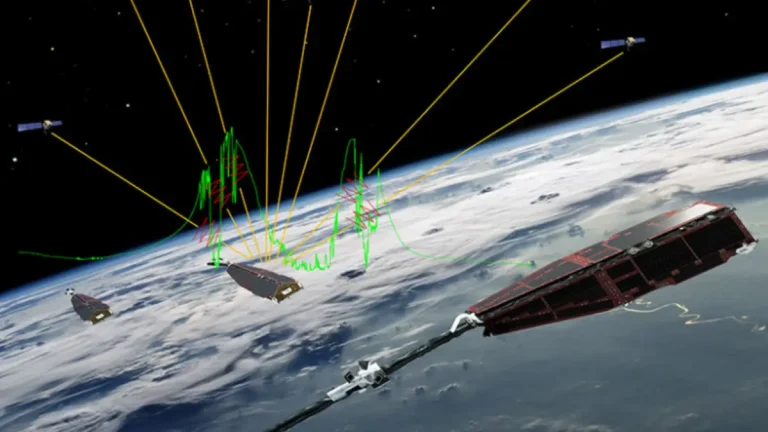
    New data from the European Space Agency’s Swarm mission show that the South Atlantic Anomaly, a weak region in Earth’s magnetic field over the South Atlantic Ocean, has expanded steadily since 2014, now covering nearly 1 % of the planet’s surface. The 11-year record marks the most detailed satellite observation of the field’s uneven weakening to date.