
Yellowstone’s silent chemistry reveals the secret of its missing sulfur dioxide
Yellowstone smells like sulfur, boils with heat, and vents enormous volumes of gas — yet one of volcanology’s most important signals is missing. The near-absence of sulfur dioxide reveals why Yellowstone’s magma stays deep, quiet, and chemically transformed long before reaching the surface.
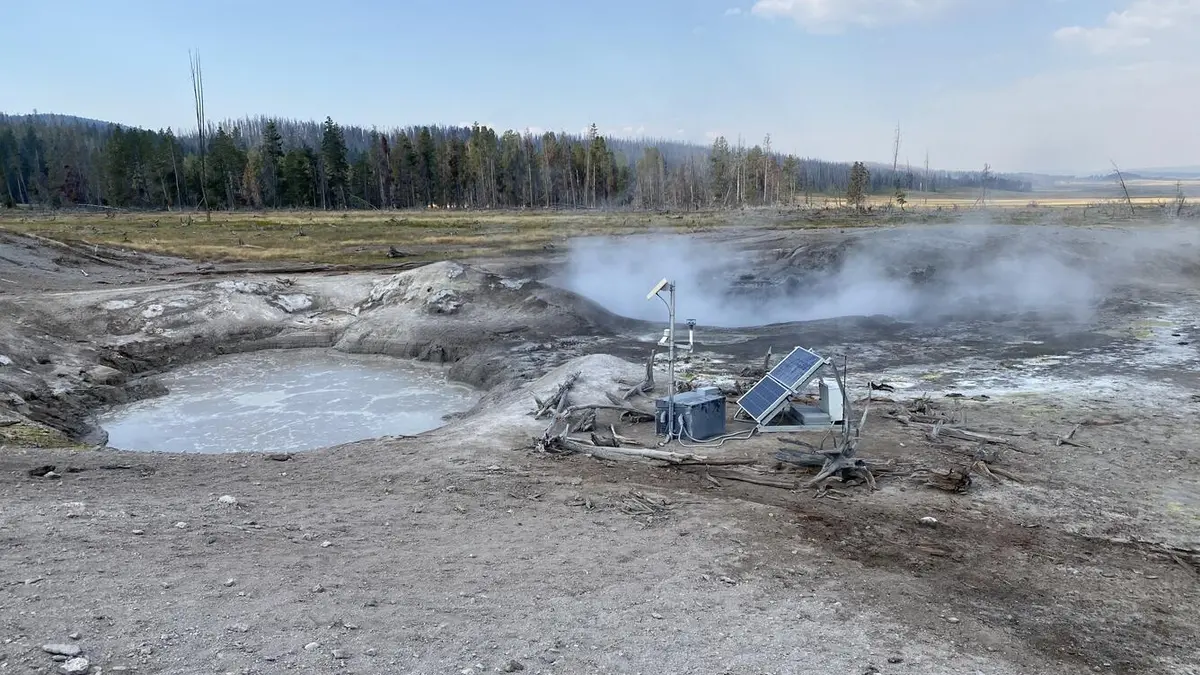
Multi-GAS station installed in the Mud Volcano area of Yellowstone National Park, where scientists monitor concentrations of carbon dioxide, hydrogen sulfide, and water vapor to track changes in the volcanic system. Credit: USGS
Yellowstone National Park is one of the most active hydrothermal systems on the planet, yet it produces almost no measurable sulfur dioxide. This absence stands in sharp contrast to other active volcanoes, such as Kīlauea in Hawai‘i, which releases thousands of metric tons of sulfur dioxide daily, or Mount Etna in Italy, whose gas plumes are visible from space. At Yellowstone, there are no such emissions.
The contrast is more than visual. Volcanoes that produce strong sulfur dioxide emissions are typically erupting or degassing magma near the surface. Yellowstone, in comparison, emits massive volumes of carbon dioxide but none of the sharp sulfur signal that satellites detect elsewhere. For scientists, this lack of sulfur dioxide is both puzzling and reassuring. It indicates that the magma feeding Yellowstone remains deep beneath the crust.
Researchers from the Yellowstone Volcano Observatory have confirmed that the magmatic system beneath the park sits far below the level where most volcanic gases escape. This depth limits the ability of sulfur gases to reach the surface. The result is an invisible barrier that changes the gas chemistry completely before it can enter the atmosphere.
The consequence is that Yellowstone’s volcanic activity is quiet, chemical, and concealed. The heat beneath the ground drives boiling geysers and steaming fumaroles, but the truly volcanic gases have already been transformed long before they reach the light of day.
Where the magma lies and what it means for gas escape
Seismic imaging and magnetotelluric studies reveal two vast magma chambers beneath Yellowstone. The upper chamber, composed of rhyolitic magma, lies about 4–17 km (2.5–10 miles) below the surface. Beneath that, a deeper basaltic reservoir stretches from roughly 20–50 km (12–30 miles). Together they form a complex, two-layered system extending across the heart of the caldera.
At volcanoes where magma rises closer to the surface, gases separate easily from the melt as pressure decreases. This process, called exsolution, can be compared to bubbles forming in a carbonated drink when the cap is removed. Each gas within magma escapes at a different depth depending on its solubility. Carbon dioxide, which dissolves poorly in magma, begins to separate as deep as 40 km (25 miles). Sulfur dioxide, which is more soluble, only emerges when magma nears the surface within a few kilometers.
Because Yellowstone’s magma remains buried much deeper, sulfur dioxide never gets the chance to escape freely. The gases that do form have to move upward through many kilometers of solid and fractured rock saturated with groundwater. Along the way, they encounter a zone where the Earth’s chemistry takes over.
This journey defines the unique character of Yellowstone’s gas emissions. Instead of emerging as sulfur dioxide, the gases change form entirely, creating the distinctive “rotten egg” smell that tourists associate with the park’s steaming vents. The smell comes from hydrogen sulfide, the lighter, more stable cousin of sulfur dioxide, and the direct product of chemical transformation deep below.
The hidden process that erases sulfur dioxide
Above the magma chamber lies a layer unlike any other on Earth. Yellowstone’s hydrothermal system, composed of more than 10 000 hot springs, geysers, mud pots, and fumaroles, forms a massive natural chemical reactor. This system covers more than 100 thermal areas and contains an intricate mixture of steam, liquid water, and minerals circulating through fractured rock.
When sulfur dioxide rises from magma into this water-saturated zone, it dissolves rapidly. Inside the boiling, acidic waters, the gas undergoes a reaction called disproportionation. In this process, sulfur dioxide splits into several new compounds: hydrogen sulfide, dissolved sulfate ions, and occasionally elemental sulfur. The bright yellow crusts seen near many springs are the visible product of this underground chemistry.
This transformation is what volcanologists refer to as scrubbing. The water effectively “cleans” the gas stream, trapping reactive components and preventing sulfur dioxide from reaching the atmosphere. The process is so efficient that even highly sensitive satellite instruments fail to detect sulfur dioxide over Yellowstone.
The byproduct of this scrubbing is what visitors actually smell. Hydrogen sulfide, with its sharp sulfur odor, escapes easily through vents and fumaroles. Its presence is the final evidence of a complex chemical sequence that began deep in the magma and ended as a harmless vapor above the surface.
This chemical conversion also affects Yellowstone’s mineral landscape. The dissolved sulfur becomes part of circulating groundwater, influencing the colors and mineral deposits that define the park’s famous hot springs. Every hue, from milky white to bright yellow, reflects the chemistry of sulfur reacting underground.
What the absence of sulfur dioxide reveals about Yellowstone’s calm
For the scientists who monitor Yellowstone, the lack of sulfur dioxide is more than a curiosity—it is an indicator of stability. The presence of strong sulfur dioxide emissions would mean that magma had risen higher into the crust and created dry pathways through the hydrothermal zone. That would also suggest the boiling away of groundwater, a potential sign of volcanic unrest.
In contrast, today’s conditions show a hydrothermal system that remains intact and water-rich. Gases such as carbon dioxide and hydrogen sulfide dominate, both of which can pass through water or form through secondary reactions. The continuous steam plumes and strong sulfur smell, while dramatic to visitors, represent equilibrium rather than escalation.
The Yellowstone Volcano Observatory maintains several Multi-GAS monitoring stations, including one in the Mud Volcano region, to record these emissions in real time. The instruments measure concentrations of carbon dioxide, hydrogen sulfide, water vapor, and other gases. Any sudden appearance of sulfur dioxide would immediately trigger a detailed review of subsurface changes.
This makes gas monitoring one of the most valuable early warning systems for Yellowstone’s long-term behavior. Unlike seismic or deformation data, which can fluctuate naturally, gas composition provides a direct chemical fingerprint of magma depth and hydrothermal conditions.
At present, the fingerprint remains consistent. Yellowstone’s subsurface remains deep, wet, and chemically balanced. Its gases may smell intense, but they tell a story of a system in dynamic stability rather than imminent eruption.
Yellowstone’s chemistry as a model for volcanic systems worldwide
The processes that occur at Yellowstone are not unique to this park. Similar scrubbing and gas transformations take place at other large calderas, including Campi Flegrei in Italy and Taupō in New Zealand. Studying Yellowstone’s chemistry helps volcanologists understand how water modifies magmatic gases in different geological settings.
Laboratory studies confirm that the rate of sulfur dioxide disproportionation increases with both temperature and acidity. In systems like Yellowstone, where water temperatures can exceed 100°C (212°F) and acidity varies across the hydrothermal network, this reaction becomes nearly instantaneous. Over time, this chemistry not only alters gases but also changes the rocks themselves, forming mineral layers that record the history of fluid circulation.
Such chemical records are valuable for reconstructing past eruptions. Sulfur minerals in ancient rock layers preserve evidence of earlier episodes when magma may have been shallower or the hydrothermal system drier. Yellowstone thus serves as both a living laboratory and a geological archive.
Understanding these chemical interactions also improves hazard forecasting. Detecting changes in gas ratios can provide early evidence that magma is intruding upward or altering its composition. This insight is critical for volcano observatories around the world that rely on gas monitoring as part of their alert systems.
In the end, Yellowstone’s apparent quiet is not emptiness but complexity. Beneath the steam and sulfur lies a vast, unseen chemical factory continuously converting volcanic gases into harmless compounds. It is a natural reminder that some of the planet’s most dramatic processes unfold invisibly, deep below the surface.
References:
1 Beneath Yellowstone’s steaming geysers and fumaroles lies a chemical mystery: where did all the sulfur dioxide go? – USGS – December 15, 2025

I’m a science journalist and researcher at The Watchers, contributing to the Epicenter edition, where I cover peer-reviewed scientific research and emerging discoveries across Earth and space sciences. With a background in astronomy and a passion for environmental science, I’ve worked in shark and coral conservation in Fiji, conducting reef and shark-behavior research, contributing to mangrove restoration, and earning PADI Open Water and Coral Reef Certifications. I bring a blend of scientific rigor and storytelling to illuminate the discoveries shaping our planet and beyond.

Commenting rules and guidelines
We value the thoughts and opinions of our readers and welcome healthy discussions on our website. In order to maintain a respectful and positive community, we ask that all commenters follow these rules.