
First confirmed stellar coronal mass ejection reshapes exoplanet science
Astronomers confirmed the first coronal mass ejection ever observed from another star at about 130 light-years away, using LOFAR and XMM-Newton, according to research published this week in Nature.

Coronal mass ejection on May 27, 2024. Credit: SOHO (ESA & NASA), NASA/SDO/AIA, JHelioviewer/D. Müller
Astronomers have made the first definitive detection of a coronal mass ejection (CME) from another star. This finally confirms that stars beyond the Sun can launch massive outbursts of magnetized plasma that escape into surrounding space. For decades, scientists suspected these eruptions occurred but lacked direct evidence.
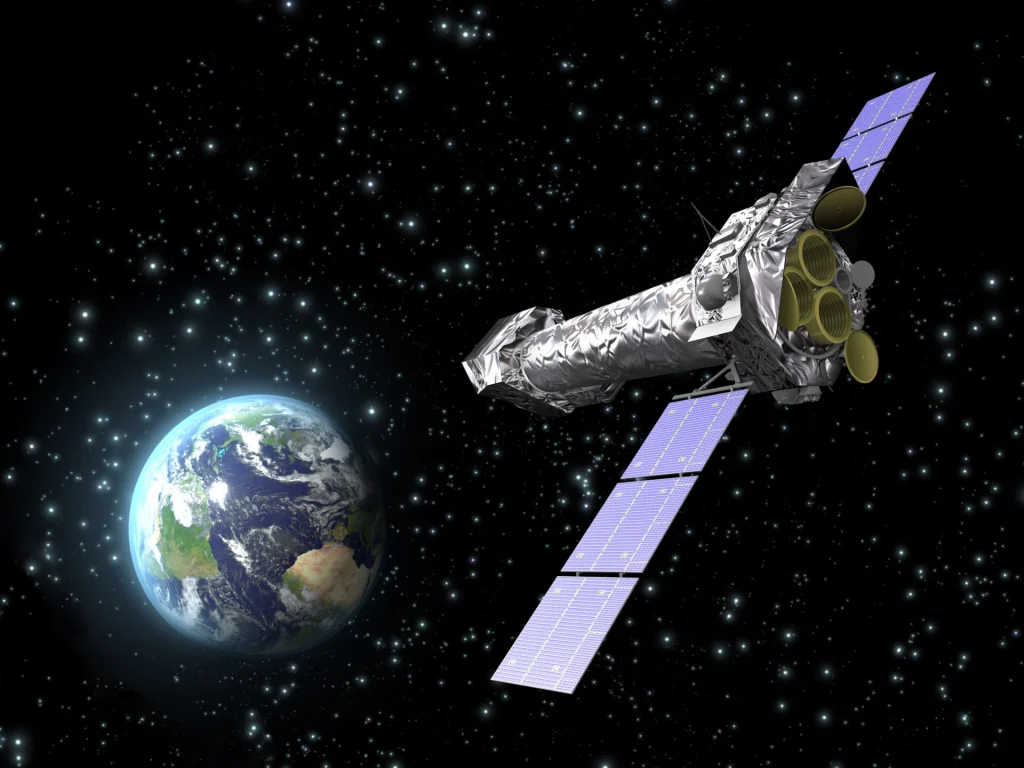
The discovery was made using the Low Frequency Array radio telescope and ESA’s XMM-Newton X-ray observatory. Together, they captured the signatures required to confirm that plasma escaped the star’s magnetic control region. LOFAR detected the radio shock, while XMM-Newton recorded the energetic conditions inside the star’s corona.
The eruption originated from an early M-dwarf star located about 130 light-years away. M-dwarfs dominate the Galaxy and often host tightly orbiting rocky planets. Because these planets sit so close to the star, their atmospheres are especially vulnerable to extreme stellar weather.
The detected radio burst was not a typical flare. It showed the precise frequency drift pattern expected from a shock wave produced by plasma moving outward at high speed. This is the same behaviour seen in solar type II bursts, which are caused only when material escapes the Sun.
“Astronomers have wanted to spot a CME on another star for decades,” said Joe Callingham of ASTRON. “Previous findings have inferred that they exist, or hinted at their presence, but haven’t actually confirmed that material has definitively escaped out into space. We’ve now managed to do this for the first time.”
How astronomers verified the explosive outburst of material
The CME generated a shock wave as it travelled away from the star. That shock emitted a brief, intense radio burst that drifted downward in frequency as it moved outward into lower-density regions. This frequency drift is essential because it cannot be produced unless plasma has physically left the star’s magnetically confined region.
“This kind of radio signal just wouldn’t exist unless material had completely left the star’s bubble of powerful magnetism,” Callingham explained. “In other words: it’s caused by a CME.” This recognition provided the first unambiguous confirmation that the outburst was a true mass ejection.
The detection relied on advanced signal-processing methods developed by Cyril Tasse and Philippe Zarka. Their algorithms helped isolate faint, rapid transients from the crowded low-frequency radio environment. Without these techniques, the CME signal would have been buried in background noise.
XMM-Newton’s X-ray data offered the complementary information needed to confirm the star’s energetic conditions. It revealed the star’s temperature, rotational behaviour, and coronal brightness. These factors allowed researchers to calculate how fast the CME was moving and to compare it directly to solar eruptions.
“We needed the sensitivity and frequency of LOFAR to detect the radio waves,” said co-author David Konijn. “And without XMM-Newton, we wouldn’t have been able to determine the CME’s motion or put it in a solar context. Neither telescope alone would have been enough. We needed both.” Their combined datasets revealed a CME speed of about 2 400 km/s (1 490 miles/s).
Why this red dwarf can unleash extreme space weather
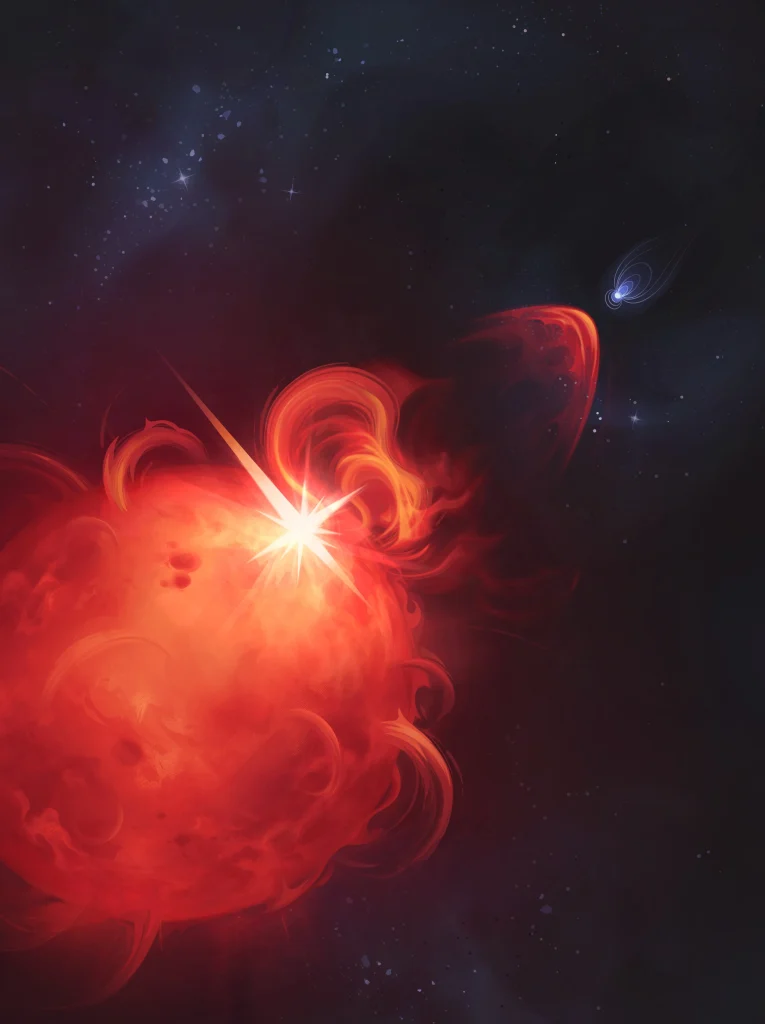
The star responsible for the eruption is a red dwarf with about half the mass of the Sun. It rotates about 20 times faster than the Sun, which strengthens its magnetic dynamo and produces intense magnetic fields. The star’s magnetic field is estimated to be nearly 300 times stronger than that of the Sun.
This powerful magnetic environment creates an ideal setting for large-scale eruptions. When magnetic energy accumulates and reconnects, it can launch massive amounts of plasma into space. Red dwarfs are known for producing energetic flares, but direct evidence of a CME has been missing until now.
These stars are of particular interest because they host the majority of discovered rocky exoplanets. Many of these planets orbit within a few million kilometers of their host star, placing them inside regions of strong magnetic activity and frequent flaring. Such proximity increases exposure to particle radiation and shock waves.
Because red dwarfs are the most common stars in the Galaxy, understanding their space weather is essential for evaluating the long-term habitability of planets around them. The new CME detection shows that their eruptions may be far more extreme than previously assumed.
The CME detected in this study travelled at a speed only seen in one out of every 2 000 solar CMEs. Such a rare and powerful event carries enough energy to strip away the upper atmosphere of a close-orbiting planet, especially one lacking a strong magnetic field.
What this means for planets and the search for life
A planet located in a habitable zone can still lose its atmosphere if exposed to repeated CMEs. Even if temperatures allow liquid water, strong stellar eruptions can remove atmospheric gases over time. This transforms potentially habitable planets into barren worlds.
The CME observed here was capable of stripping the entire atmosphere from any planet orbiting close to this red dwarf. Over millions of years, such erosion would prevent the development of stable surface conditions, regardless of how favourable the orbital distance might appear.
The Goldilocks concept of habitability focuses on distance from the star. However, the new findings show that stellar weather can be just as important. Even planets within the ideal temperature range may not survive if exposed to frequent atmospheric-loss events.
“This work opens up a new observational frontier for studying and understanding eruptions and space weather around other stars,” said Henrik Eklund of ESA. “It seems that intense space weather may be even more extreme around smaller stars. This has important implications for how these planets keep hold of their atmospheres and possibly remain habitable over time.”
The discovery provides astronomers with the first direct evidence that red dwarf planets must be evaluated not only by distance but also by atmospheric survival.
A major turning point for stellar space weather science
This detection marks a significant advance in space weather research beyond the Solar System. Until now, scientists could study stellar activity only through indirect signs or theoretical modelling. The confirmed CME provides a direct observational foundation for measuring how often eruptions occur around different stars.
ESA missions such as SOHO, Swarm, Proba satellites, and Solar Orbiter have studied the Sun’s space weather environment in detail. The new findings extend this approach to other stars, allowing comparisons between solar and stellar magnetic processes.
XMM-Newton remains one of ESA’s most capable X-ray observatories. Since its launch in 1999, it has examined black holes, galaxy clusters, superheated plasma, and stellar magnetic environments. Its measurements are essential for understanding the high-energy processes that shape stellar coronae.
“XMM-Newton is now helping us discover how CMEs vary by star,” said ESA Project Scientist Erik Kuulkers. “It also demonstrates the immense power of collaboration, which underpins all successful science. The discovery was a true team effort, and resolves the decades-long search for CMEs beyond the Sun.”
The result opens the door for systematic searches for stellar CMEs and for mapping their impact on planets throughout the Galaxy.
References:
1 First confirmed sighting of explosive burst on nearby star – ESA – November 12, 2025
2 Radio burst from a stellar coronal mass ejection – J. R. Callingham et al. – Nature – November 12, 2025 – https://doi.org/10.1038/s41586-025-09715-3

I’m a science journalist and researcher at The Watchers, contributing to the Epicenter edition, where I cover peer-reviewed scientific research and emerging discoveries across Earth and space sciences. With a background in astronomy and a passion for environmental science, I’ve worked in shark and coral conservation in Fiji, conducting reef and shark-behavior research, contributing to mangrove restoration, and earning PADI Open Water and Coral Reef Certifications. I bring a blend of scientific rigor and storytelling to illuminate the discoveries shaping our planet and beyond.

Commenting rules and guidelines
We value the thoughts and opinions of our readers and welcome healthy discussions on our website. In order to maintain a respectful and positive community, we ask that all commenters follow these rules.